Two Labs, One Nucleus: The First Nuclear Clocks Tick

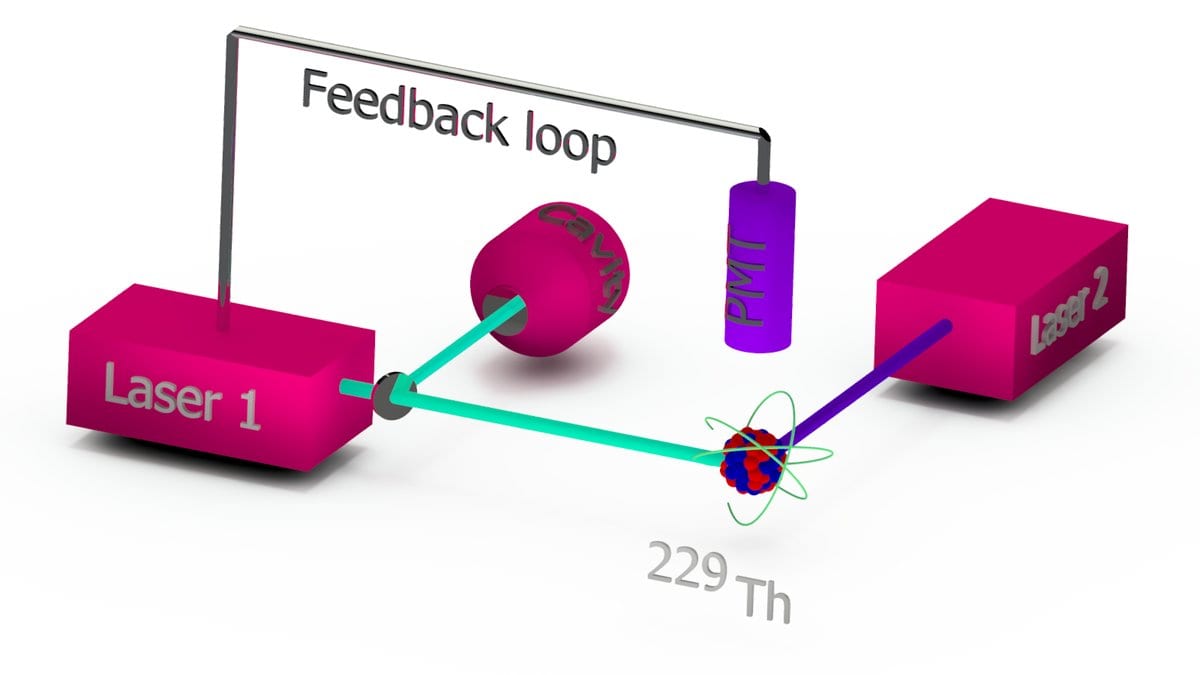
Every clock is, at heart, a thing that ticks at a rate you can count on. A pendulum swings; a quartz crystal vibrates; in the best atomic clocks, electrons jump between two energy levels exactly so many trillion times a second. For more than two decades, a small community of physicists has been chasing a stranger metronome: not the electrons of an atom, but the nucleus buried at its center. This month, two laboratories on opposite sides of the planet reported, independently, that they had finally made it tick.
The atom in question is thorium-229, and it is peculiar. Almost every atomic nucleus is locked away behind enormous energies; nudging one between states takes the kind of radiation you find inside a particle accelerator, not on a lab bench. Thorium-229 alone happens to have two nuclear states separated by a gap small enough that ordinary laser light (admittedly, deep ultraviolet light at a wavelength of about 148 nanometers) can flip it back and forth. That accident of nuclear structure is the whole reason a nuclear clock is even thinkable.
Turning a thinkable clock into a ticking one is another matter. Both teams started from the same recipe: embed thorium-229 nuclei inside a transparent crystal of calcium fluoride, then shine a finely tuned continuous-wave ultraviolet laser onto them and hold the laser's frequency precisely on the nuclear transition. Lock the laser to the nucleus, and you have a reference that ticks: a clock. The detail that makes the announcement convincing is what happened next, in two places at once.
The team at the Vienna Center for Quantum Science and Technology, led by Luca Toscani De Col, used crystals packed with a relatively high concentration of thorium and a comparatively gentle laser. The group at Tsinghua University in Beijing, led by Beichen Huang in the lab of Shiqian Ding, went the other way: a laser roughly a hundred times more powerful illuminating a crystal with fewer thorium nuclei in it. The two approaches pull on opposite ends of the same problem, yet the signals they produced came out comparable, and both clocks ran. When two groups arrive at the same result by deliberately different paths, the chance that either is fooling itself drops sharply.
How well do they keep time? For now, modestly, by the standards of this field. Each clock drifts by roughly a second over the course of a few million years. The Vienna group reports its instability approaching one part in a thousand trillion after a day of continuous operation, with the Beijing figures in the same range. That is extraordinary by any everyday measure and still short of the best optical atomic clocks, which would gain or lose a second only over tens of billions of years. A nuclear clock is not yet the most precise timekeeper on Earth. The point is that it works at all.
What makes physicists willing to chase a less precise clock is where the precision could eventually go, and why. A nucleus is roughly ten thousand times smaller than the atom around it, tucked behind its own cloud of electrons. That isolation is the prize: stray electric and magnetic fields, the perennial enemies of any atomic clock, barely reach the nucleus. In principle a mature nuclear clock could be more rugged and more stable than anything built on electrons, and small enough, one day, to leave the temperature-controlled laboratory.
There is also a deeper motive, and the Vienna team has already started acting on it. By comparing their nuclear transition against an established ytterbium-ion optical clock and watching for any wobble in the thorium frequency over timescales from twenty seconds to a day, they searched for signs of ultralight dark matter: a hypothesized field that, if real, would make the constants of physics breathe ever so slightly in and out. They found nothing, but the search itself set limits that compete with the best atomic clocks and, for certain ways dark matter might couple to the strong nuclear force, reach further than any previous measurement. A nuclear clock is sensitive to the inside of the nucleus in a way an electron clock simply is not, which is exactly why it could become a tool for testing whether the rules of nature are as fixed as we assume.
Sources
- www.nature.com
- arXivPreprint
- arXivPreprint