A Microbe With Many Copies of a Chromosome Keeps Them Evenly Spaced

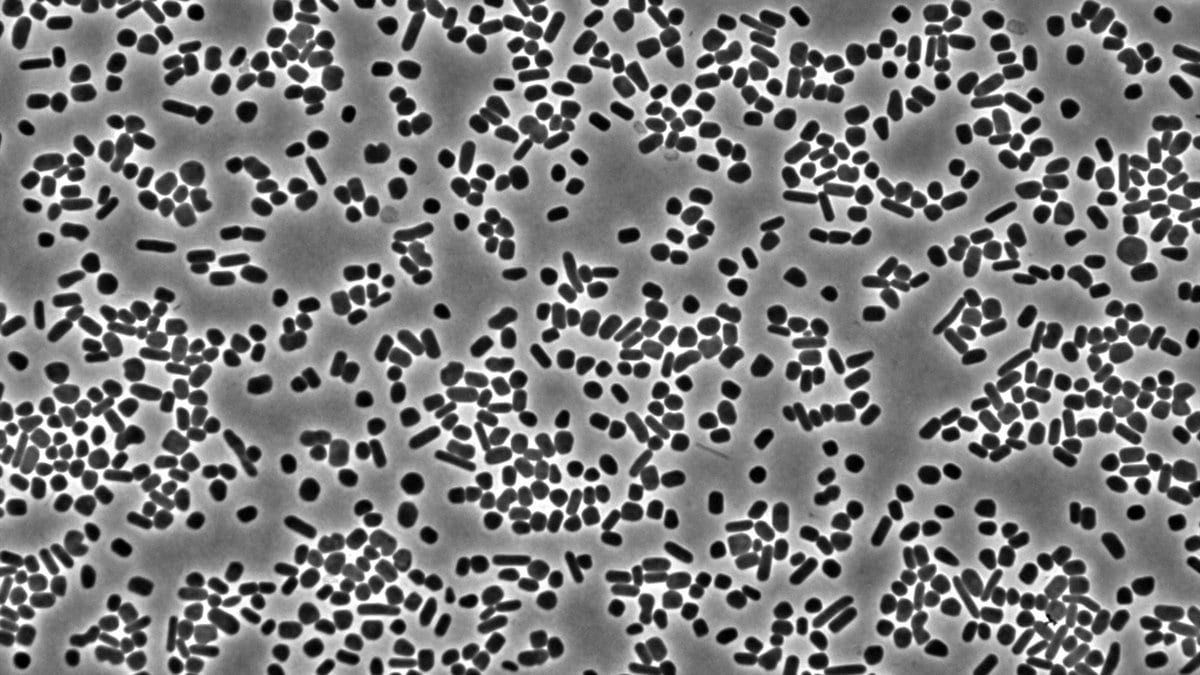
Scatter olives across a pizza without looking, and some slices come out loaded while others get none. Space them out deliberately, and every slice gets one. The image belongs to Kiel University, which used it to explain a study published Oct. 30, 2026, in Nature Communications, and the distinction that image draws is the study's whole point. A cell holding many copies of a chromosome can still hand a daughter cell none of them, if where those copies sit is left to chance.
The cell is Haloferax volcanii, an archaeon. Archaea are the third great branch of life, single-celled like bacteria but distinct from them through much of their molecular machinery. This one is halophilic, a salt-lover: its cytoplasm holds close to 2 M potassium chloride, which is brine. It is also polyploid, which means it carries many copies of its genetic material at once. Earlier work put that at roughly 20 copies of the main chromosome during fast growth and 12 once growth slows.
That abundance is why nobody went looking for a distribution mechanism. With so many copies in play, each daughter cell should inherit enough of them whether or not anything sees to it. The authors put the standing view plainly in their Nature Communications paper: "Due to high ploidy, genomic segregation in H. volcanii is typically considered random." Kartikeyan Premrajka, Marc Bramkamp and six colleagues at the Institute for General Microbiology in Kiel went looking anyway. They found four two-gene stretches of the genome coding for proteins of the ParA family, the ATP-driven proteins bacteria use to move DNA around, and characterized one pair, naming them HpaA and HpaB. Both sit on pHV3, one of the microbe's secondary chromosomes: a separate chromosome of 438 kb that the cell keeps alongside its main one.
Ordered or random is a question for statistics
Under the microscope, HpaB gathered into bright clusters, two or three per cell. Delete the gene for HpaA and the count roughly doubled, to four or five. A picture of dots in a cell cannot by itself settle whether they are spaced or merely scattered, so the team treated each cluster as a point on a plane and ran the nearest-neighbor statistics built for that question, across 3,688 normal cells and 4,740 mutant ones in three replicates. In normal cells the clusters kept their distance from one another, preferring a gap of 0.4 to 0.7 micrometers. Without HpaA the pattern fell back to what complete randomness would produce.
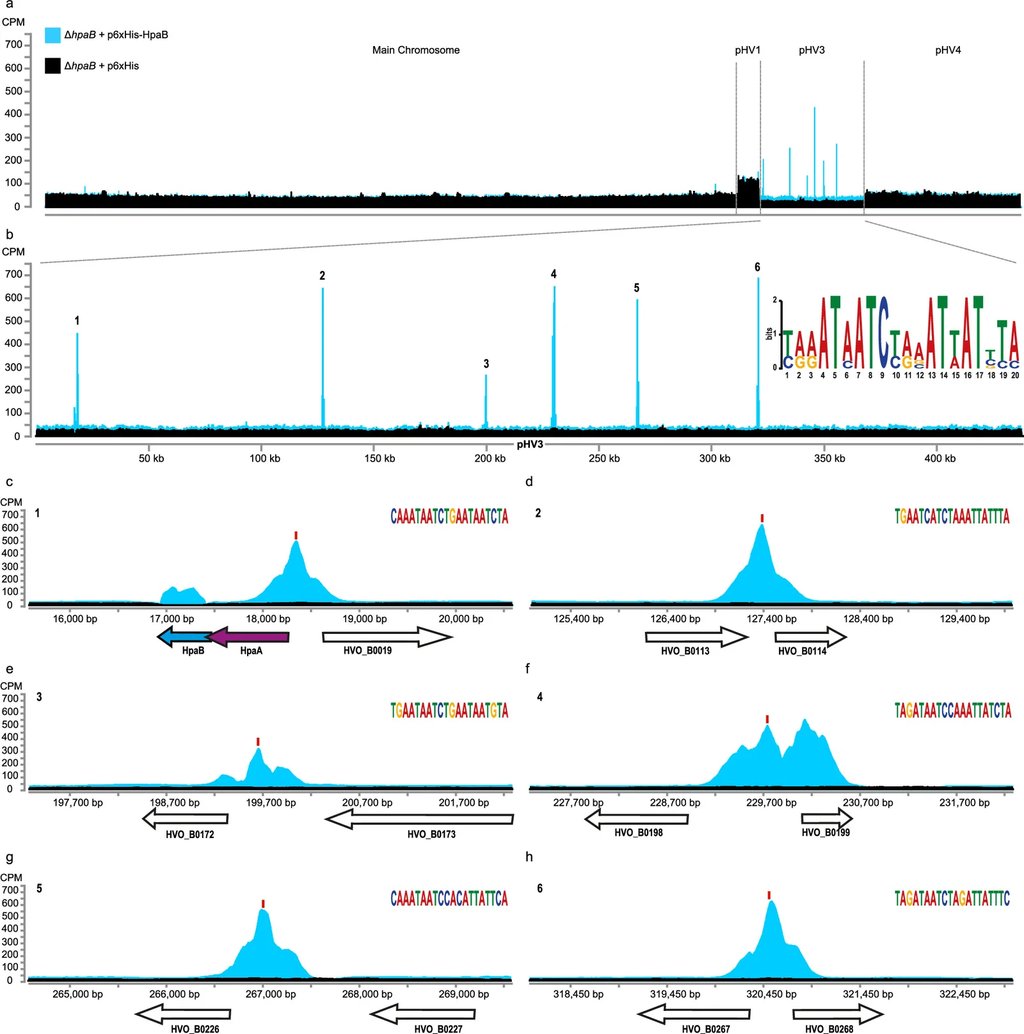
Two more lines of work tied HpaB to pHV3 in particular. Mapping where the protein sits on DNA across the whole genome returned "six discrete and highly significant peaks located exclusively on pHV3," each at or beside a short AT-rich stretch the team proposes as the protein's docking site; those sequencing reads are deposited publicly, so another group can redo the mapping. Counting the DNA directly showed the cost of losing the system: the ratio of pHV3 to the main chromosome fell from about 1 in normal cells to about 0.35 without HpaB and about 0.6 without HpaA. Those strains also grew badly when xylose was their only carbon source, which fits, because pHV3 carries the whole set of genes for taking up and breaking down xylose, and restoring either gene brought growth back to normal. The authors mark the connection as an inference rather than a result, writing: "We therefore suggest that the growth defects seen with xylose as a carbon source is a direct result of unequal inheritance of pHV3."
The motor nobody could catch in the act
HpaA is called an ATPase, an enzyme that runs on ATP, and the case for it is built from several kinds of indirect evidence. It carries the Walker motifs that mark this protein family. A structure predicted by AlphaFold 3 puts ATP sandwiched between two copies of HpaA. Purified HpaA binds DNA when ATP is present, and not when it is absent or swapped for ADP. Three single changes to those motifs each altered where the protein ended up in the cell. What is missing is the enzyme caught working, and the authors say so themselves: "However, despite repeated attempts, we were unable to detect ATPase activity in vitro under the tested conditions." They suggest it may need the right salt and its partners present before it will run. The structural models, including the predicted contact surface between HpaA and HpaB, are predictions rather than measurements.
Half bacterial, and claimed for one chromosome
The two halves of the system came from different places, and that is the part Bramkamp picks out. HpaA is a ParA protein of bacterial origin. HpaB resembles no bacterial protein at all; the authors settle for calling it functionally analogous to known DNA-binding partners in bacteria and archaea, on the strength of a shared fold. "This modular system likely evolved via horizontal gene transfer" and adaptation to high salt, they write: the motor half crossed over from bacteria.
How far the finding reaches is drawn narrowly. What was shown is the even spacing of copies of pHV3, one secondary chromosome in one species. The main chromosome is left as a possibility: because each of the smaller chromosomes carries an HpaAB pair of its own, the authors write that "we think it might be possible that these systems may contribute to the segregation of the main chromosome." Their broadest statement is that the arrangement "may reflect a broader evolutionary strategy in pleomorphic Archaea," pleomorphic meaning able to change shape. That is also why even spacing would pay. H. volcanii grows as rods early and as flat plates later, so there is no fixed pair of poles to push copies toward, and spacing them across two dimensions works in either shape. Within that scope the team claims a first: "It represents the first active chromosome segregation system identified in a highly polyploid organism." Active partition systems in archaea are not themselves new, and the paper cites two found in Sulfolobus, but those cells hold one or two copies of their chromosome rather than twenty.
Premrajka, the paper's first author and a doctoral student in Bramkamp's group, described the result in the university's German-language announcement of the work. "Our results now show that the cell evidently does not have to leave anything to chance: it has an active system that positions the copies of a chromosome at regular intervals," he said, calling it a surprising discovery. The payoff, on the authors' reading, is that a division plane in a plate-shaped cell can fall anywhere, and copies kept an even distance apart are likely to end up on both sides of it. Olives, spaced out.