The Giant Kangaroo That Outlived the Extinction Script

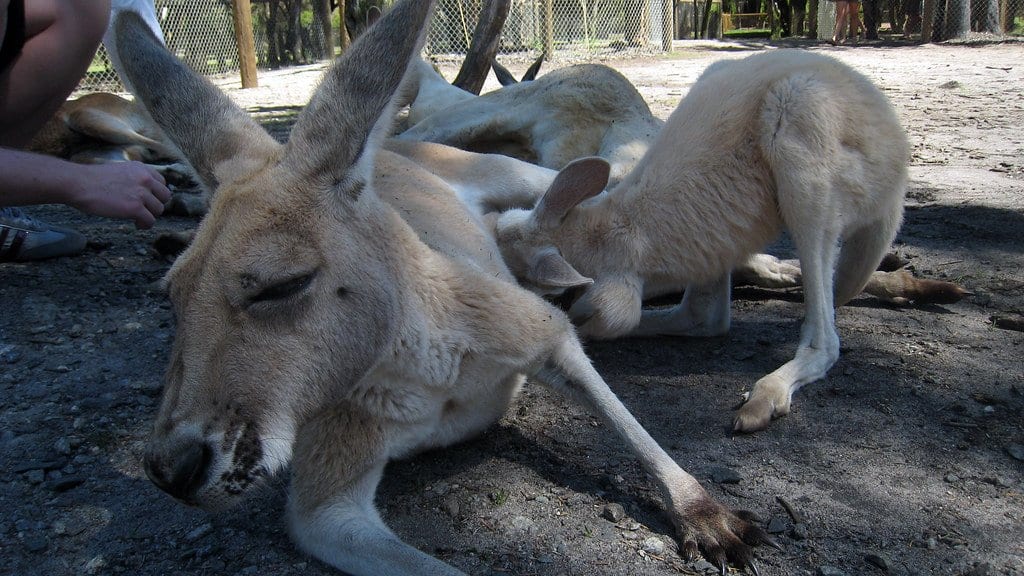
Picture a kangaroo the weight of the biggest reds alive today, but built wrong for the part: too stocky, too muscular, and by most reckoning barely able to hop. Protemnodon tumbuna seems to have moved mostly on all fours, using long, powerful forelimbs to bound through the steep, tangled rainforest of New Guinea's mountains. It lived there roughly 50,000 years ago. By the textbook timeline, it should have been gone not long after. Australia's Protemnodon species were extinct by about 41,000 years ago.
That is the timeline a new study in npj Biodiversity pushes hard against. Loukas Koungoulos, Isaac Kerr and Sue O'Connor report a single bone that, if it belongs where they think it does, drags the animal's last known appearance forward into the mid-Holocene, an era of pottery, gardens and coastal villages, not one most people associate with lumbering marsupial giants.
The bone itself is modest: a manual phalanx, one finger bone, recovered from the Taora rockshelter on the coast west of Lachitu, in Sandaun Province. It is worth being precise about what that is and is not. The specimen comes from a macropodid (the kangaroo and wallaby family) noticeably larger than any marsupial living in the region today, and it carries distinctive raised projections where the middle finger bone meets the claw. On the strength of that comparison, the team concludes it "most likely" belongs to P. tumbuna. Most likely, not certainly. One bone rarely closes a case on its own, and the authors do not pretend otherwise.
What gives the find its weight is the date. Radiocarbon evidence places the animal's survival, in the paper's careful phrasing, "as late as 6,000 years ago"; in their own account for a general audience, the authors round that to about 6,500. Either way, the number is startling against what came before. Earlier New Guinea traces of Protemnodon run to roughly 22,000 to 27,000 years ago at the Nombe rockshelter, and past 18,000 years at Lachitu cave. Taora, if the identification and dating both hold, would extend that by many thousands of years, into a window when farming was already reshaping the island's valleys.
That gap is the whole point. For decades, one popular account of megafaunal extinction has leaned on "overkill": humans arrive, big slow animals disappear soon after, case closed. A giant kangaroo still hopping (or rather, not hopping) around a coast where people were already gardening does not fit that clean sequence. It suggests humans and megafauna were neighbours for tens of thousands of years, not adversaries in a brief rout.
The authors read the evidence as a slower, messier collapse. Rather than a single cause, they point to several pressures grinding together: a drying climate that shrank the rainforest these animals depended on, the small home ranges that made isolated populations fragile, and steady human hunting over a very long stretch. Extinction, in this telling, ran less like a starting gun and more like a local clock, ticking at different speeds in different places, and, on one stretch of the New Guinea coast, running unusually late.
There are honest limits here, and the researchers flag them. This is peer-reviewed work, published in npj Biodiversity (not a preprint), but the central claim leans on a single specimen with a probable, not confirmed, identification, and dates carry their own margins. A second bone, or a firmer species match, would turn a striking possibility into something sturdier. For now, the finding is best read as a well-supported challenge to a tidy narrative rather than its final replacement.
Still, the image it leaves is hard to shake: a stocky, ground-bounding giant kangaroo, sharing a coastline with farmers, thousands of years after the species was supposed to be a memory. The details are covered in the authors' own account in The Conversation and in the peer-reviewed paper. If it holds up, the lesson is less about one animal than about the shape of extinction itself: "when did it die out?" may not have a single answer, only a map of local ones.