Six Panamanian Frog Species Spent a Century Classified Under Another Species' Name

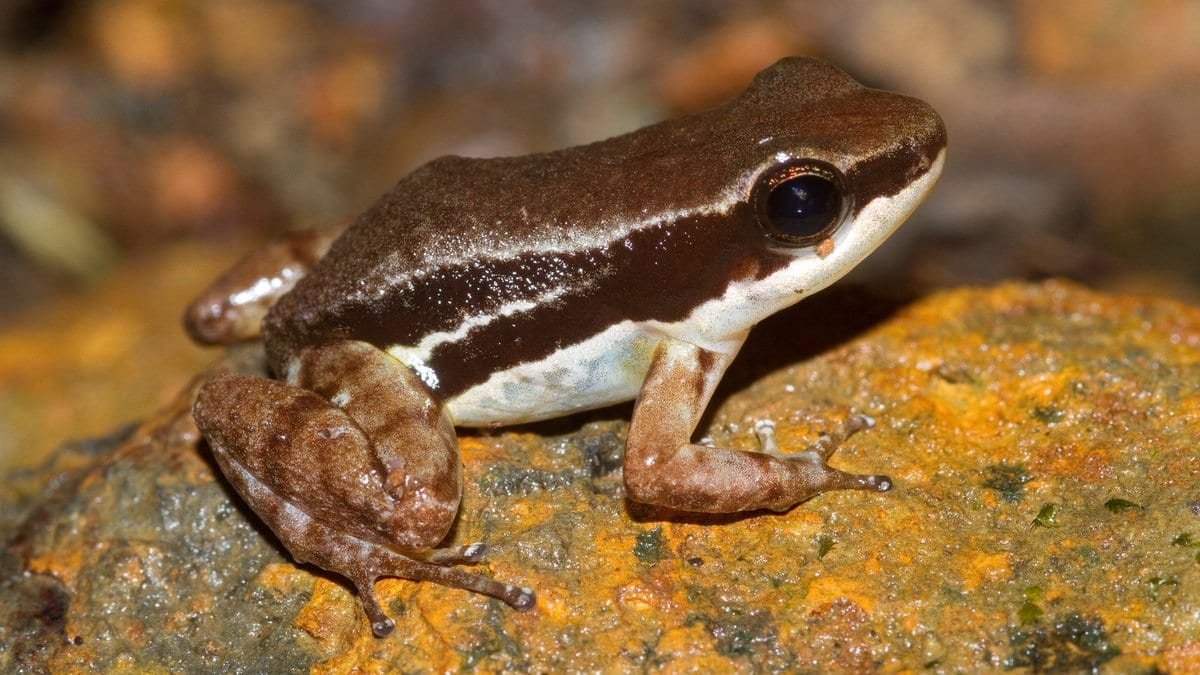
A male Colostethus is not an animal that photographs well. He is a small brown frog on a wet rock beside a stream, with a pale stripe along each flank, and from a meter away he looks like every other brown frog on every other wet rock from Bocas del Toro to the Darién. For most of the 20th century that was precisely the problem. Herpetologists working in Panama's mountains kept writing one name on these frogs, and the name belonged to an animal from Colombia.
The name was Colostethus pratti, given by Boulenger in 1899 to frogs from Santa Inés, in the Colombian department of Antioquia. Panamanian frogs were referred to it in the 1920s, and the label stuck even as doubts accumulated. In 1968, Savage, revising Central America's dendrobatid frogs, the poison-frog family, pointed out that the Panamanian animals differed from the Colombian original in the coloring of their thighs, and suspected the lowland populations would need a name of their own. He could not prove it without frogs from the place Boulenger's had come from, and for the next half century nobody had any.
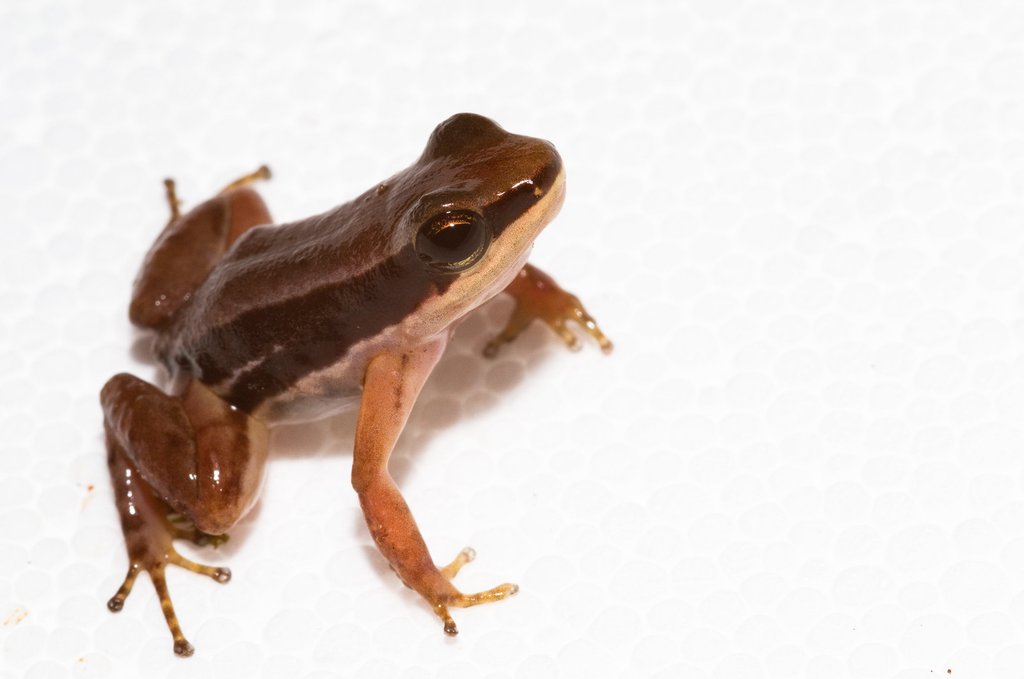
Two specimens from the Colombian side are what finally settled it. In a paper published online Nov. 4, 2026, in Vertebrate Zoology, Tadeáš Venkrbec and Milan Veselý of Palacký University in Olomouc, with eight colleagues in Panama, Colombia and the Czech Republic, report that the Panamanian frogs are not C. pratti and never were. Sequenced alongside material collected across eastern, central and western Panama between 2006 and 2025, they form a branch of their own, sister to Colostethus latinasus. The team describes six species from inside that branch, all new to science.
They are Colostethus bocatoro, C. donosensis, C. kuara, C. portobelensis, C. sanblasensis and C. chucantiensis, and they take the C. latinasus group to 11 species and the genus Colostethus to 17. All six are already in the American Museum of Natural History's Amphibian Species of the World, the standard catalog of amphibian names. C. pratti itself is untouched: it remains a valid Colombian species, neither split up nor sunk. The Panamanian frogs that wore its name simply do not belong to it, and the authors treat even their own Colombian identification as provisional, since nobody has sequenced the specimen that defines the name.
Where the eye fails, the ear does not
Nothing about the animals made this easy. The six differ only in subtle coloration and in how much webbing their feet carry, so the species boundaries had to be drawn from several kinds of evidence at once: two mitochondrial genes, part of one nuclear gene, automatic clustering of the DNA sequences, body measurements, geography, and the calls males use to advertise themselves. The last of those is the one a person in the field can use. Measured side by side, the calls are the single character that separates all six without ambiguity.
The calls themselves are plain: short pulsed notes delivered from the leaf litter in the early morning or after rain. What differs between species is the most countable thing imaginable — the number of notes a male strings together. On Cerro Chucantí, C. chucantiensis calls in bursts of three or four. In the Darién ranges, C. kuara runs to nearly 50. A recording of each species and the measurements taken from them are public, deposited on Dryad.
The nuclear part of the evidence is the thinnest, and the authors say so: the partial data from RAG1, a single nuclear gene, give only moderate support, one of the six is missing from it entirely, and the arrangement is offered as a working hypothesis to be tested with matching nuclear markers or whole genomes across every species involved. The sample of measured specimens is small too, which is why body measurements play a minor part in the argument.
Mountain ranges that work like islands
For a frog that cannot cross dry lowland, a mountain range is an island. The team's dates put the split between C. latinasus and the ancestors of the Panamanian group at about 3.7 million years ago, which they say may reflect the continuing rise of the Isthmus of Panama isolating populations in separate ranges. The splits within the group itself are younger, inside the last 2.5 million years. Because the dates rest on a calibration borrowed from other studies rather than on fossils, the authors warn against tying any single split to a particular geological episode.
Each of the six, as far as the team knows, keeps to a single mountain range or an isolated region, and the hedge is the authors'. They are not all separated from their relatives, either — C. kuara shares the Serranía de Pirre with C. latinasus, which shows that two lineages can evolve apart, meet again and still hold together as separate species.
Narrow ranges, and what assessing them would take
Those narrow ranges are why the paper closes on conservation, and this is where its wording matters. On the information available, and following the IUCN Red List Categories and Criteria, the authors judge that four of the six may qualify as Endangered, one as Vulnerable and one as Near Threatened. That is a proposal, not a listing: none of the six has been formally assessed, and the paper says what one would need, which is "additional information on population size, trends, and the extent of occurrence and area of occupancy of each species." The only species in the story carrying a real Red List category is C. latinasus, already listed as Critically Endangered, and the authors say they agree with it.
The threats they name are the standard ones for Panamanian amphibians: habitat loss, climate change and chytridiomycosis, the fungal skin disease that has emptied streams across Central America. Two of the six have already been through collapses attributed to that disease at particular sites, the paper records, citing earlier field work. The Chucantí frog is the most exposed of them. It is known only from the Serranía de Majé, and part of its range lies outside any protected area, where, according to maps published by the Ministry of the Environment between 1992 and 2016, 48% of forest cover has been cleared for cattle grazing and other agricultural uses.
What the work puts in the hands of anyone going back into those mountains is a way to tell the animals apart: six descriptions, an identification key, type specimens lodged in the public herpetology collection at the Universidad Autónoma de Chiriquí in David, and a recording of each call. Panama's herpetologists can now identify these frogs in the dark, by ear, which is how the frogs have been doing it all along.