Antibodies From Past RSV Infections May Help Neutralize a Bat Virus, Lab Tests Suggest

A virus found in West African fruit bats can get into human cells in laboratory tests, but much less readily than respiratory syncytial virus, the childhood lung virus it is distantly related to. Antibodies from people previously exposed to RSV also neutralized it, researchers at the Institute of Virology at Charité in Berlin and the German Center for Infection Research report in Science Advances. The paper appeared Nov. 25, 2026.
RSV is the leading cause of severe lung infections in young children worldwide and has no known animal reservoir, the authors write. They tested this virus to ask whether an animal virus in the same group could cross into people.
Attempts to grow the bat virus in human and bat cells failed, so Wendy K. Jo, Jan Felix Drexler and colleagues measured entry with pseudoviruses, lab-made particles that carry only the bat virus's fusion protein, the part that opens a cell. Those particles entered human cell lines 4.5 to 53.5 times less efficiently than particles carrying RSV's fusion protein, with the widest gap in lung cells. All 10 human blood samples with RSV antibodies that the team tested, and an international RSV reference antiserum, blocked them. The paper's Fig. 3 sets the two results side by side.
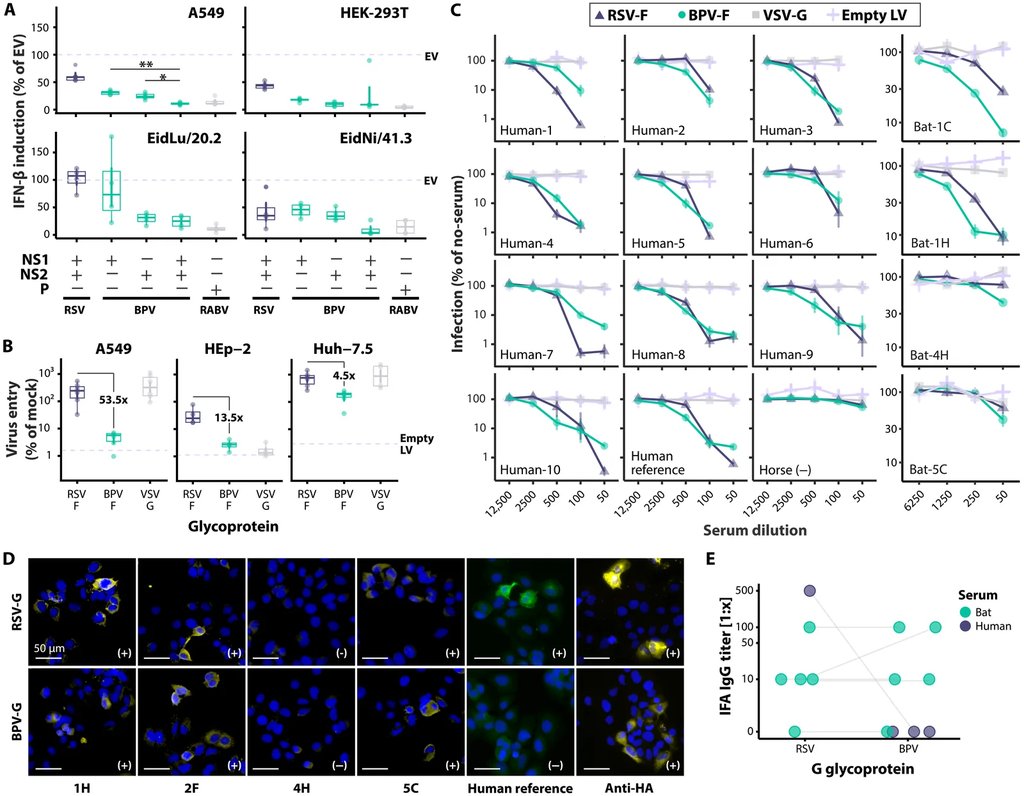
Palivizumab, the antibody given to high-risk infants against RSV, did not neutralize the bat particles, and the antiviral lonafarnib did not inhibit them; the paper attributes both to differences in the bat protein's structure. MPE8, an experimental antibody aimed at a site shared across this virus family, did neutralize them.
The virus is uncommon in the bats themselves. Of 1,778 bat samples collected in Ghana and Benin, 24 carried its RNA, all of them from straw-colored fruit bats, and 6 of 66 bat blood samples carried antibodies to it. The authors read that as infrequent, episodic circulation.
The near-complete genomes the team recovered showed the layout typical of this group of viruses, except that both lacked the SH gene RSV carries, which encodes a protein involved in the inflammatory response.
Sources
- Science AdvancesPeer-reviewed
- pmc.ncbi.nlm.nih.gov

Medical Disclaimer: This content is provided for general informational and educational purposes only. It is not medical advice and should not be used as a substitute for professional medical advice, diagnosis, or treatment. Always consult a qualified healthcare professional regarding any medical condition, concern, symptom, or treatment decision.