In a Choice Between Two Mice, Kissing Bugs Favored the Infected One

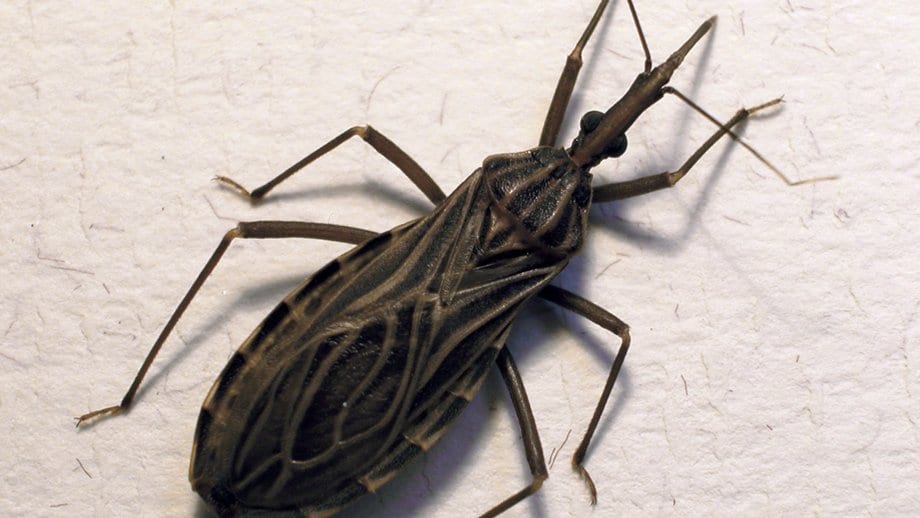
Fifty kissing bugs spend the daylight hours inside a folded piece of cardboard at the center of a glass arena. They have not eaten for a month. In one corner, two mice sit in sealed plastic containers, close enough for the insects to smell them and feel their warmth but too far to bite. One of the mice carries a parasite. When the lights go out, the bugs leave the shelter and climb the containers, and more of them end up on the one holding the infected mouse.
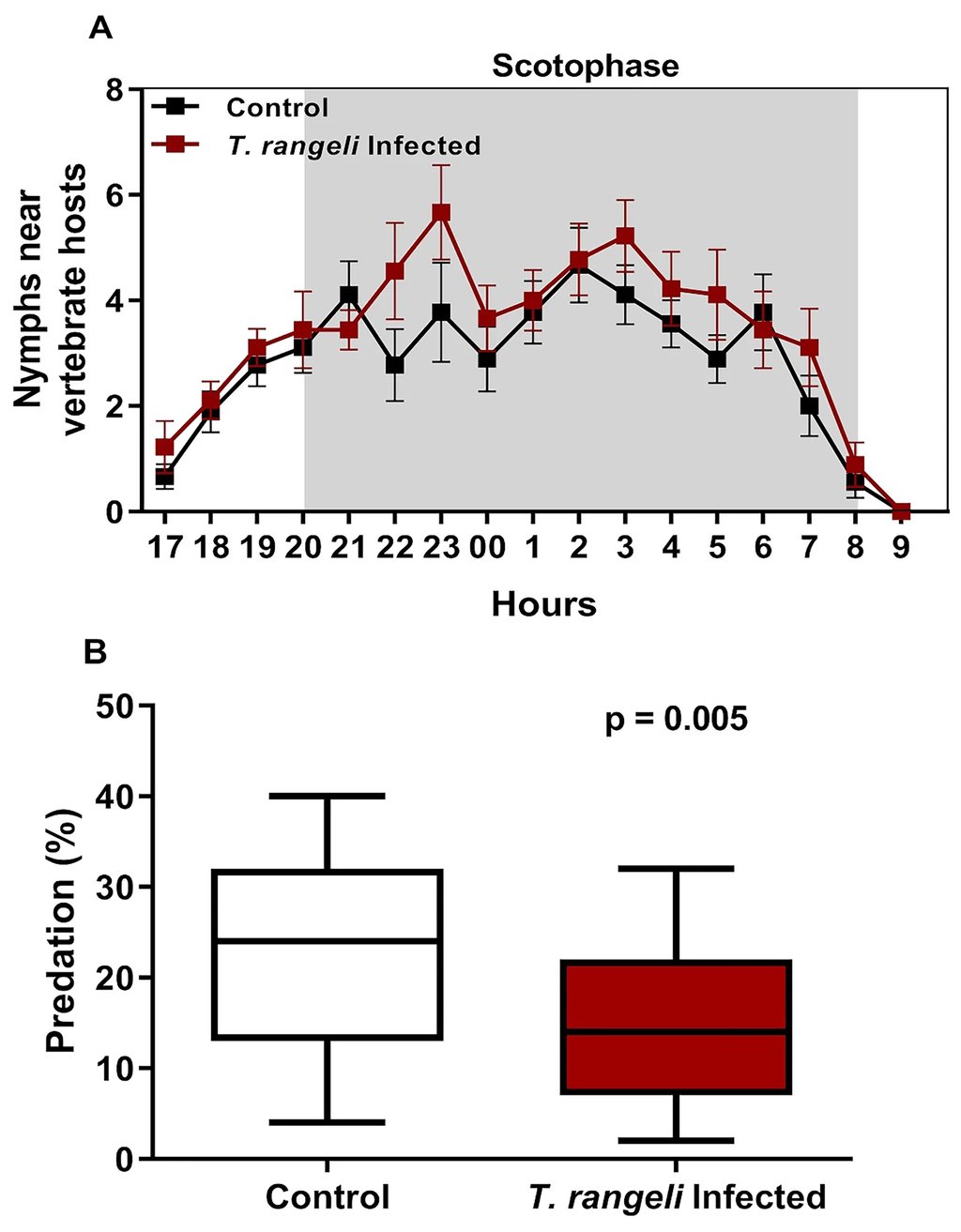
That is the experiment a group at the Instituto René Rachou, a Fiocruz institute in Belo Horizonte, Brazil, ran 21 times over. Luan F. Santos, Alessandra A. Guarneri and two colleagues reported it Nov. 11, 2026, in Proceedings of the Royal Society B. The parasite was Trypanosoma rangeli, one of the trypanosomes, a group of single-celled parasites that pass between mammals and blood-feeding insects. Counting what the infrared cameras recorded at each container through the night, the team's model put the chance that an insect approaching either mouse chose the infected one at an estimated 62.7%.
A second experiment took the barrier away. Each mouse sat in a wire cage with a centimeter between the bars, wide enough for a bug to crawl through and feed, and wide enough for a mouse to catch one and eat it. Mice eat kissing bugs readily, and over nine nights they ate plenty: 22.89% of the insects released with an uninfected mouse. With an infected mouse the figure was 14.67%. The bugs that fed were not short-changed for the trouble of arriving, and 46.5% of those that drank from an infected mouse picked up T. rangeli.
Two ways to read the same result
Together those results have the shape of a parasite arranging matters for itself. A mouse that draws more bugs and kills fewer of them is a better place for T. rangeli to sit. The authors decline to claim it, and offer the deflating alternative themselves: the drop in predation may not be an adaptive parasite strategy at all but a pathological side effect, since a sick or weakened animal may put up a feebler defense against an insect crawling over it. They ask that the whole result be read as evidence that infection alters the dealings between host and vector in a way that may favor transmission, not as definitive proof that the parasite manipulates its host.
What lifts the result above a curiosity is the control. Trypanosoma cruzi, the parasite that causes Chagas disease, uses the same bugs and the same mammals as its relative. Run through the same arena on 15 nights, it produced no pull toward the infected mouse at all. Slightly more bugs stuck to the tape around the uninfected animal, by a margin too small to separate from chance. The model, built on every approach the cameras saw rather than on the insects caught by the tape, found a direction. It put the chance of approaching the infected mouse at an estimated 47.4%, against 52.6% for the uninfected one, which the paper's figure caption calls a "modest but statistically significant preference for the control mouse." Whatever is happening to these mice, then, is not a general consequence of trypanosome infection, and the Chagas parasite did not make its host easier to find.
Why one parasite and not the other
The authors offer a possible explanation, and present it as no more than that: the two have different evolutionary histories and different ways of getting around. T. cruzi circulates among a wide range of mammals and bugs, and can also infect by mouth, so it may be under little pressure to improve its odds of an encounter. T. rangeli is fussier. It depends on bugs of one genus, Rhodnius, inside which it has to reach the salivary glands before a bite can pass it on, and only a fraction of infected bugs get that far. For a parasite with that bottleneck, anything that brings a competent insect to an infected animal would be worth having.
What a kissing bug follows in the dark
What the infected mice are doing differently is not known, and the team is direct about why: an arena that lets insects respond to everything a mouse gives off is a good way to detect a preference and a poor way to explain one. The likely candidates are the cues a kissing bug follows toward a warm body in the dark — heat, carbon dioxide, the volatile compounds in an animal's odor — and this study measured none of them. The authors point to earlier work reporting that T. rangeli infection raises a mouse's body temperature slightly as the infection runs on, and heat is among the strongest close-range signals a bug has.
The phenomenon itself is not unheard of. Dogs infected with Leishmania have drawn more sand flies than healthy dogs in both laboratory and field tests, and the paper points to a study of 50 children in Kenya in which mosquitoes were more attracted to the children carrying the malaria parasite. None of that is evidence for what T. rangeli does in a mouse; it is the reason this result reads as plausible instead of exotic. The claim the authors make for themselves is narrow, and they word it narrowly: "To our knowledge, this is the first demonstration that infection of a mammalian host is associated with increased attraction of triatomine bugs."
This is one experiment from one laboratory, and the animals in it sat a long way from any natural transmission cycle: laboratory-bred mice, all of them female, of a genus the authors say has never been recorded carrying a natural T. rangeli infection. The parasite is considered non-pathogenic in people, though it is hard on the bugs that carry it, and that is part of why it has drawn far less attention than its relative. What the arena offers now is a way to ask, from the mammal's side, a question that has mostly been put from the insect's: what a trypanosome does to the animal it sits in while it waits for a ride.