A Six-Meter Rainbow Serpent, and Why Arnhem Land's Paintings Grew Enormous

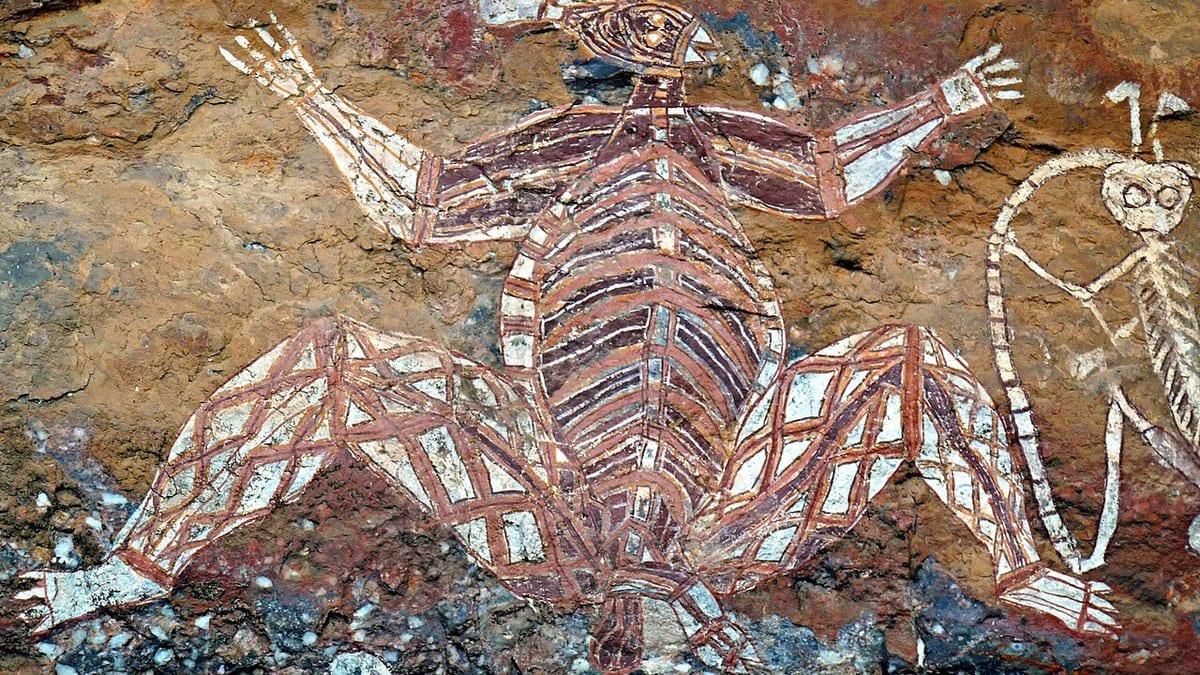
The ceiling of a rock shelter at Awunbarna, in western Arnhem Land, carries a painted serpent more than six meters long. It has a crocodile-like head, bared teeth and a long extended tongue. Paul Taçon, an archaeologist at Griffith University, has been recording rock art in this part of Australia for most of his working life, and this one stopped him. "This is one of the largest Rainbow Serpent paintings I have seen in 40 years of Arnhem Land rock art fieldwork, and look at those teeth and tongue!" he told Phys.org, recalling his first sight of the panel at the site the team labels AW5.
The serpent is one of the images at the center of a paper published on August 14 in Australian Archaeology. Its authors are Taçon, Sally K. May of the University of Adelaide and Andrea Jalandoni of Griffith, together with Charlie Mungulda, a senior Amurdak Traditional Owner. Their subject is a pattern rather than a single panel. Across western Arnhem Land, the authors write, exceptionally large paintings of animals, humans and Ancestral Beings became more common in recent times, Rainbow Serpents among them. After reviewing examples from the 1800s and early 1900s, the paper turns to images in the northwest that it calls "previously undescribed," new to the scholarly record, which is not the same as new to the country that holds them.
Behind the paper is a long recording effort. Since 2018, the team has worked with Mungulda to document 165 rock art sites across the Awunbarna region, also known as Mount Borradaile, Taçon told Phys.org. Among them are 29 images of Rainbow Serpents at 21 sites, which the researchers describe as the largest concentration of these beings anywhere. The same account includes a painted whale that they say is the only known depiction of a baleen whale in Australian rock art.
Not all of it is on stone walls. The paper also describes what it calls a unique Rainbow Serpent stone arrangement: a head-like stone at the end of a winding neck, attached to a body outlined in stones on the ground. The team told Phys.org that it runs about 124 meters.
Dating is the hinge of the argument, and none of it is done with radiocarbon. Many of these images cannot be radiocarbon-dated at all, Taçon told Phys.org. The serpents are frequently layered over older art, and much of the work is in white pipe clay, a pigment that tends to fade within a few centuries. That places the paintings in the recent past rather than the deep past: enough to put them in the era of European contact, not enough to give any single painting a year.
What arrived in that era is on the walls as well. Awunbarna "was a focal point between various Aboriginal language groups for trade, ceremonies and other social gatherings," Taçon said, and it was among the first places the colonial buffalo-shooting industry moved into during the late 1800s. In paintings from those decades, crocodiles, fish and other powerful creatures were often placed over and beside European ships and firearms.
The paper's answer to why the images grew so large is offered as a conclusion rather than a measurement. Its authors conclude that the production of Rainbow Serpents and other large Ancestral Beings, animals and humans "was in response to cultural change brought about by Europeans visiting and settling in Aboriginal Country," and that it was "a way of reasserting power over changing cultural landscapes in challenging times." The reading rests on subject matter, on layering and on the behavior of pigment rather than on a chronology anyone can test, which is why the paper argues it rather than reports it.
Taçon put the reasoning in plainer terms. "As the most powerful of all Ancestral Beings, the Rainbow Serpent was a potent force that could be used, through depictions, stories and ceremonies, to help give Aboriginal people some stability and control over their destiny in rapidly changing times by reinforcing traditions," he said.
The work was done on Amurdak Country, with Mungulda as one of the paper's authors, and Taçon is explicit about what the paintings are now. They are, he said, "a testament to Aboriginal creativity, tradition and worldview," used to pass on important knowledge between generations, and "part of Aboriginal living culture."
Sources
- Australian ArchaeologyPeer-reviewed
- phys.org