Whether Naming a Feeling Quiets the Amygdala Depends on Which Language Is Stronger

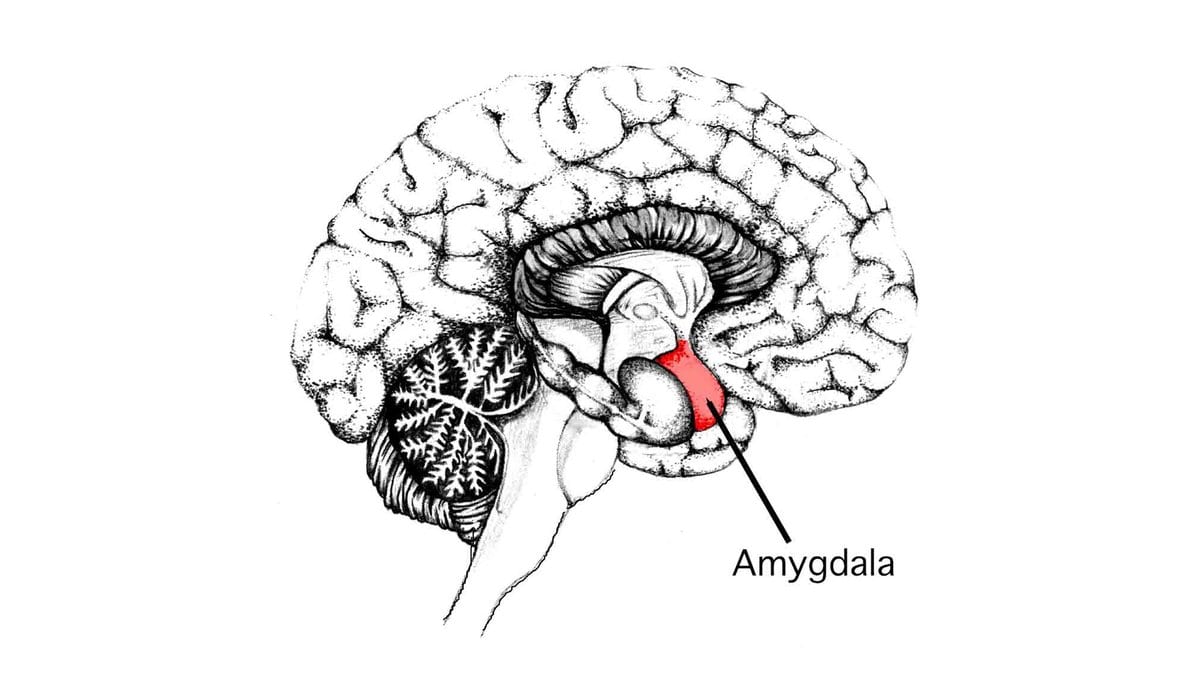
Say it out loud and something shifts. Naming a feeling ("I'm sad," "I'm anxious") is one of the few pieces of folk psychology to survive contact with a brain scanner: label the emotion, and the amygdala, the small structure that drives much of the body's alarm response, does less. Nearly everyone scanned doing this, though, had one language to do it in. Much of the world has two.
The effect first documented in a 2007 paper. In 2007, Matthew Lieberman and colleagues at UCLA reported in Psychological Science that putting feelings into words damped the amygdala's response to negative images while activity rose in one frontal region, the right ventrolateral prefrontal cortex. The two moved inversely, as though the frontal region were doing the damping. The caution built into that literature early on is that the body and the self-report do not always agree: in a 2012 exposure-therapy experiment, people who labeled their fear of a live spider later showed a smaller skin-conductance response than the other groups and no difference in what they reported feeling.
Now a team at Universitat Jaume I in Castellón de la Plana has run the experiment on people who have a choice. Tatiana Davydova led it, with Víctor Costumero as senior author and co-authors in Zaragoza, Leiden and Providence. Their paper, submitted in January and accepted at the end of July, appeared in the Proceedings of the National Academy of Sciences on August 31. They scanned 151 bilinguals drawn from two pairings, Spanish-English and Spanish-Catalan, and had them label emotions in each of their two languages. Everyone in the study spoke Spanish, which puts the result in one corner of the world's bilingualism rather than across it.
What separated the two outcomes was dominance. Some participants had one clearly stronger language; others had two of roughly equal strength, and the two groups did not behave alike. In the unbalanced bilinguals, labeling reduced amygdala activity only in the dominant, native language: a difference in the scanner's signal, averaged across a group, not a record of how anyone said they felt. The pattern held in both samples, Spanish-English and Spanish-Catalan, an internal replication rather than one cohort's quirk. And it behaved like a dose: the less someone used their second language, the wider the gap between the two languages.
Then the surprise, which the authors mark as one. Balanced bilinguals showed no amygdala down-regulation in either language, including the one they had grown up with. That is a null in a subgroup, an absence of a detectable effect in a slice of the 151, and absences carry less weight than the positive results beside them. Read it as evidence that the effect has conditions nobody had thought to look for, not as proof that labeling does nothing for balanced bilinguals.
The connectivity analysis moved with the main result and pointed back at the mechanism Lieberman's group proposed. Coupling between the amygdala and the ventrolateral prefrontal cortex, the same frontal territory that rose while the amygdala fell in 2007, was higher during labeling in a dominant native language. In a weak second language, the relationship reversed. Whatever the frontal cortex does when a well-worn word lands on a feeling, it does something else when the word takes effort.
One part of this is not new, and the paper does not pretend otherwise. In 2021, Marc-Lluís Vives and colleagues reported in Affective Science that 26 unbalanced bilinguals labeling emotions in their foreign language got no reduction in amygdala activity at all; activation there ran higher than in the native language. Two of that paper's authors, Vives and Costumero, are on the new one, which cites it. This is a laboratory returning to its own finding with a larger sample, not an outside group confirming it.
What the new work adds is the reason to read it. Twenty-six participants became 151. One language pair became two, with the pattern holding in both. Native-versus-foreign became a graded question about dominance, with the dose-response to support it. The connectivity reversal is new. And the balanced bilinguals, a group the 2021 study did not include, are the part that presses on theory, because they have a native language and the effect did not appear in it.
The authors' own conclusion is narrow and specific: language dominance is a boundary condition on affect labeling, and any theory of why naming an emotion helps has to carry language experience inside it rather than treating the naming as the whole mechanism. The data and materials behind the paper are posted publicly on OSF, which means the balanced-bilingual null, the claim here most worth arguing over, is open to anyone who wants to go at it.
Sources
- Proceedings of the National Academy of SciencesPeer-reviewed