Skip to content
See the World Through ScienceA project of ALLATRA

NASA Finds Far Less Damage on the Heat Shield That Brought Artemis II Home
Space

Republish this story

Our work is licensed under Creative Commons BY-NC 4.0. You may republish this piece for free — with credit to ALLATRA Media and a link to the original, unedited beyond length trims, and not for commercial use.

Read the full license

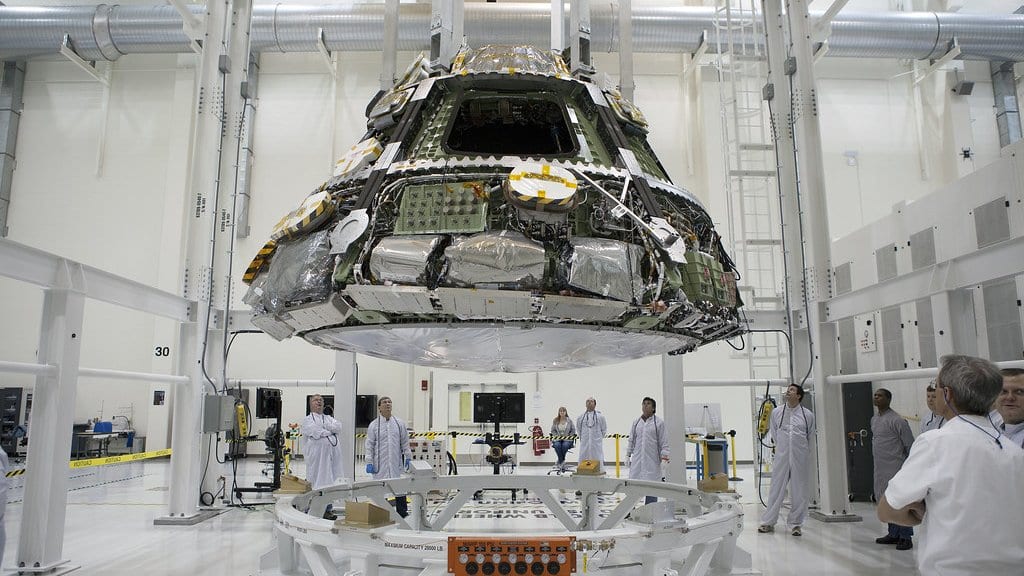
An Orion crew module hangs from overhead lifting gear above a white support stand while technicians in white coats watch from the floor of a high bay.
Lockheed Martin technicians watch an Orion crew module hang above its stand in the Operations and Checkout Building at Kennedy Space Center in Florida, photographed June 3, 2014, during preparations to fit the ablative dish that protects the capsule in reentry (illustrative)."Preps for heat shield Preps for heat shield installation" by NASAKennedy, via nasa, BY-NC

NASA has finished the engineering review of the heat shield that brought the Artemis II crew home, and reports nine spots of char loss on the shield's dish, against 103 after the uncrewed Artemis I flight.

The dish is the part of the Orion capsule that takes the heat of reentry, and NASA says the review set out to establish whether the thermal protection system kept the astronauts and Orion's systems safe as the spacecraft came back through the atmosphere. Artemis II, which splashed down April 10, 2026, was the first time a crew flew aboard Orion.

Orion's return path was changed after the investigation into cracking and char loss on the Artemis I shield. The agency shortened the maximum distance the capsule was allowed to fly between entering the atmosphere and hitting the water, which it says limits how long the shield spends in the temperature range where the Artemis I damage occurred. In its post-flight assessment review, NASA states that the shorter path cut cracking and char loss by a factor of 10, and describes that as proof that the trajectory change was effective.
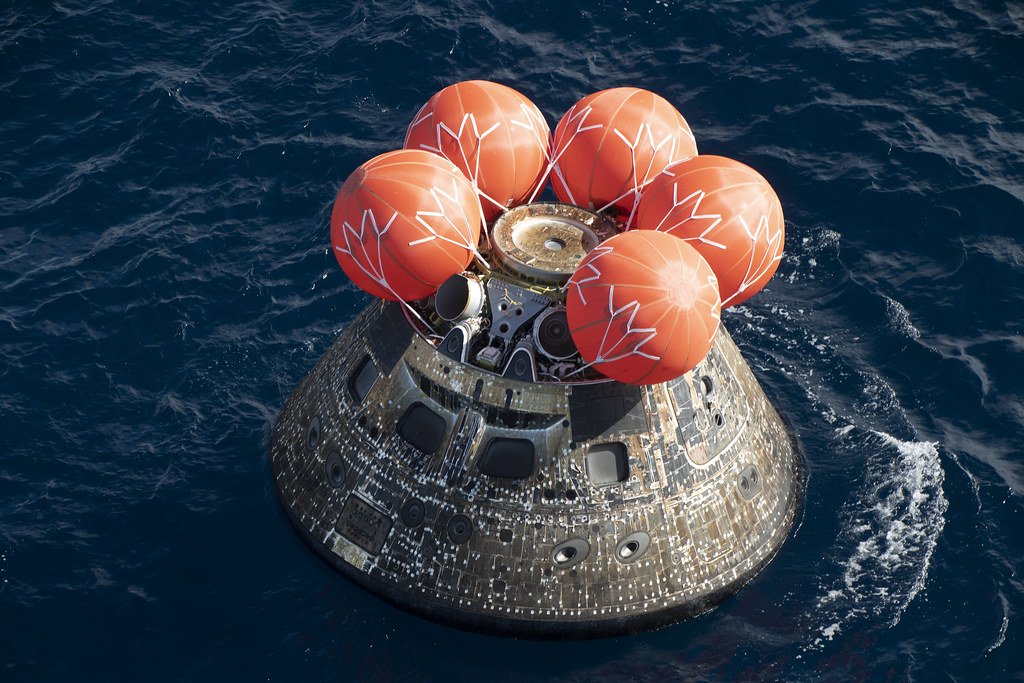
An Orion capsule floats in dark blue ocean water with five orange flotation bags inflated around its upper rim.
The Artemis I Orion capsule floats in the Pacific Ocean after splashing down Dec. 11, 2022, held upright by inflated bags during open water testing. NASA counted 103 spots of char loss on that uncrewed flight's heat shield, against nine on Artemis II. "Orion Comes Home to Earth" by NASA's Marshall Space Flight Center, via nasa, BY-NC

The dish is built from 186 blocks of Avcoat, a material designed to char and wear away so the heat does not reach the crew, and outside temperatures passed 4,000 °F on the way down. The ceramic tiles on the capsule's sloped backshell, including the seals around windows, vents, thrusters and the side hatch, showed no signs of overheating.

Work on the shield continues. Engineers at NASA's Marshall Space Flight Center in Huntsville, Alabama, are still cutting samples out of it, and laser scans of the surface are being compared against pre-flight measurements to work out how much material burned off. The shield for Artemis III, whose Avcoat blocks were redesigned to be more uniform, was fitted to that spacecraft's crew module in July 2026.

Sources

Spot an error?

Spot an error?

Report an error

Spotted a mistake on this page? Tell us what's wrong and our editors will take a look.

What kind of problem?

Only if you'd like us to be able to follow up. We won't use it for anything else.

We correct mistakes openly. Select any text to flag it. Fixes are logged under our Corrections Policy.

Report an error

Reporting on

NASA Finds Far Less Damage on the Heat Shield That Brought Artemis II Home

What kind of problem?

Only if you'd like us to be able to follow up. We won't use it for anything else.

We read every report. Corrections are logged publicly.