Skip to content
See the World Through ScienceA project of ALLATRA
Source: Peer-reviewedNature Neuroscience1 source

Psilocybin's Brain Rewiring and Its Head Twitches Come Apart in Mice
Science

Republish this story

Our work is licensed under Creative Commons BY-NC 4.0. You may republish this piece for free — with credit to ALLATRA Media and a link to the original, unedited beyond length trims, and not for commercial use.

Read the full license

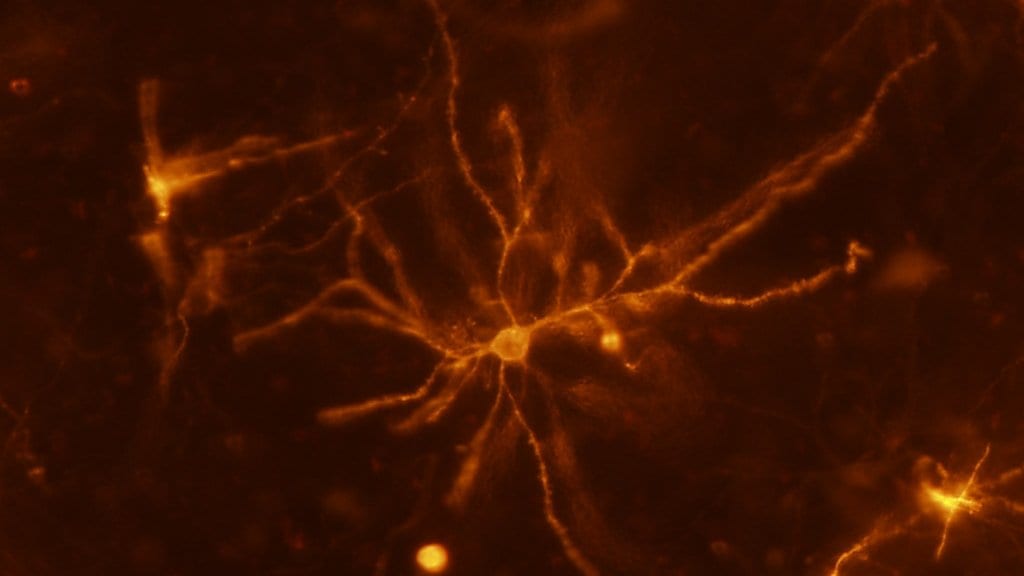
Fluorescence micrograph of a mouse neuron, its cell body bright at the center with thin branching processes spreading across a dark orange field.
A single nerve cell and its branches stand out in mouse brain tissue under fluorescence imaging. The study followed psilocybin's effect on the synapses that sit along branches like these in mice (illustrative)."Mouse neuron" by National Institutes of Health (NIH), via Flickr, CC BY-NC

A study in mice has pulled apart two effects of psilocybin that normally arrive together: the rewiring of connections between brain cells, and the head twitching that researchers use as a rodent stand-in for a hallucination. Jacob J. Baker, Yi Zuo and colleagues at the University of California, Santa Cruz trace the rewiring to one serotonin receptor in a single class of cortical cells, and report that the same receptor there is not needed for the twitching. Their paper was published Oct. 15, 2026, in Nature Neuroscience.

The authors set the work up as an open question: it was unclear how these receptors, known as 5-HT2A, act in the large cells of the cortex's fifth layer to produce psilocybin's hallucinations on one side and its remodeling of the brain's wiring on the other. Their Brief Communication answers it for the remodeling.
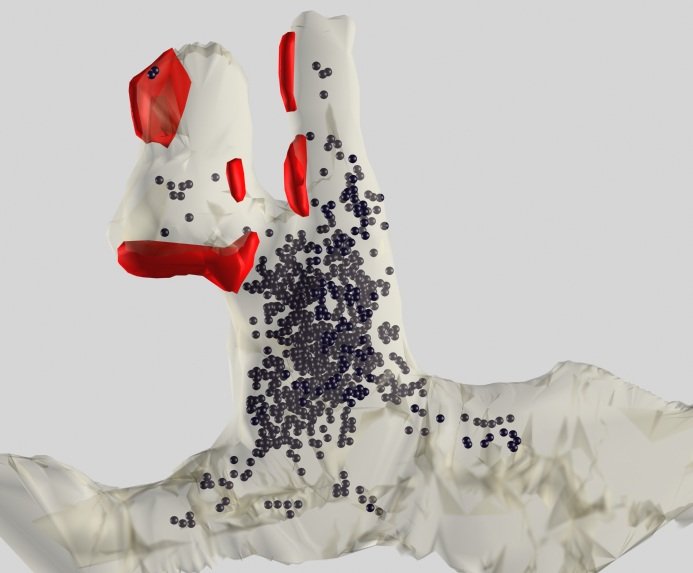
Three-dimensional model of a single dendritic spine, a pale branching shape with red patches marking synaptic contacts and dark beads scattered inside it.
A model of one spine, built from stacked electron microscope slices, with its contact patches in red. Structures like this are the junctions whose gain and loss were counted in the mouse cortex (illustrative). "File:Three-dimensional reconstruction of the complex dendritic spine, showing the multiple macular synapses (red) and massive aggregation of polyribosomes (black)..jpg" by Dr, John C. Fiala, and Dr. Kristen M. Harris, via Wikimedia, CC BY-SA 3.0

The authors report that psilocybin both builds new synapses, the junctions through which brain cells pass signals, and pushes them to mature, while speeding up the loss of synapses already in place. A manipulation aimed at one cell type then showed that this receptor signaling in the fifth-layer cells is both required for that remodeling and enough on its own to produce it. It is not required for the head-twitch response, which is the stand-in the field uses for a hallucination in a rodent rather than a measure of what the animal experiences.

The work is in mice throughout, and the paper is a Brief Communication, the journal's short format. Source data are published with it, and the group has posted its analysis code publicly on GitHub.

Sources

By Olga SchmidtEditor-in-Chief, Writer

Spot an error?

Spot an error?

Report an error

Spotted a mistake on this page? Tell us what's wrong and our editors will take a look.

What kind of problem?

Only if you'd like us to be able to follow up. We won't use it for anything else.

We correct mistakes openly. Select any text to flag it. Fixes are logged under our Corrections Policy.

Report an error

Reporting on

Psilocybin's Brain Rewiring and Its Head Twitches Come Apart in Mice

What kind of problem?

Only if you'd like us to be able to follow up. We won't use it for anything else.

We read every report. Corrections are logged publicly.