How Anyons Help Locate Critical Points


When heated, a magnet can gradually lose its magnetization until it disappears. This is an example of a continuous phase transition: the quantity used to distinguish between two states of matter changes without a jump. Near such transitions, even very different substances can obey the same mathematical laws. For example, the same patterns describe the disappearance of magnetization and the convergence of the densities of a liquid and its vapor near the critical point. How many types of collective behavior are there altogether? There is no complete answer, even for two-dimensional models in which interacting particles lie in a plane.
Researchers from Fudan University, Tsinghua University, and the Beijing Institute of Mathematical Sciences and Applications have proposed a new way to search for previously unknown critical points in two-dimensional models. They are Kaixin Ji, Yu Zhao, Ce Shen, Yidun Wan, and Ling-Yan Hung. The authors work at the intersection of quantum and mathematical physics. In their article “An algorithm to generate two-dimensional critical lattice models using competing anyon condensation,” published in Nature Physics on Sept. 14, 2026, they describe how to construct these models and predict the parameter values at which a transition occurs.
Using this algorithm, the researchers reproduced known exact results and obtained numerical evidence for three critical points that may correspond to previously unknown types of collective behavior. This remains a hypothesis: the researchers still need to determine whether three new theories are indeed required to describe these transitions.
How the Boundary Disappears
Before discussing two-dimensional lattice models, let us look at critical behavior in a real substance through a classic experiment that can be repeated in any laboratory equipped with a thermostat.
Ethane is sealed in a thick-walled ampoule, with the amount chosen so that its average density is close to the critical density. As it is slowly heated, the boundary between liquid and vapor, the meniscus, first becomes blurred and then disappears. At the same time, the transparent substance turns cloudy, like water with a drop of milk in it. This is critical opalescence. Marian Smoluchowski explained it in 1908, followed by Albert Einstein in 1910: light scatters from density fluctuations, regions where molecules briefly cluster more closely together or are more sparsely distributed than average. As ethane approaches its critical point, at approximately 32.2 °C and 48.7 bar, these regions grow from a few molecules across to sizes comparable to the wavelength of visible light, and beyond.
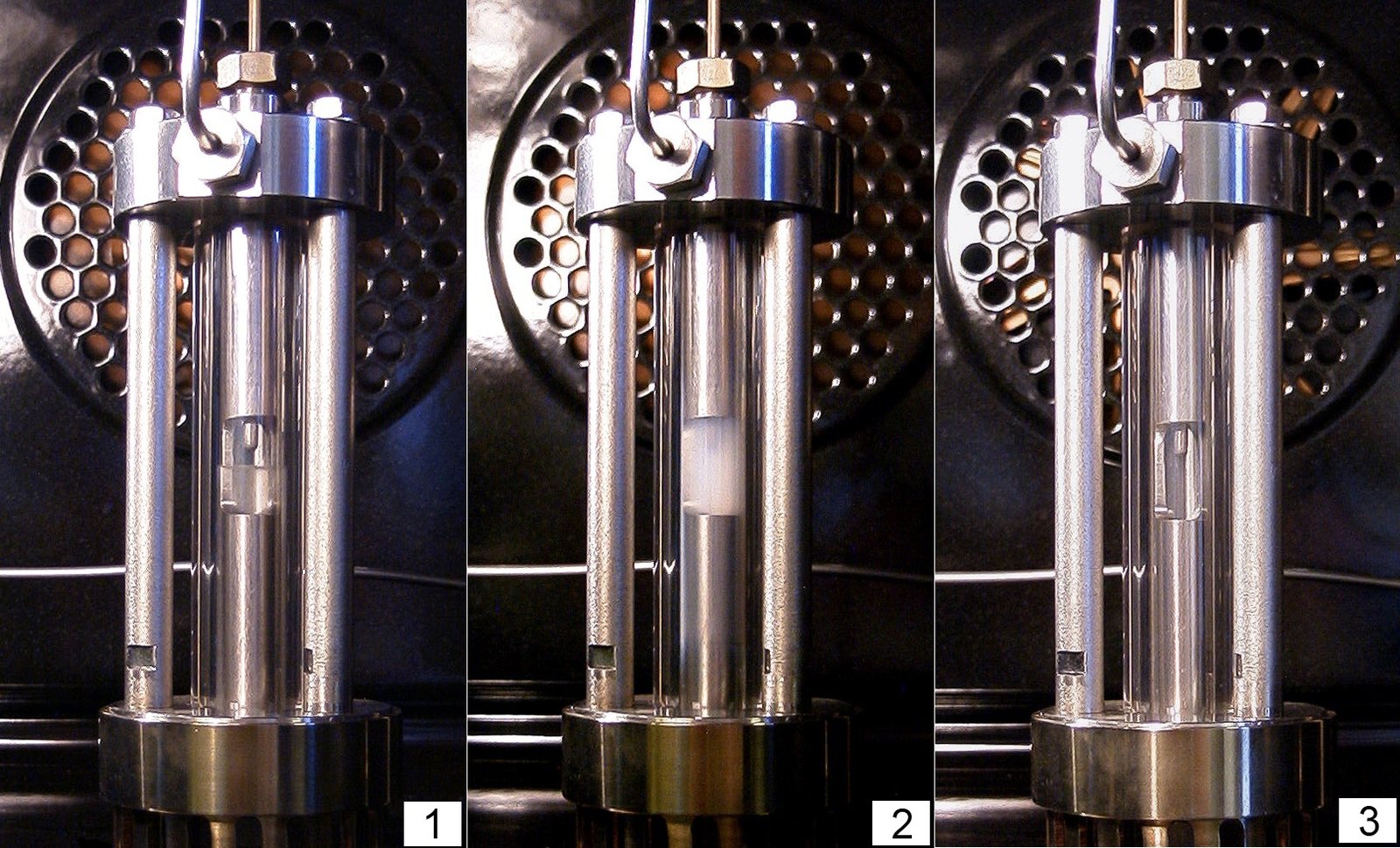
The most interesting part of this experiment cannot be seen with the naked eye. As the critical temperature is approached from below, the difference between the densities of the liquid and vapor goes to zero according to a power law, proportional to . Here, is the temperature, and is its critical value. For ethane, as for other simple fluids, the exponent is close to 0.326. This exponent determines how quickly the density difference approaches zero as the transition is approached. The same exponent describes how magnetization vanishes in a three-dimensional model of a uniaxial magnet with short-range interactions. In a liquid mixture, it governs the decrease in the difference between the compositions of the two phases as the critical point is approached. These systems have entirely different transition temperatures, interaction strengths, and particles, yet they all share the same exponent. This shared behavior is called universality, and a family of systems with the same universal critical properties is called a universality class.
A complete list of these classes would be something like a periodic table for the collective behavior of matter. Such a classification has not yet been constructed for three-dimensional systems, but much more progress has been made in two dimensions.
Why Details Stop Mattering
Physicists distinguish between first-order and continuous transitions. In a first-order transition, such as the melting of ice, two phases coexist, and density and entropy change abruptly. The difference between the phases is described by a quantity called the order parameter. In a ferromagnet, this is spontaneous magnetization, the magnetization that persists without an external magnetic field. At a continuous transition, it decreases smoothly to zero as the critical temperature, or Curie point, is approached. Near such a transition, regions in which particles behave in a coordinated way grow larger. Their characteristic size is called the correlation length. In an ideal infinite system, the correlation length becomes infinite at the critical point itself. In a real experiment, its growth is limited by the size of the sample and by how closely the critical point can be approached.
When the correlation length far exceeds the distance between molecules, many details of their interactions no longer affect the critical exponents. Behavior at large scales is determined by only a few general properties: the spatial dimensionality, the symmetry of the order parameter, and how rapidly the interaction decays with distance. One example of such symmetry is the equivalence of two opposite directions of magnetization: without an external field, neither is preferred. For a fluid near its critical point and a three-dimensional model of a uniaxial magnet with short-range interactions, these properties lead to the same universality class. In the fluid, the sign of the density’s deviation from its critical value plays the role of the direction of magnetization: a small region may be slightly denser or slightly less dense than average. Figuratively speaking, different orchestras are playing the same score. Each has its own set of instruments, yet the melody remains recognizable.
In his essay “More Is Different,” published in Science in 1972, Philip Anderson wrote that the ability to reduce everything to simple fundamental laws does not yet give us the ability to reconstruct the world from those laws. Knowing the structure of a single ethane molecule is not enough to predict how the meniscus will disappear: we need to describe the collective behavior of many molecules. In the theory of critical phenomena, universality is an enormous help. To find the exponent for ethane, it is enough to study the simplest model in the same class.
For many critical states, physicists use conformal field theory (CFT). It describes the behavior of a system at distances much greater than the spacing between particles. At the critical point, the form of the statistical patterns remains unchanged as we move from one such scale to another: no single length becomes characteristic of the entire system. Conformal symmetry extends this idea. It relates the values of physical quantities even under transformations that change the local scale differently at different points while preserving angles. In two dimensions, there are infinitely many such local transformations, which greatly strengthens the constraints on the theory. In 1984, Alexander Belavin, Alexander Polyakov, and Alexander Zamolodchikov used this symmetry to solve an entire family of two-dimensional theories exactly, the so-called minimal models. Since then, a great deal has been learned about two-dimensional CFTs, but a complete list is still lacking.
The ampoule containing ethane is three-dimensional, and the new method does not apply to it directly. The algorithm developed by Ji and his colleagues constructs two-dimensional lattice models with their own critical exponents. For example, in the two-dimensional Ising model, the exact value of the exponent is .
How to Find a Model for an Unknown Theory
Critical theories can be approached from two directions. The conformal bootstrap starts with the requirement that different ways of calculating the same physical quantity yield consistent results. The name “bootstrap” comes from the English expression “to pull oneself up by one’s bootstraps.” The method does without a microscopic model of matter. It took its modern form in a 2008 paper by Riccardo Rattazzi and his coauthors. Physicists specify a symmetry and make additional assumptions about the content of the theory, then determine which values of its characteristics are compatible with the general requirements for a CFT. In 2016, this approach yielded the critical exponent and the exponent governing the growth of the correlation length, , for the three-dimensional Ising universality class. Ethane belongs to the same universality class, so these exponents also describe its behavior near the critical point. Such a calculation accounts for the general properties of the class; the structure of ethane molecules is not modeled separately. Connecting the resulting theory to a particular substance or lattice model requires a separate physical justification.
Another way to find a critical theory is to start with a lattice model. A variable is assigned to each lattice site, for example, a spin represented by an arrow pointing up or down. One then specifies how the interaction energy between neighboring sites depends on these variables. If the model has a continuous transition, its behavior at large distances may be described by a CFT. But choosing interactions that produce the desired critical behavior is difficult: critical parameter values are lost among noncritical ones. With two independent tuning parameters, the phase boundary is just a line in a plane, and a small deviation from it takes the system into one of the neighboring phases. It is like searching for a radio station without knowing its frequency: trying different combinations of knob settings takes a long time, and silence on the airwaves proves nothing. You may simply have skipped past the right setting.
Physicists have long sought ways to narrow this search. In 1941, Hendrik Kramers and Gregory Wannier noticed that the Ising model on a square lattice maps onto itself when high temperatures are exchanged for low ones. If there is only one transition, it occurs at the fixed point of this mapping, the temperature that the transformation leaves unchanged. This made it possible to find the critical temperature without solving the model. The exact solution came later: in 1944, Lars Onsager calculated the model’s free energy at zero field. In August 1948, at a conference at Cornell, he wrote on the board a formula for spontaneous magnetization that he had obtained together with Bruria Kaufman. He never published the derivation, only repeated the result a year later in Florence, where the formula appeared in print as a remark during a discussion. It is this formula that gives ; the first published derivation was provided in 1952 by Chen Ning Yang.
In 1984, George Andrews, Rodney Baxter, and Peter Forrester constructed an infinite family of exactly solvable lattice models whose critical behavior is described by the minimal models of Belavin, Polyakov, and Zamolodchikov. These solutions, however, relied on special properties of the models, and extending them to a new symmetry was rarely possible.
More general algebraic constructions gradually emerged as well. In 2020, David Aasen, Paul Fendley, and Roger Mong showed how to construct topological defects and dualities on a lattice using fusion categories. A fusion category specifies the allowed types of objects and consistent rules for their fusion. Here, a defect is a line along which the interactions are modified in a particular way. It is called topological if it can be moved without changing observable results, as long as it does not cross other defects or points where observables are evaluated. In this language, Kramers–Wannier duality becomes a special case of a general construction. The new paper continues in this direction: the authors use competition between different ways in which anyons can condense.
Competition Between Two Condensates
The researchers call their approach a “conformal field theory factory.” The rules for constructing the models are derived analytically. The authors numerically test the predicted transition locations and the nature of the transitions in both known and new models.
This “factory” rests on the behavior of special quasiparticles called anyons. In a quantum many-particle system, a collective excitation often behaves as an independent object: it moves, scatters, and carries energy, sometimes also carrying charge. Such an object is called a quasiparticle. A wave on water helps illustrate the idea: it exists because of the molecules, but its motion can be described as that of a single entity.
The properties of anyons are tied to what happens when particles exchange positions. This can be a thought experiment or a real one: two identical particles are moved so that each takes the other’s place. In quantum mechanics, the state of a system is described by a wavefunction, which is used to calculate the probabilities of measurement outcomes. When two bosons are exchanged, the wavefunction remains unchanged; when two fermions are exchanged, it changes sign.
Anyons are also possible in systems where motion is confined to two dimensions. For them, the paths along which they move around one another matter: an exchange can change the phase of the wavefunction or, in a more complex case, mix several states of the system. The phase difference determines whether contributions from different quantum paths reinforce or weaken one another. The way particles are exchanged can therefore have observable consequences. Frank Wilczek introduced the name “anyon” in 1982, deriving it from the English word “any.” Their only connection to chemical anions is the sound of their names.
Anyon condensation changes the system’s ground state itself, the state with the lowest energy. Here, it is called the vacuum: individual excitations are distinguished relative to it. During condensation, an admissible set of anyons becomes indistinguishable from the new vacuum. The possibilities available to the remaining excitations also change. If moving around the condensed anyons causes an excitation’s wavefunction to acquire a nontrivial phase or mixes states of the system, that excitation can no longer exist freely as an individual quasiparticle in the bulk of the new phase. This phenomenon is called confinement. In this way, the set of available quasiparticles is reorganized, and a different phase emerges.
Turning this physical description into a method for constructing a model requires precise rules. In the authors’ construction, these are specified by a Frobenius algebra and a module over it. The algebra describes which objects combine into a condensate and how they fuse. The module specifies the allowed local boundary states and the algebra’s action on them. From these mathematical data, the authors construct states for individual cells of the future lattice, referred to below as boundary states. But first, let us consider where the lattice itself comes from.
Ji and his coauthors begin with a quantum state constructed according to the prescription of Michael Levin and Xiao-Gang Wen (2005). Labels are assigned to the edges of a lattice, and fusion rules determine which combinations of labels are allowed at the vertices. Each allowed configuration forms a string-net; the initial quantum state is a superposition of these string-nets with specified amplitudes.
This state is then paired with another, specified separately on each unit cell: their overlap—the inner product of the two states—is calculated. The result is the partition function of a classical two-dimensional model, the sum of the weights of all possible lattice configurations. It can be used to calculate the system’s equilibrium properties. This construction is called a strange correlator. It was proposed by Yi-Zhuang You, Cenke Xu, and their coauthors in 2014. In 2018, Robijn Vanhove and his colleagues applied it to string-nets, obtaining critical models in this way.
The initial topological order specifies the types of anyons and their fusion and exchange rules. The generalized symmetries of the two-dimensional model depend on it. In modern terminology, such an order is called a symmetry topological order, SymTO: it exists, as it were, in an “extra” dimension and encodes the symmetry of the lattice that emerges at the boundary. The choice of boundary state specifies a particular model with these symmetries. Previously, finding a critical boundary state for new symmetries often required a separate guess. In the new paper, the authors construct it from competing condensates and calculate their relative contributions using algebraic rules.
At the heart of this approach is the incompatibility of certain anyon condensates: two types of excitations cannot always condense simultaneously. Consider Alexei Kitaev’s toric code. It contains electric and magnetic excitations; these names are conventional and refer to charges in the model’s gauge theory. Each type can condense separately. But if an excitation of one type is moved around an excitation of the other, the wavefunction changes sign. In a shared condensate, both would have to become indistinguishable from the new vacuum, yet moving around the vacuum does not produce such a change. These requirements are incompatible: the two condensates compete rather than combine.
The authors use this incompatibility to locate the transition. For each unit cell, a repeating portion of the lattice, they specify a superposition, a linear combination of the boundary states of two competing condensates. The relative weights of these states can be varied. When one sufficiently outweighs the other, the model’s behavior at large distances corresponds to its phase. The transition must be located between the regions where the two phases dominate.
The remaining question is exactly where. Simply comparing the coefficients of the superposition is not enough: they refer to states with different structures. The authors first put the contributions on a comparable footing. To do this, they use the quantum dimensions of the algebras and modules, numbers determined by the fusion rules. For a pair of competing condensates, according to the rule proposed by the authors, the transition occurs where the normalized weights are equal. This equality may correspond to a far-from-obvious value of a physical parameter, such as temperature. The location of the transition alone says nothing about its order: equal normalized weights can yield either a continuous transition or a first-order discontinuity. These two questions must be kept separate, and for the second, the authors provide a separate criterion and numerical verification.
Testing Against Known Transitions
The first test, fittingly, uses the Ising model. Consider a square lattice with spins represented by arrows pointing up or down. Neighboring spins interact with the same positive coupling constant J along both axes, and there is no external field. This interaction makes it energetically favorable for neighboring spins to point in the same direction. From the category associated with the symmetry of simultaneously flipping all spins and two of its Frobenius algebras, the construction yields the critical value
,
the very value that Kramers and Wannier found in 1941. Here, denotes the Boltzmann constant, and is the critical temperature. No fitting to numerical calculations is involved: the number follows from the algebraic data.
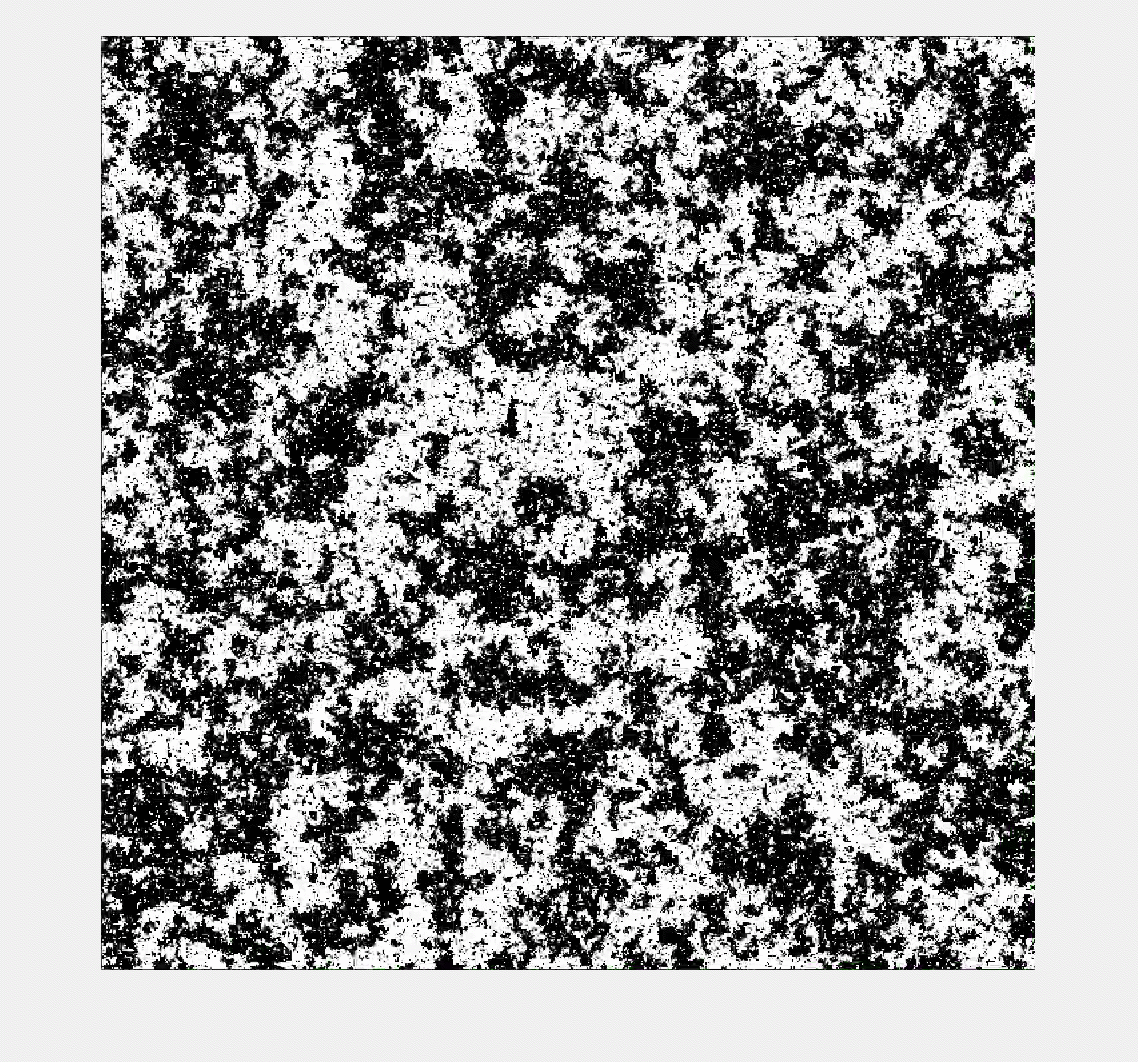
For A-series categories, the same procedure reproduces the critical points of the entire Andrews–Baxter–Forrester family. Their behavior at large scales is described by unitary minimal models with central charges (I will explain this quantity shortly)
For , this gives the Ising model with ; for , the tricritical Ising model with ; for , a theory with ; and so on.
The central charge has nothing to do with electricity. Roughly speaking, it characterizes the effective number of degrees of freedom, the independent ways in which the system’s state can change at large scales. Its value can be fractional: a free boson has , while a free Majorana fermion, which describes the critical Ising model at large scales, has .
The central charge can be estimated from how the free energy depends on the width of the sample. The free energy is obtained from the partition function; it accounts for the contributions of energy and entropy and determines the system’s equilibrium at a given temperature. Consider an isotropic lattice with a unitary critical theory on an infinitely long cylinder with a large circumference , measured in lattice spacings. At the critical point, the free energy per site, expressed in units of and including the leading correction, takes the form
where the first term corresponds to the infinite plane. The coefficient of determines . This result was obtained independently in 1986 by Henk Blöte, John Cardy, and Peter Nightingale, and by Ian Affleck. The value of alone is not enough to identify a theory, but it allows results from different methods to be compared.
A test with a catch is useful, too. For cyclic groups with a prime number of elements, the construction yields the Potts model. This generalizes the Ising model: each lattice site can take several discrete states. The transition occurs at the self-dual point, the point left unchanged by the Kramers–Wannier transformation. With two or three states, the transition is continuous (as it is with four, but four is not prime, so this case does not arise in this construction). With five or more states, it is a first-order transition, as follows from Baxter’s exact solution of 1973. The five-state case is deceptive: the discontinuity is very weak, and the correlation length in the disordered phase at the transition reaches approximately 2,500 lattice spacings. At smaller scales, such a transition can easily be mistaken for a continuous one.
One explanation was proposed in 2018 by Victor Gorbenko, Slava Rychkov, and Bernardo Zan. In their approach, the theory’s parameters are continued into the complex domain, where a pair of fixed points described by complex CFTs is found. This mathematical extension helps explain the behavior of the original model with real parameters: under successive coarse-graining, its description lingers near these points for a long time. At accessible system sizes, the system may therefore appear critical, even though a first-order transition emerges at still larger scales.
For their construction, Ji and his colleagues proposed a separate condition that they conjecture guarantees a continuous transition. They compare two numbers: how many condensates compatible with the chosen module compete within a unit cell, and how many independent parameters the cell has. If the competitors outnumber the parameters, then, according to the authors’ reasoning, the chosen space of local states leaves no freedom for a first-order discontinuity. The authors propose this condition as a sufficient criterion for a continuous transition, based on physical reasoning. As they themselves state in their response to a reviewer, there is not yet a rigorous proof. If the condition is not met, the question remains open: the transition may still be continuous. This is precisely what happens in the three-state Potts model.
Why a Promising Plateau Is Not Enough
The authors investigate the new models numerically using tensor networks. Here, a tensor is a multidimensional table of numbers: its indices specify which element of the table to select. The network specifies which indices of neighboring tables must be connected and which values to sum over when multiplying their elements. In this way, the partition function of an enormous lattice can be represented by many small tables.
Neighboring tensors are then combined into one. An entire region of the lattice becomes a coarse-grained cell: its internal configurations have already been accounted for in the sums, while its connections to neighboring cells are preserved. By repeating this procedure, the researchers describe the system at increasingly large distances. This sequence of descriptions is called a renormalization group flow. If the description retains its form under further coarse-graining and rescaling, it is said to have reached a fixed point. In his 1982 Nobel lecture, Kenneth Wilson explained the renormalization group as a strategy for problems involving many length scales: the problem is solved step by step, with one step for each scale.
When neighboring tensors are combined, the number of elements in the resulting tensor grows rapidly. To keep the calculation manageable, the researchers retain only part of this information, limiting the number of values each internal index can take to called the bond dimension. In these calculations, truncation introduces a small perturbation that, at a finite can cause the numerical flow at large scales to move away from the critical fixed point into one of the phases. The researchers’ construction has an important advantage here: the symmetry specified by the fusion category is preserved at every coarse-graining step of the tensor network. Truncation therefore does not generate perturbations that break this symmetry. Conventional tensor renormalization group methods offer no such protection.
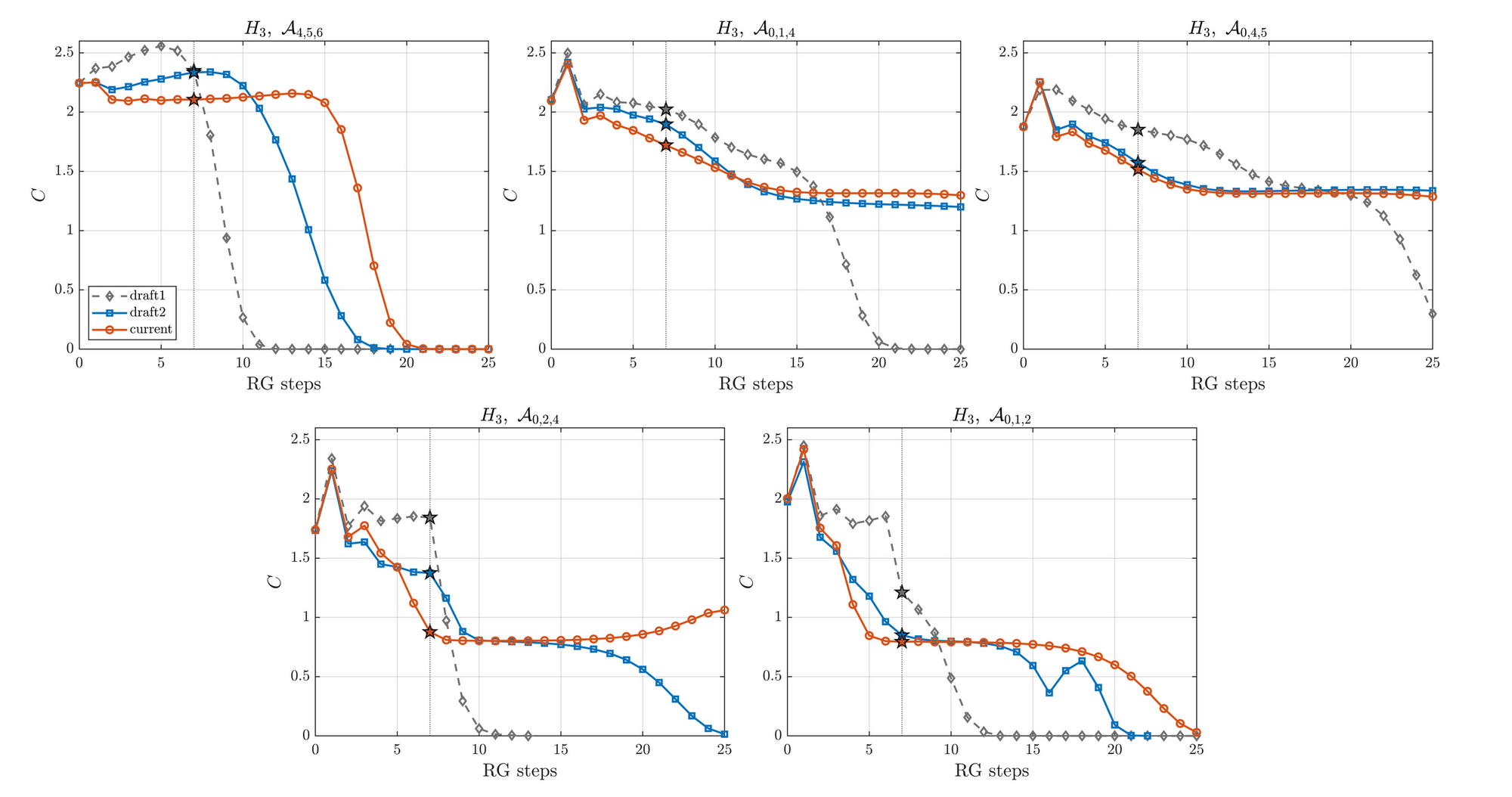
But this does not eliminate the main trap. Criticality appears as a plateau: the calculated central charge remains nearly unchanged for several steps before falling. If the plateau grows longer as increases, this supports the existence of a true critical point. However, weak first-order transitions, such as that in the five-state Potts model, produce similar plateaus. Unfortunately, the computer does not warn the researcher that they have stopped at a particularly encouraging point.
This is precisely where the work changed significantly during peer review. The published correspondence with the reviewers shows that, after the calculations were improved, some transitions had to be classified as first order, and estimates of the central charges had to be revised. The way these values were extracted from the calculated curves also changed. In the first version, the values were taken at the same coarse-graining step for all diagrams; in the final version, the authors examined the progression of each curve separately. In my view, this correspondence deserves attention: it shows how checking a calculation's stability can change the physical conclusion.
What Was Found for Haagerup Symmetry
The most interesting test involved the Haagerup category, a structure from operator algebra theory named after the Danish mathematician Uffe Haagerup. It belongs to a family of fusion categories that cannot be obtained from groups and quantum groups through the usual constructions; mathematicians call them exotic. For physicists, they specify generalized symmetries, including non-invertible ones. An ordinary symmetry, such as a rotation, can always be undone by rotating in the opposite direction. A non-invertible operation has no such inverse. Applying these operations in succession can produce sums of several operations. The simplest example appears in the Ising model itself: Kramers–Wannier duality, realized as a defect on the lattice, behaves in precisely this way.
For a long time, it was unclear whether critical behavior with Haagerup symmetry existed. In 2022, two groups, Huang and his coauthors and Vanhove and his coauthors, independently constructed lattice models with this symmetry and found numerical evidence for a critical point with a central charge of about 2. The new algorithm makes it possible to construct such models systematically and consider competition among three condensates at once. Their relative weights are represented by points inside a triangle. The vertices correspond to individual condensates, the sides to superpositions of two condensate states, and the interior to superpositions of three. Marking which phase corresponds to each point produces a phase diagram.
The authors call the point where the boundaries of the three phases meet tricritical. In phase transition theory, this term usually denotes a point at which three coexisting phases simultaneously become indistinguishable. In the simplest diagrams, it appears as the place where a line of continuous transitions gives way to a line of first-order transitions. A point where three boundaries meet without this condition is more often called a triple point. The term is also used in this conventional sense in the name of the tricritical Ising model mentioned above. For the Haagerup diagrams, the authors’ terminology is retained here.
The article’s final Supplementary Information describes three critical points that the authors conjecture may correspond to new conformal field theories. Numerical estimates of the effective central charge are approximately 2.11, 1.32, and 1.31. In the latter two cases, the calculation initially reached an intermediate plateau at a higher value, and only further coarse-graining brought it to a lower, stable plateau. The estimates changed during peer review, so the numbers given here are taken from the journal’s Supplementary Information rather than the early 2025 preprint.
Two other diagrams yield values around 0.8, although the numerical estimates are less stable here. One of them, 0.805, is close to 4/5. For a particular pair of condensates, the authors establish a connection to an already known construction built from separate sectors of the critical three-state Potts model. Here, sectors are distinct families of states in the model. When the partition function is calculated, they are treated as different possibilities, and their contributions are added together. In this construction, the central charge remains 4/5. A similar value at the point where three phases meet does not, by itself, establish the nature of the theory or provide evidence that it is new.
There is also a result that has not yet been confirmed. For the pair of condensates A₀ and A₁, tentatively linked to the anyon chain in the 2022 paper, the initial calculation yielded a central charge of about 2. When the numerical accuracy was increased, a stable critical fixed point could not be obtained. In Table 1 of the main article, this transition is classified as first order. In the Supplementary Information, the authors state their conclusion more cautiously and note that whether the transition is continuous requires further investigation. This model, therefore, does not yet confirm that the critical chain of 2022 has been reproduced. This has no direct bearing on the result of that earlier work, since the connection between the chain and the factory model remains conjectural.
Mathematical Details of the Construction
For readers familiar with tensor networks, the method can be described more precisely. A unitary fusion category specifies the initial string-net state and the partition function is written as a strange correlator,
where is the product of local boundary states over the unit cells. A condensate is described by a Frobenius algebra together with a module over it. A superposition of the boundary states of two competing condensates, with normalization expressed in terms of the quantum dimensions of the algebras and modules, specifies the predicted transition point. For several of the models considered, the predicted transition occurs at the self-dual point under generalized Kramers–Wannier duality.
The proposed condition for a continuous transition is
Here is the number of competing algebras compatible with the chosen perfect common module . Perfection means that every element shared by these algebras acts identically on the module, regardless of which algebra it is considered part of. is the dimension of the reduced local state space of the unit cell; after the overall normalization is factored out, independent parameters remain. This counting applies within the specified construction and cannot be extended to an arbitrary model simply by counting its tuning knobs. In the numerical calculations, the symmetry specified by the fusion category is preserved at every coarse-graining step of the tensor network, so truncation does not generate perturbations that break this symmetry.
What This Means for Physics
In my view, the main contribution of this work is the ability to study critical models as families. By choosing a fusion category, the underlying rules for combining objects, researchers can systematically examine the allowed algebras and modules. For a suitable pair of condensates, the algorithm predicts a transition point; for three, it predicts approximate phase boundaries, whose meeting point is refined numerically. In known examples, the predictions agree with exact results. Whether the transition is continuous or first order must be established separately. Comparing neighboring members of a family makes it easier to understand which features of criticality are robust and which depend on specially chosen conditions. Examples with first-order transitions are useful, too: comparing them with continuous transitions can help reveal which features of the construction account for the difference.
It is not yet known whether this method can encompass all possible two-dimensional critical theories. The authors work with a particular lattice geometry and particular unit cells, and other choices may require different rules. The novelty of the three candidate critical theories has not yet been established either. The values 1.32 and 1.31 are so close that they alone cannot establish that the theories are distinct. This requires more accurate calculations, independent checks, and spectra of scaling dimensions, which characterize how observables and their correlations behave as the scale changes. The authors leave these tasks for further research.
The work has no direct practical implications yet, and the authors promise none. Critical models with reliably known properties are needed primarily to test computational methods and understand systems whose behavior is governed by one or two spatial dimensions. Topological states of string-net models are already being prepared on quantum processors, so models constructed using the new method may eventually be studied on quantum simulators, controllable quantum devices that reproduce the behavior of other systems. Before that can happen, researchers still need to determine how to implement the required interactions and observe the predicted behavior.
Let us return to the ampoule of ethane. The disappearance of the meniscus is a visible manifestation of collective patterns shared by very different substances. The algorithm developed by Ji and his colleagues makes it possible to systematically construct two-dimensional models in which previously unknown types of critical behavior may emerge. Continuing this work is important for determining whether the points found truly correspond to new theories and understanding how broadly this search method applies.
The better we understand the collective behavior of particles, the more confidently we can calculate the properties of materials and investigate quantum systems. Work like this expands our ability to do so: it provides new models on which computational methods can be tested and patterns sought. The path from these models to practical applications still lies ahead. Here, I would like to return to Anderson’s idea: knowing the properties of individual particles does not tell us everything about what they can do together.
Sources
- Ji K., Zhao Y., Shen C., Wan Y., Hung L.-Y. An algorithm to generate two-dimensional critical lattice models using competing anyon condensation. Nature Physics, September 14, 2026. DOI: 10.1038/s41567-026-03438-6.
- Ji K. et al. Supplementary Information accompanying the journal article: critical points, central charge estimates, the condition for continuous transitions, and numerical tests.
- Anonymous Referees; Ji K. et al. Peer Review File accompanying the journal article. Correspondence with the reviewers, including revisions to the numerical results; CC BY 4.0.
- Hung L.-Y., Ji K., Shen C., Wan Y., Zhao Y. A 2D-CFT Factory: Critical Lattice Models from Competing Anyon Condensation Processes in SymTO/SymTFTs. arXiv:2506.05324v2, 2025. Early version; the numerical estimates cited in this article are taken from the journal’s Supplementary Information.
- Smoluchowski M. Molekular-kinetische Theorie der Opaleszenz von Gasen im kritischen Zustande, sowie einiger verwandter Erscheinungen. Annalen der Physik, series 4, 25, 205–226 (1908). DOI: 10.1002/andp.19083300203.
- Einstein A. Theorie der Opaleszenz von homogenen Flüssigkeiten und Flüssigkeitsgemischen in der Nähe des kritischen Zustandes. Annalen der Physik, series 4, 33, 1275–1298 (1910). DOI: 10.1002/andp.19103381612.
- Anderson P. W. More Is Different. Science 177, 393–396 (1972). DOI: 10.1126/science.177.4047.393.
- Belavin A. A., Polyakov A. M., Zamolodchikov A. B. Infinite conformal symmetry in two-dimensional quantum field theory. Nuclear Physics B 241, 333–380 (1984). DOI: 10.1016/0550-3213(84)90052-X.
- Rattazzi R., Rychkov V. S., Tonni E., Vichi A. Bounding scalar operator dimensions in 4D CFT. Journal of High Energy Physics 12, 031 (2008). DOI: 10.1088/1126-6708/2008/12/031.
- Kos F., Poland D., Simmons-Duffin D., Vichi A. Precision islands in the Ising and O(N) models. Journal of High Energy Physics 08, 036 (2016). DOI: 10.1007/JHEP08(2016)036.
- Kramers H. A., Wannier G. H. Statistics of the Two-Dimensional Ferromagnet. Part I. Physical Review 60, 252–262 (1941). DOI: 10.1103/PhysRev.60.252.
- Onsager L. Crystal Statistics. I. A Two-Dimensional Model with an Order-Disorder Transition. Physical Review 65, 117–149 (1944). DOI: 10.1103/PhysRev.65.117.
- Yang C. N. The Spontaneous Magnetization of a Two-Dimensional Ising Model. Physical Review 85, 808–816 (1952). DOI: 10.1103/PhysRev.85.808.
- Andrews G. E., Baxter R. J., Forrester P. J. Eight-vertex SOS model and generalized Rogers–Ramanujan-type identities. Journal of Statistical Physics 35, 193–266 (1984). DOI: 10.1007/BF01014383.
- Aasen D., Fendley P., Mong R. S. K. Topological Defects on the Lattice: Dualities and Degeneracies. arXiv:2008.08598 (2020).
- Wilczek F. Quantum Mechanics of Fractional-Spin Particles. Physical Review Letters 49, 957–959 (1982). DOI: 10.1103/PhysRevLett.49.957.
- Kitaev A. Yu. Fault-tolerant quantum computation by anyons. Annals of Physics 303, 2–30 (2003). DOI: 10.1016/S0003-4916(02)00018-0.
- Levin M. A., Wen X.-G. String-net condensation: A physical mechanism for topological phases. Physical Review B 71, 045110 (2005). DOI: 10.1103/PhysRevB.71.045110.
- You Y.-Z., Bi Z., Rasmussen A., Slagle K., Xu C. Wave Function and Strange Correlator of Short-Range Entangled States. Physical Review Letters 112, 247202 (2014). DOI: 10.1103/PhysRevLett.112.247202.
- Vanhove R., Bal M., Williamson D. J., Bultinck N., Haegeman J., Verstraete F. Mapping Topological to Conformal Field Theories through Strange Correlators. Physical Review Letters 121, 177203 (2018). DOI: 10.1103/PhysRevLett.121.177203.
- Blöte H. W. J., Cardy J. L., Nightingale M. P. Conformal Invariance, the Central Charge, and Universal Finite-Size Amplitudes at Criticality. Physical Review Letters 56, 742–745 (1986). DOI: 10.1103/PhysRevLett.56.742.
- Affleck I. Universal Term in the Free Energy at a Critical Point and the Conformal Anomaly. Physical Review Letters 56, 746–748 (1986). DOI: 10.1103/PhysRevLett.56.746.
- Baxter R. J. Potts model at the critical temperature. Journal of Physics C 6, L445–L448 (1973). DOI: 10.1088/0022-3719/6/23/005.
- Buffenoir E., Wallon S. The correlation length of the Potts model at the first-order transition point. Journal of Physics A 26, 3045–3062 (1993). DOI: 10.1088/0305-4470/26/13/009.
- Gorbenko V., Rychkov S., Zan B. Walking, weak first-order transitions, and complex CFTs II. Two-dimensional Potts model at Q > 4. SciPost Physics 5, 050 (2018). DOI: 10.21468/SciPostPhys.5.5.050.
- Wilson K. G. The Renormalization Group and Critical Phenomena. Nobel lecture, December 8, 1982.
- Haagerup U. Principal graphs of subfactors in the index range 4 < [M:N] < 3 + √2. In: Subfactors (Kyuzeso, 1993). World Scientific, 1994, pp. 1–38.
- Huang T.-C., Lin Y.-H., Ohmori K., Tachikawa Y., Tezuka M. Numerical Evidence for a Haagerup Conformal Field Theory. Physical Review Letters 128, 231603 (2022). DOI: 10.1103/PhysRevLett.128.231603.
- Vanhove R., Lootens L., Van Damme M., Wolf R., Osborne T. J., Haegeman J., Verstraete F. Critical Lattice Model for a Haagerup Conformal Field Theory. Physical Review Letters 128, 231602 (2022). DOI: 10.1103/PhysRevLett.128.231602.
- NIST Chemistry WebBook. Ethane: Phase change data. Reference values for ethane’s critical temperature and pressure.
- Xu S. et al. Non-Abelian braiding of Fibonacci anyons with a superconducting processor. Nature Physics 20, 1469–1475 (2024). DOI: 10.1038/s41567-024-02529-6.
- Longuet-Higgins H. C., Fisher M. E. Lars Onsager. Biographical Memoirs 60, 182–233 (1991). National Academy of Sciences. An account of the announcement of the spontaneous magnetization formula in 1948.