Astronomers Sort the Rubble Left by Crashes Between Young Planets
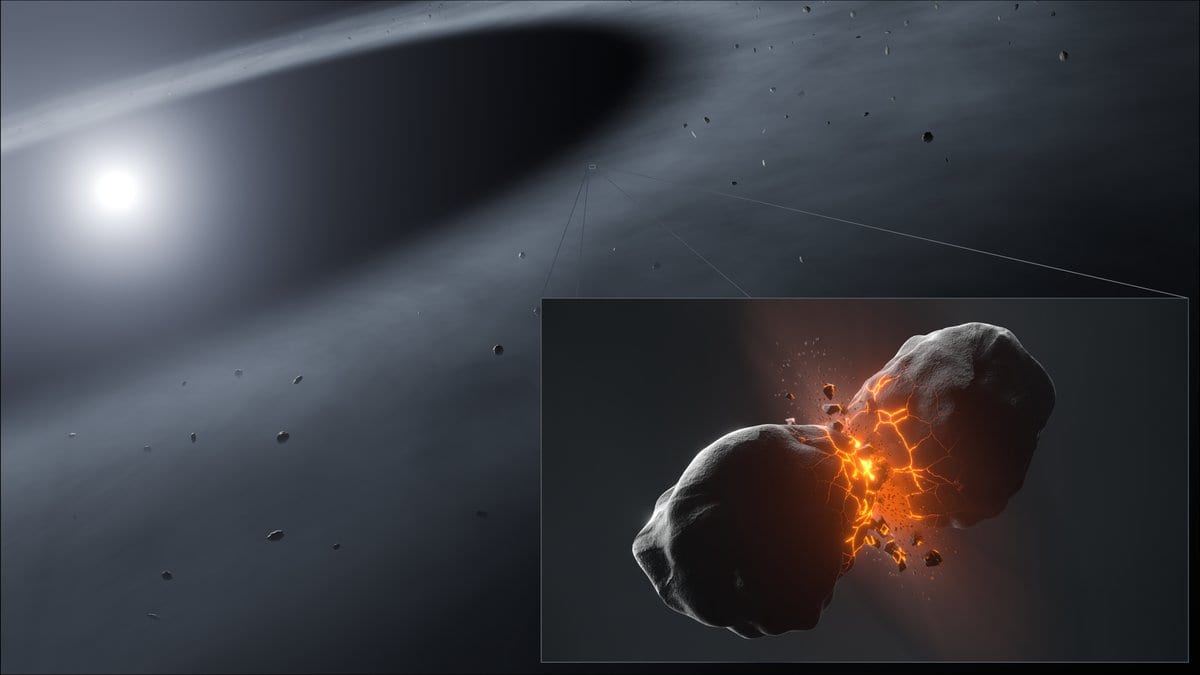
Astronomers using NASA's James Webb Space Telescope have assembled 21 young star systems whose dust appears to be the wreckage of collisions between rocky bodies, and have sorted them into two groups according to the minerals in that debris.
A debris disk is the dust and rubble that orbits a star after its planets have formed, the ground-up remains of objects running into one another. The ones in this sample are the extreme cases, with unusually large amounts of warm dust close in, where rocky planets orbit in our own system. NASA says these collisions are the kind thought to have shaped the early Earth and flung out the material that became the Moon, which is why the agency treats the disks as relevant to how our own system formed.
The work, led by Kate Su of the Space Science Institute in Boulder, Colorado, was published online Oct. 1 in The Astrophysical Journal. Su and colleagues call it the first time enough of these systems have been gathered to understand the class. Sixteen of the disks were observed with Webb; the rest came from the archive of the retired Spitzer Space Telescope, which discovered the subclass. NASA says roughly 1% of young stars show signs of the phase, far fewer than theory predicts.
The dust glows in the infrared, and the pattern of that glow identifies which minerals are present. About a third of the sample is rich in silica, the stuff of quartz and glass. NASA says that points to high-energy impacts between Mars-sized bodies, in which much of the material is vaporized, while the remaining silica-poor two-thirds point to gentler, grazing hits between Moon-sized objects. Silica-rich disks appear only around stars younger than 300 million years.
Only three disks in the sample are old enough to test one of the team's predictions, that no silica-rich systems should survive to later ages. Coauthor Attila Moor of Konkoly Observatory in Budapest said more such systems need to be observed to confirm it.
Sources
- science.nasa.gov
- The Astrophysical JournalPeer-reviewed