Flares From a Young Star Could Explain a Planet's Missing Methane
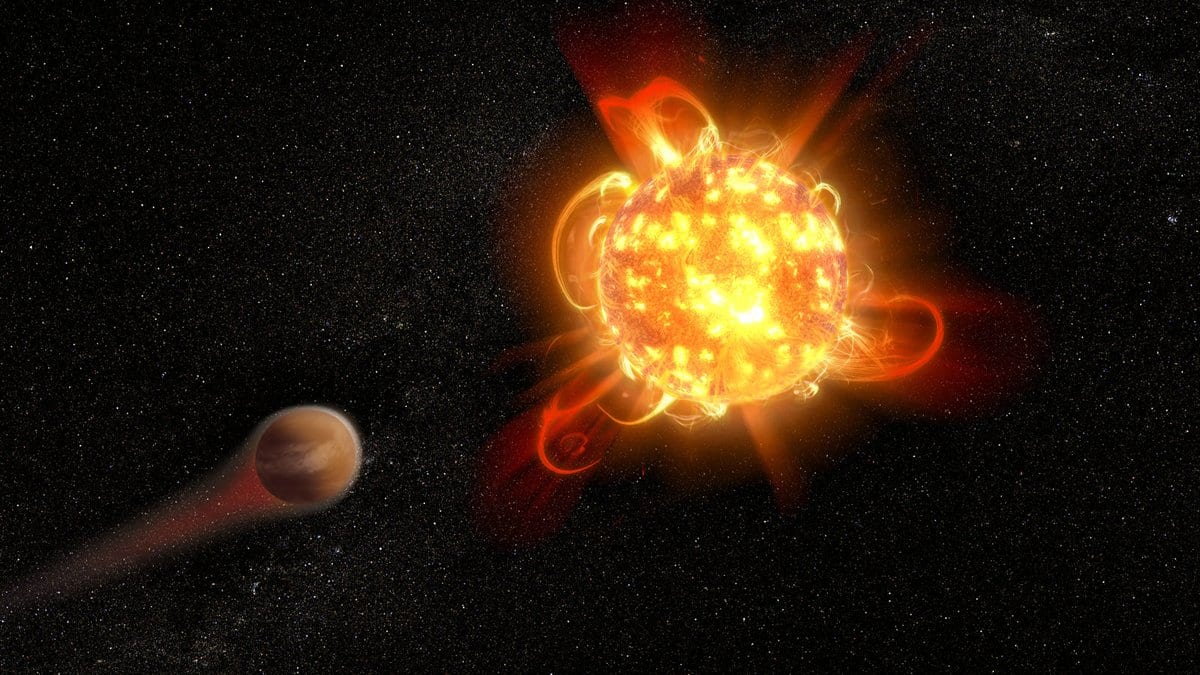
Flares from a young star can strip enough methane out of the atmosphere of the planet V1298 Tau b to account for the gas astronomers cannot find there, Danica Adams and colleagues at the University of California report in a modeling study published Nov. 13, 2026, in The Astrophysical Journal Letters.
Methane should be easy to find there, which is why the shortfall is a standing puzzle. The paper notes that Hubble, Spitzer and JWST have turned up many planets smaller than Jupiter, all with temperatures below 800 K, holding far less methane than standard chemistry predicts. Astronomers call the mismatch the missing methane problem.

V1298 Tau b is 9.85 times Earth's radius and circles a K-type star 10 million to 30 million years old. Its atmosphere is short of methane and unexpectedly rich in carbon dioxide. The explanation astronomers have favored is heat from below, with strong mixing driven by a warm interior. The authors put the internal temperature that mixing would need on this planet at 500 K, too high for a planet of its age and size under standard theories of how planetary interiors evolve.
The authors show that flares can do the same work with an interior near 100 K. During a flare, the star's light breaks methane apart in the thin upper layers faster than gas moving up from deeper down can replace it. Young, active stars flare often, and the team calculates that the methane can take longer to recover than the typical gap between flares. The atmosphere then settles into a new balance, set by how often the star flares and how energetic the flares are. In that balance it stays short of methane and carries abundant carbon monoxide, carbon dioxide and hydrogen cyanide.
Spectra computed from that model reproduce the main features of JWST's observations of V1298 Tau b, the authors report. They present flares as a possible cause of the missing methane, not a demonstrated one.
Sources
- The Astrophysical Journal LettersPeer-reviewed