Skip to content
See the World Through ScienceA project of ALLATRA
Source: PreprintarXiv1 source

A Star With a Companion Star Turns out to Have Two Planets
Space

Republish this story

Our work is licensed under Creative Commons BY-NC 4.0. You may republish this piece for free — with credit to ALLATRA Media and a link to the original, unedited beyond length trims, and not for commercial use.

Read the full license

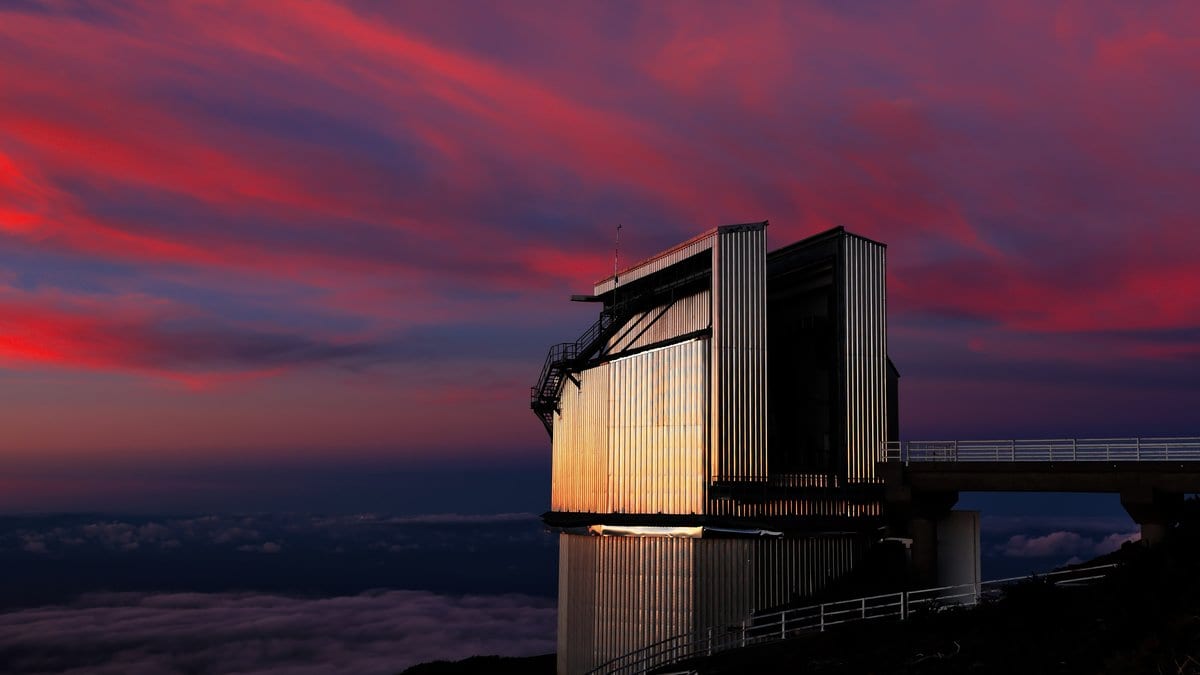
A metal-clad telescope building on a mountain ridge above a sea of cloud, under a red and purple sunset sky.
The Telescopio Nazionale Galileo at the Roque de los Muchachos Observatory on La Palma, in the Canary Islands. The HARPS-N spectrograph that measured this star's motion is installed here (illustrative)."Red sky at TNG" by Gianni0088, via wikimedia, CC-BY-SA-4.0, cropped

Astronomers have found two planets around one star of a widely separated pair: a gas-rich world a little over three times Earth's radius that circles every 4.55 days, and a far heavier one on a 108.75-day orbit. Angelica Psaridi and colleagues describe the system, called TOI-1699A, in a preprint posted to arXiv on Nov. 13, 2026; its arXiv record says the paper has been accepted for publication in the journal Astronomy & Astrophysics, which has not yet published it.

The paper reports that the system joins what the authors describe as a still-limited sample of cases where more than one planet orbits a single member of a double star. The host is a Sun-like star, and the second star is a smaller, cooler red dwarf sitting about 348 times the Earth-Sun distance away as seen on the sky.
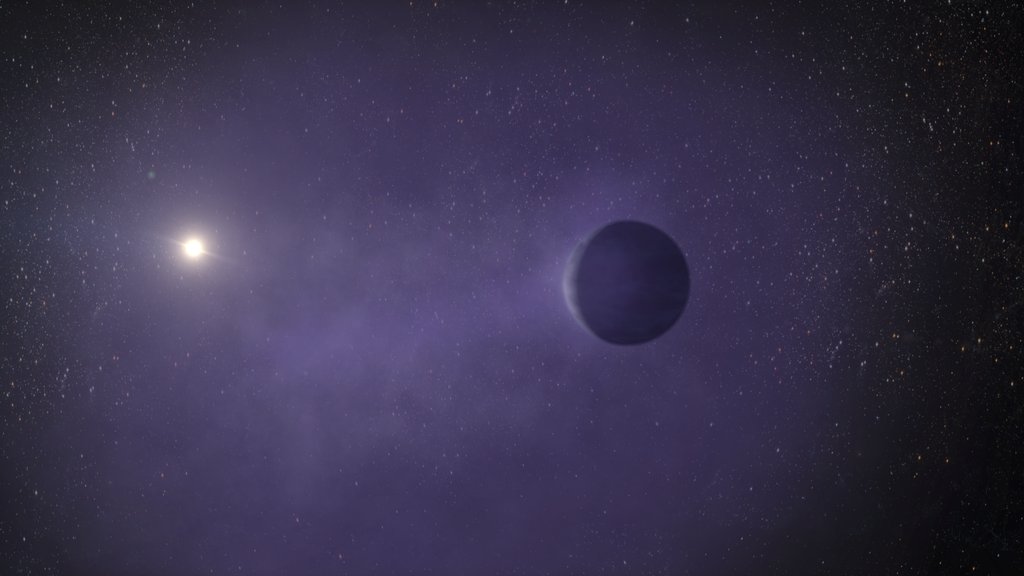
An artist's illustration of a dark bluish planet lit from the side near a bright star, with a faint purple haze of gas trailing away from it against a star field.
An artist's concept of a mini-Neptune, the class of planet the inner world belongs to, with gas escaping from its upper atmosphere (illustrative). "Artist's Illustration of Mini-Neptune TOI 560 01 (2022-009)" by ARTWORK: Adam Makarenko (Keck Observatory), via Wikimedia Commons, Public domain

TESS first flagged the inner planet, and the team confirmed it with targeted observations from the CHEOPS space telescope, ground-based telescopes and HARPS-N, a spectrograph that tracks the small motions a planet induces in its star. The planet weighs 13.9 times Earth's mass. That puts it firmly in the sub-Neptune range, bigger than Earth and smaller than Neptune, and the preprint reports that it must hold a substantial envelope of light gas and ice.

The HARPS-N measurements also turned up the outer planet, which the authors put at a minimum of 5.54 times Jupiter's mass. That method gives only a lower bound, because the true mass depends on how the orbit is tilted to our line of sight; the team's test of which orbits would stay stable argues against the object being a star and caps its mass at roughly 18 times Jupiter's. If the two planets share one orbital plane, the outer one is not expected to cross the face of the star.
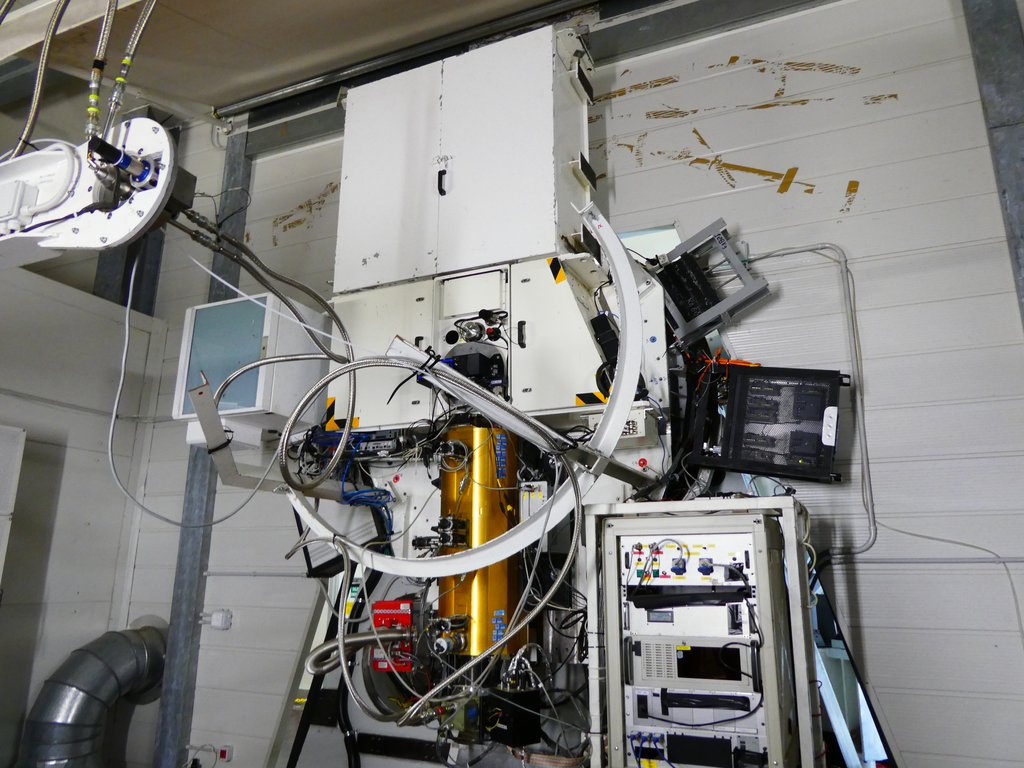
A cluttered instrument platform inside a telescope building, with a yellow and white cylindrical unit ringed by cables and hoses, electronics racks and a monitor beside it.
Instrumentation on a Nasmyth platform of the telescope that carries HARPS-N, photographed Oct. 18, 2023. The spectrograph takes starlight from the telescope through a fiber (illustrative). "Telescopio Nazionale Galileo - NASMYTH-A" by Syrio, via Wikimedia Commons, CC BY-SA 4.0, resized

The authors write that continued tracking of the star's motion, together with the next data release from the Gaia star-mapping mission, could pin down the outer planet's true mass and the tilt of its orbit.

Sources

Spot an error?

Spot an error?

Report an error

Spotted a mistake on this page? Tell us what's wrong and our editors will take a look.

What kind of problem?

Only if you'd like us to be able to follow up. We won't use it for anything else.

We correct mistakes openly. Select any text to flag it. Fixes are logged under our Corrections Policy.

Report an error

Reporting on

A Star With a Companion Star Turns out to Have Two Planets

What kind of problem?

Only if you'd like us to be able to follow up. We won't use it for anything else.

We read every report. Corrections are logged publicly.