A Sub-Neptune's Atmosphere May Begin Inside the Planet, Not Above It
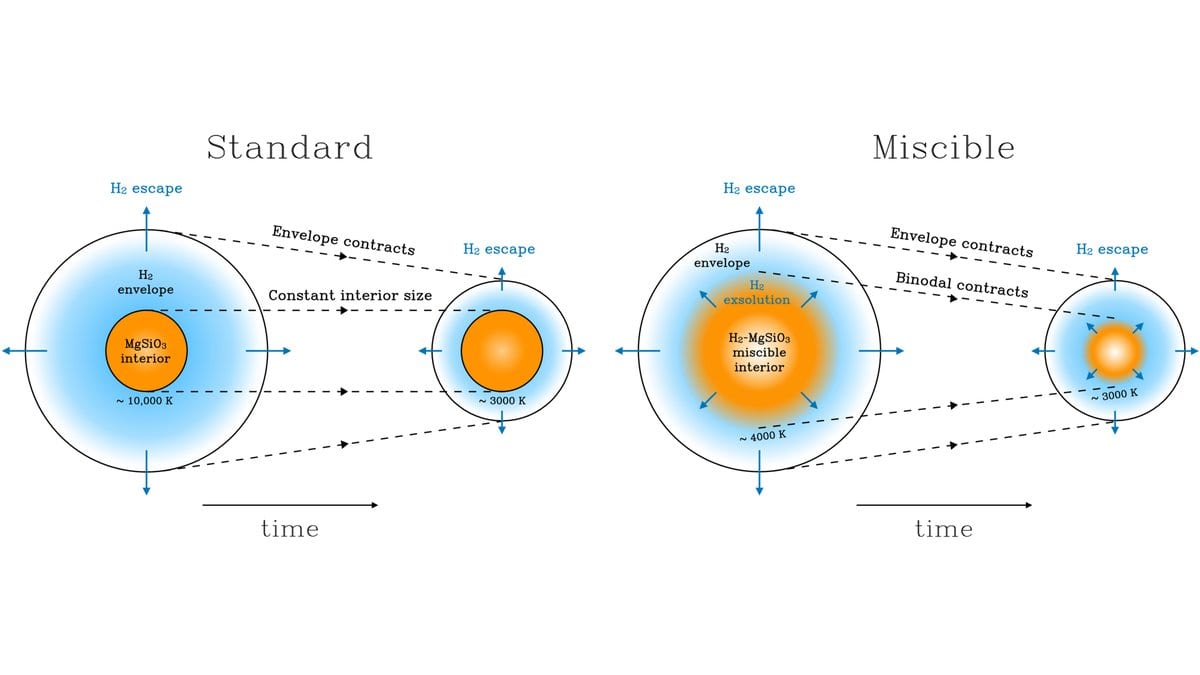
Most of the hydrogen in a young sub-Neptune may be dissolved inside the planet's molten rock rather than sitting in an atmosphere above it, according to modeling published Nov. 27, 2026. James G. Rogers of the University of Cambridge and Hilke E. Schlichting of the University of California, Los Angeles, report that for roughly the first 100 million years such a planet keeps most of its hydrogen in its interior, out of reach of its star.
Their paper in The Astrophysical Journal Letters couples that interior chemistry to the atmospheric escape thought to strip close-in planets of their gas, and its stated aim is to predict where fully mixed planets could be picked out among young exoplanets. As the star removes gas from the top of the atmosphere, more hydrogen comes out of the interior and refills the envelope, so a mixed planet shrinks more slowly than one whose rock and gas sit in separate layers. Its envelope can gain mass as well as lose it.
Earlier molecular simulations by other groups found that hydrogen and molten silicate are miscible above about 4000 K at the pressures these interiors reach, mixing into one fluid instead of forming layers. Rogers and Schlichting say that mixing is also why contraction slows: it lifts rock higher in the planet's gravity well, and the rock has to settle back down before the planet can shrink. That result holds no matter how strongly the star strips the atmosphere.
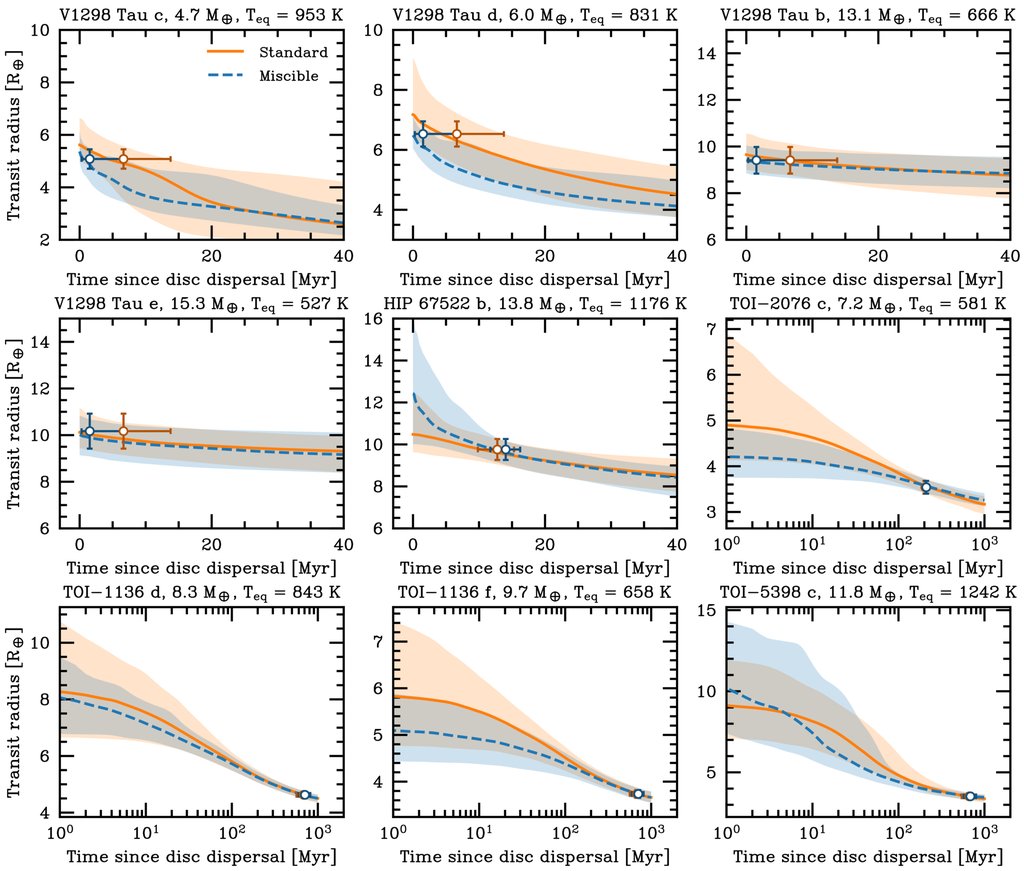
The authors then built a population-level test of how common mixed interiors are. Applied to the nine known planets younger than a billion years whose masses, radii and ages are measured well enough, both pictures reproduce the data and neither is statistically preferred. They write that real interiors are probably only partly mixed, which would bring the two predictions closer together. Mock surveys put the sample needed at about 100 to 200 young planets with all three quantities measured — within reach of missions pointed at young star clusters, such as the European Space Agency's PLATO.
Sources
- The Astrophysical Journal LettersPeer-reviewed