Webb Sees No Helium Escaping a Rocky Planet Where Another Telescope Found Some
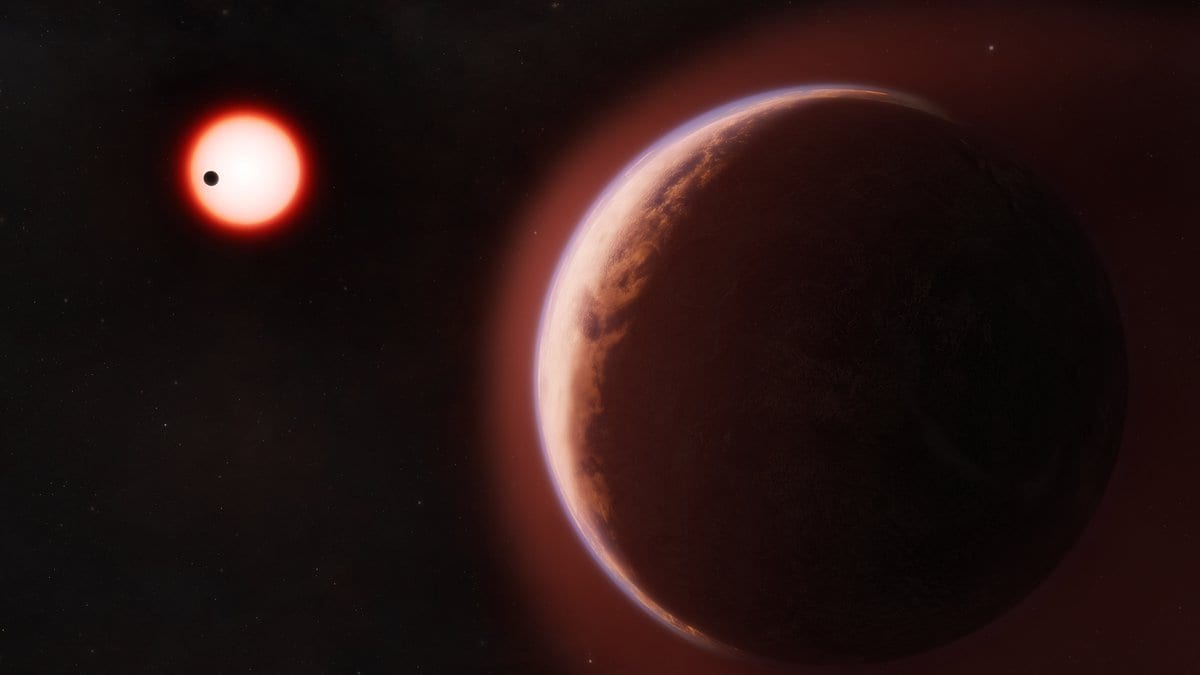
The James Webb Space Telescope watched the temperate planet LHS 1140 b cross the face of its star four times and found no helium escaping it, a team led by Amélie Gressier of the Université de Montréal reports in The Astrophysical Journal Letters. Every absorption the group measured is consistent with none at all, and observations of the neighboring planet LHS 1140 c show no helium either.
Escaping helium is one of the few signs of an atmosphere a telescope can catch leaving a planet this small, and LHS 1140 b, a rocky world about 1.7 times Earth's radius, orbits in its star's habitable zone. The authors write that the search for atmospheres on temperate rocky planets matters for understanding how such worlds form and evolve, and whether they could be habitable.
The new paper puts the ceiling on any helium absorption at LHS 1140 b between 0.72% and 1.21%, and reports that the four Webb visits taken together disfavor a persistent signal at 4.5 sigma. Those limits are set against an excess absorption of 1.24% ± 0.23%, measured during a 2024 transit with the WINERED spectrograph on the Magellan Clay telescope by Cherubim and colleagues — a different team, a different instrument. AllatRa Media reported that helium detection on Aug. 23, 2026; the Webb transits do not reproduce it. A second WINERED visit, the new paper notes, saw nothing.
The group also finds that the star's own helium line changes substantially from one observing run to another, behaving much as other small, cool M dwarf stars do. Three readings of the earlier signal remain open, the authors write: escape from the planet that happens only occasionally, a contribution from the star itself, or an instrumental effect. Separating them will take new high-resolution observations, taken both during a transit and outside one.
The paper is open access, and the Webb data behind it are public, held in the Mikulski Archive for Space Telescopes.
Sources
- The Astrophysical Journal LettersPeer-reviewed