A Supernova's Faint Radio Glow Fits Two Very Different Explanations
Astronomers have detected a faint radio source at the position of SN 2025ulz, the exploded star that appeared in the same patch of sky, at the same moment, as a weak gravitational-wave candidate in August 2025. Tanner O'Dwyer of Johns Hopkins University and colleagues report that two very different explanations fit the signal, and that their data cannot tell them apart.
The authors say the detection is a reason to follow up such coincidences routinely, and at more than one wavelength, when an exploding star appears beside a gravitational-wave candidate from an unusually light neutron star.
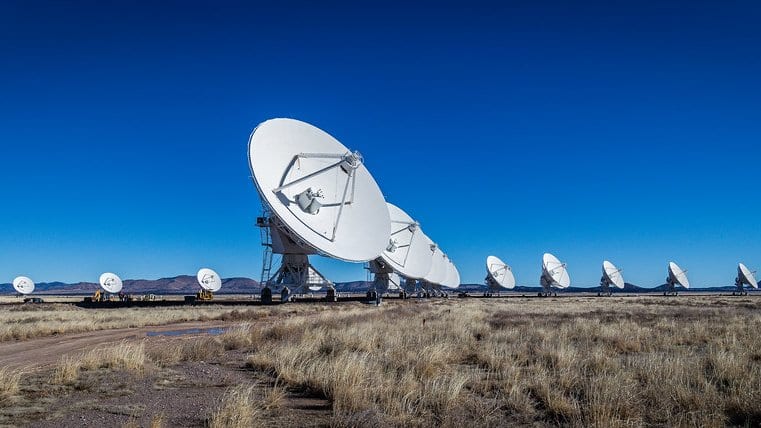
The observations came from the Karl G. Jansky Very Large Array, under a program called JAGWAR, with further data from the upgraded Giant Metrewave Radio Telescope and MeerKAT. O'Dwyer and colleagues report the source as faint but significant at 6–10 GHz in The Astrophysical Journal Letters. One reading is radio emission from supernova debris running into gas the star shed before it blew apart. The other is a jet aimed away from Earth, which their modeling suggests would peak 50 to 100 days after the trigger.
The LIGO-Virgo-KAGRA collaboration reported the candidate, S250818k, on Aug. 18, 2025, and called it subthreshold, meaning too weak to count as a confirmed detection. It fit a merger of two neutron stars, one of them possibly lighter than the Sun. The Zwicky Transient Facility then found an optical flash at the same time. It first looked like a kilonova, the afterglow of a neutron-star merger, and was later classified as a young supernova from a star that had lost its outer layers.
Whether the two are connected at all is unsettled. The authors note that the link between S250818k and SN 2025ulz would need support from later, offline analysis of the gravitational-wave data.
Sources
- The Astrophysical Journal LettersPeer-reviewed