An Eight-Second X-Ray Flash Turned up in Einstein Probe's Old Data

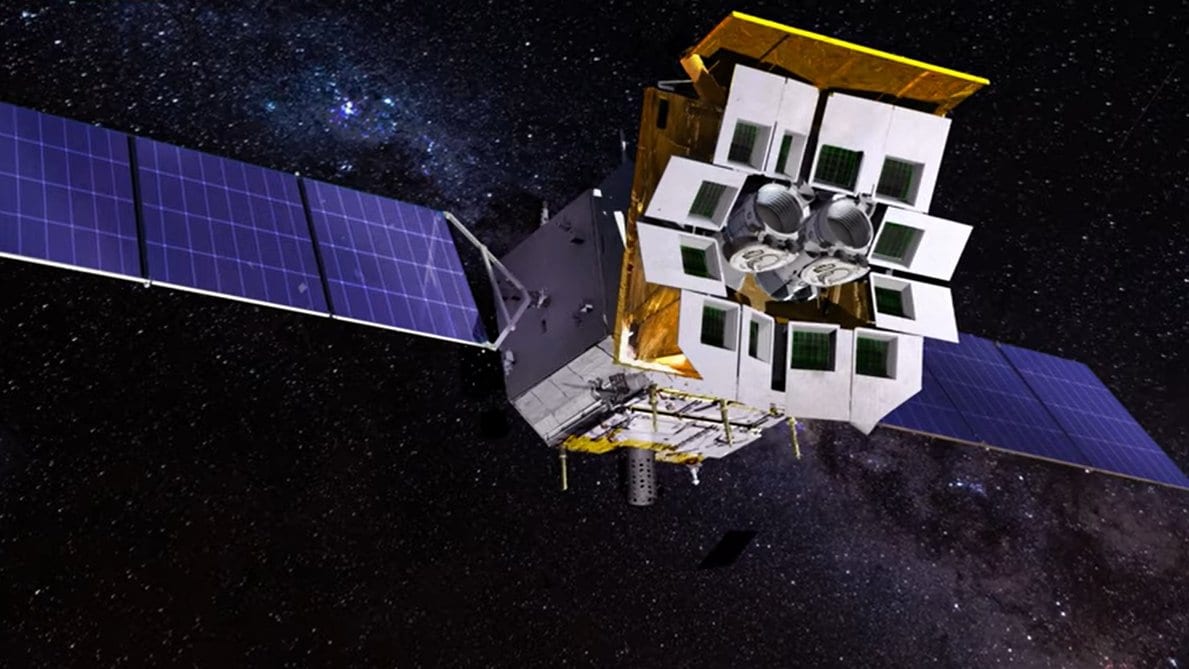
On the morning of April 11, a burst of gamma rays lasting a little over a second reached NASA's Fermi satellite from a direction the spacecraft could locate only within a wide patch of sky. Einstein Probe, a soft X-ray observatory operated by the National Astronomical Observatories of the Chinese Academy of Sciences, happened to be watching part of that same patch. Its Wide-field X-ray Telescope collected a handful of photons. Nothing on board triggered on them, and the flash stayed in the archive.
It was found by going back and looking at exactly the right time. In a preprint posted Nov. 13 and not yet peer-reviewed, Yi-Han Iris Yin of the Hong Kong Institute for Astronomy and Astrophysics, Run-Duo Liang of the National Astronomical Observatories and colleagues describe EP260411a, a soft X-ray flare lasting about eight seconds that arrived with the short gamma-ray burst GRB 260411A. If their interpretation is right, it came from two compact objects spiraling into each other.
The search was built to be narrow. The team gathered 166 short gamma-ray bursts logged between Einstein Probe's launch in January 2024 and June 2026. Only 33 had positions precise enough to identify their locations to within 10 arcseconds. Of those, just three had been observed by Einstein Probe, and all three showed X-ray emission lasting at least 10 times longer than their gamma-ray bursts. The remaining 133 had much larger localization regions. The team first searched the overlapping regions of the satellite's field of view and the bursts' localization areas, then opened a 20-second window centered on each burst's trigger time for those with suitable coverage. They stacked images from the detectors that had continuously covered the relevant region and looked for uncataloged point sources. Candidates showing sharp, isolated spikes in individual frames, likely caused by cosmic rays, were excluded. After manual checks, one candidate remained.
That roundabout route is the paper's real subject. A few seconds of soft X-rays is precisely what Einstein Probe's wide-field telescope struggles to flag on its own: its relatively small effective collecting area means that only a handful of photons arrive during such a brief event, far too few for the onboard software to trigger on. The authors state the consequence plainly: before this search, Einstein Probe had not detected a short-duration fast X-ray transient associated with a short gamma-ray burst, which the authors classify as a candidate signal from a compact-object merger.
Ten photons is the whole detection
The evidence is correspondingly thin, and the thinness is the story. Ten photons fell inside the circle drawn around the source, against eight in the surrounding background region. The team calculates a point-source significance of 5.26 and places an upper limit of about 1.6% on the probability that the X-ray flare and gamma-ray burst were unrelated events that happened to coincide. Fermi's own team had classified the burst as a likely short one, and the X-ray position falls within the much larger localization region reported by that instrument. All of which is a long way from catching a merger in the act, and is why the paper consistently calls the event a candidate.
What lifts the case above a coincidence count is the shape of the pulse. Fermi's gamma rays came in a spike lasting 1.3 seconds. The X-ray flare's measured duration, the interval containing 90% of its counts, is 6.1 seconds, with an uncertainty of about a second. The paper's own figure of about eight seconds is a rounded description of the pulse, not that measurement. Line the two bands up and the pulse grows broader and peaks progressively later as the photon energy falls. That pattern supports a common origin for the X-ray and gamma-ray emission, rather than two unrelated flashes. A joint fit to the X-ray and gamma-ray spectra is best described by a model with a low-energy break between the bands.
One independent reading does not sit easily with that. The Gamma-Ray Monitor on SVOM, a joint Chinese-French mission, detected the same burst and reported that its light curve "consists of multiple pulses." The preprint's closing argument leans on EP260411a and its burst showing only a single pulse, and it does not cite that circular, although its acknowledgments thank one of the circular's authors for checking the SVOM detection. Finer time bins across a wider energy band can resolve structure that coarser ones smooth into a single rise and fall, so the two accounts need not be in conflict. A single pulse is not settled, though.
Nobody knows how far away it happened
The merger interpretation itself rests on a single, indirect test. Plot a burst's peak photon energy against the total energy it released and the two main classes of gamma-ray burst separate reasonably well; this event's track falls within the band occupied by mergers. The catch is that the second axis requires a distance, and this event has none. Nobody measured one, nobody detected a fading afterglow and nobody saw the glow of freshly forged heavy elements that a neutron-star collision can produce. So the team ran the calculation over an assumed range of distances, stretching from the nearby universe across much of cosmic history. Several galaxies lie inside the X-ray error circle, but the paper says plainly that "neither a unique host association nor a more restrictive redshift range can be established." The authors' language stays careful throughout: the results support, are consistent with or favor an interpretation. How far away this happened is not known.
How narrow the first really is
"EP260411a thus represents the first short-duration EFXT candidate detected by EP in association with a short GRB," the authors write, and every part of that is doing work. A candidate, not a confirmed case. Inside one mission's own archive. In the brief-flare class, with the merger label a separate inference. Alongside a short gamma-ray burst. And, an earlier section adds, with soft X-ray coverage reaching down to 0.5 keV, the low end of the instrument's range.
The paper narrows the claim further. EP250704a had already shown a short, hard X-ray spike arriving with a short gamma-ray burst, within an event whose X-ray emission continued for minutes. The new flare is described as "similar to the initial short spike of EP250704a." A second near-relative, EP251021b, lasted around 24 seconds in X-rays, with an associated gamma-ray burst too weak to trigger the onboard detection system. What is new is an Einstein Probe event whose entire X-ray flare is short, unlike the previously reported merger-type events, whose X-ray emission lasted longer. The mission's own circular on EP260527a records a flare that "lasted for about 200 seconds."
And the claim has no outside assessment yet. The preprint has not been peer-reviewed, no independent group has weighed in and several of its authors work at the institute responsible for operating Einstein Probe. The mission's detection record is therefore being assessed in part by researchers affiliated with the team that operates it. What the work does give the field is the method: a narrow time window, an old archive and a known burst time.