Skip to content
See the World Through ScienceA project of ALLATRA
Source: Peer-reviewedNature Astronomy1 source

A Radio Source Pulses Every 7.9 Minutes, and Its Companion Looks Like the Sun
Space

Republish this story

Our work is licensed under Creative Commons BY-NC 4.0. You may republish this piece for free — with credit to ALLATRA Media and a link to the original, unedited beyond length trims, and not for commercial use.

Read the full license

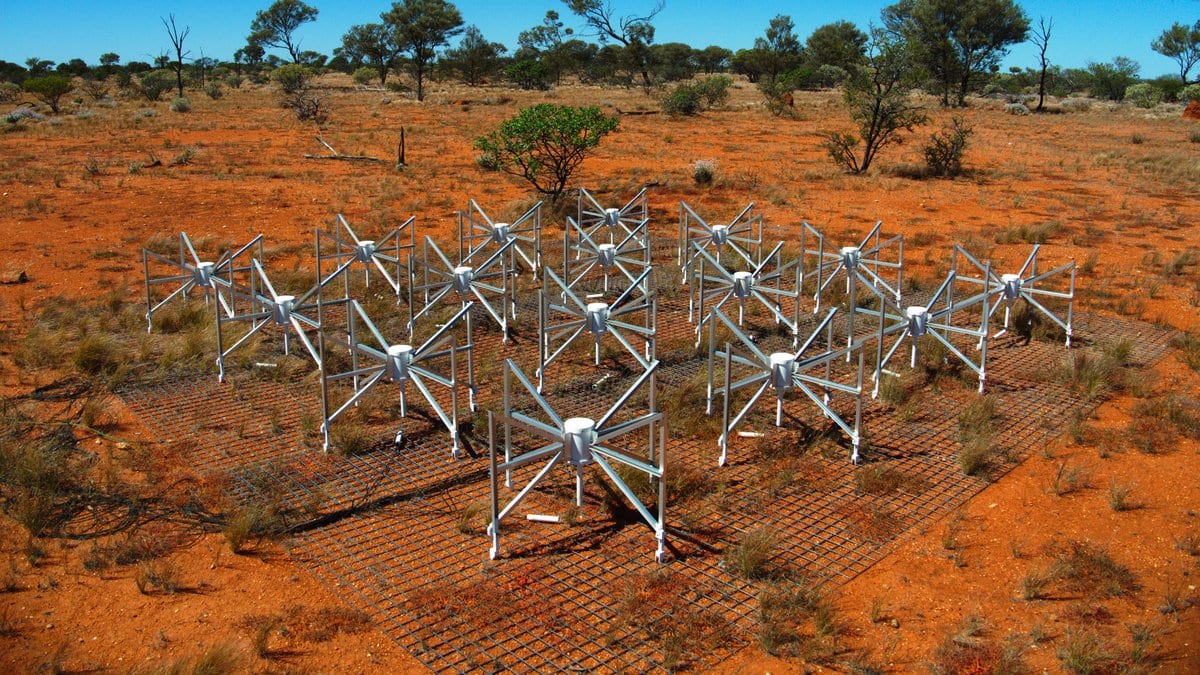
Sixteen silver dipole antennas arranged in a square on a wire mesh mat, standing on red desert ground with low green scrub and trees behind.
An early tile of the Murchison Widefield Array on the red earth of outback Western Australia, photographed Sept. 12, 2011. The array is one of the radio telescopes the team used to follow the 7.9-minute pulses."MWA 32T Tile" by Natasha Hurley-Walker, via Wikimedia Commons, CC BY-SA 3.0, cropped

Astronomers have identified a radio source that pulses every 7.9 minutes as a low-mass white dwarf, the burned-out core of a star, paired with a star much like the Sun. A team led by Samuel J. McSweeney of the International Centre for Radio Astronomy Research at Curtin University reports the system in Nature Astronomy.

The paper was published Nov. 12, 2026. Its authors conclude that the pulsed radio emission in such a pair depends on the white dwarf's interaction with its companion rather than on the white dwarf alone, and that the companion can be a G-type star like the Sun in an orbit lasting about a day.
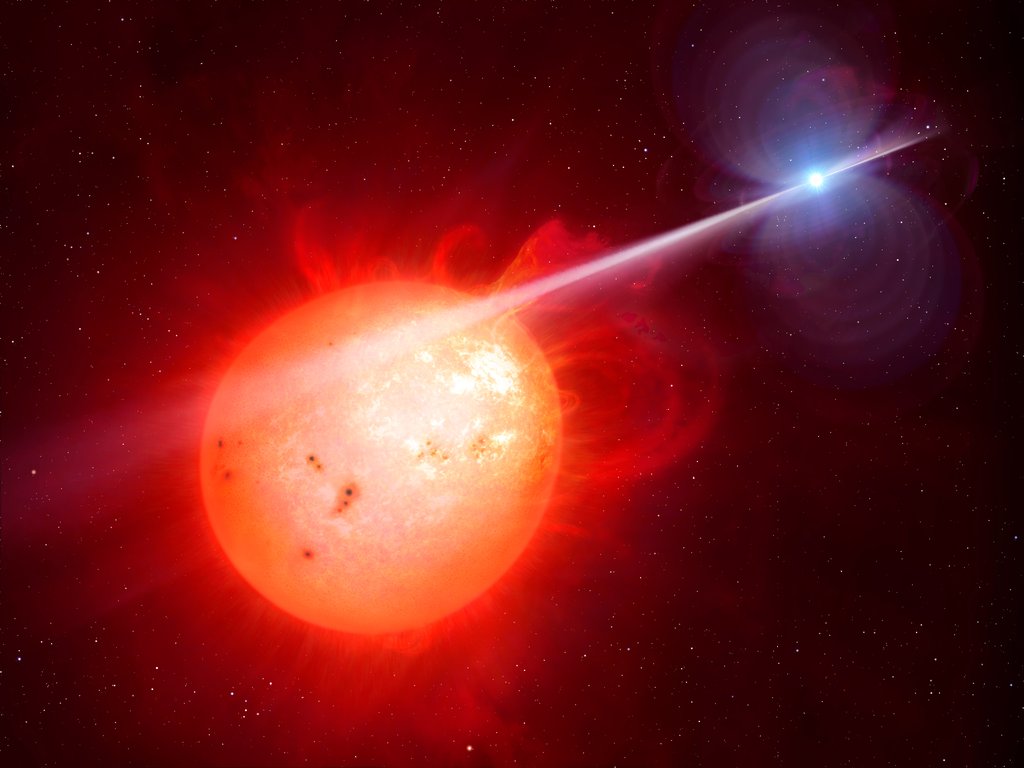
An illustration of a small blue-white star firing a narrow beam of light across space at a large red star, whose surface flares where the beam strikes it.
An artist's view of a white dwarf whose beam sweeps the face of its companion. The companion here is a cool red star, where the one in the new pair is much like the Sun (illustrative). "Artist’s impression of the exotic binary star system AR Scorpii" by M. Garlick/University of Warwick/ESO, via ESO, CC BY 4.0, resized

Long-period transients are an emerging class of repeating radio sources with periods of minutes to hours. Optical follow-up has confirmed at least four of 12 of them as a white dwarf paired with an M dwarf, a small and cool star. The new source, designated GPM J071507-114153, also varies on a much longer cycle of about 1.3 days, which the authors read as the pair's orbital period.

Timing of the radio pulses constrains the orbit and suggests the G-type star does not fill its Roche lobe, meaning it is not swollen enough to spill gas onto the white dwarf. The twist the radio waves pick up on their way to Earth also changes quickly when the white dwarf is on the far side of its companion, consistent with the waves crossing the companion's corona, the hot gas of its outer atmosphere.
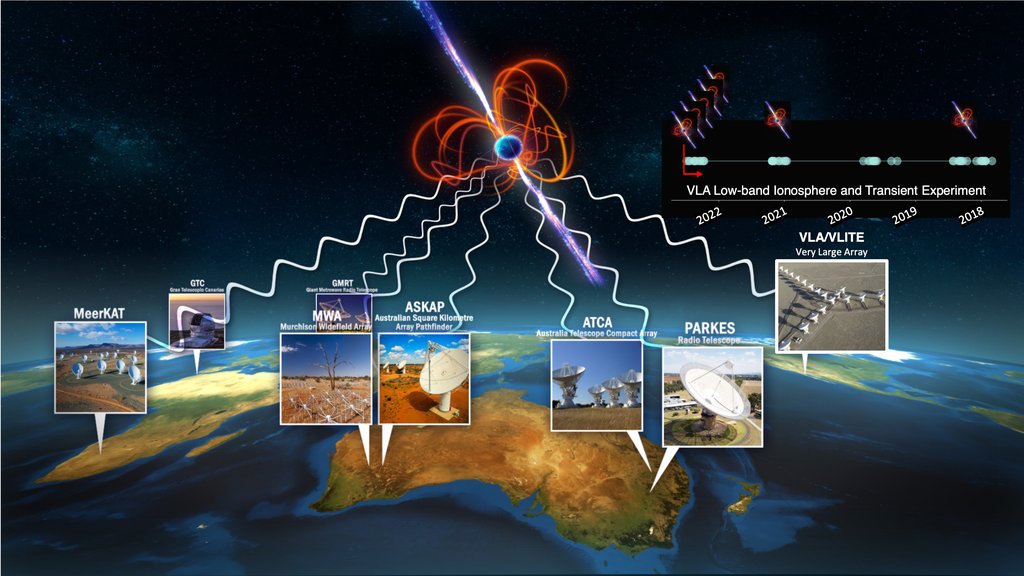
A diagram showing a compact star with looping magnetic field lines above a view of Earth, with radio waves reaching labeled telescopes including MeerKAT, the Murchison Widefield Array and the Very Large Array.
Radio telescopes on three continents, the Murchison Widefield Array and MeerKAT among them, are what pick up sources that pulse on timescales of minutes (illustrative). "NRL Astronomers Track New Stellar Phenomenon (7921679)" by U.S. Navy NRL by U.S. Naval Research Laboratory, via Wikimedia Commons, Public domain

The paper records that the pulses were found in a survey of the Galactic plane, then followed up with the Murchison Widefield Array in Western Australia and with MeerKAT, run by the South African Radio Astronomy Observatory. The companion was identified from a spectrum taken at the Keck Observatory on Maunakea. Measurements of every detected pulse are posted on Zenodo, and the processing code is on GitHub.

Sources

Spot an error?

Spot an error?

Report an error

Spotted a mistake on this page? Tell us what's wrong and our editors will take a look.

What kind of problem?

Only if you'd like us to be able to follow up. We won't use it for anything else.

We correct mistakes openly. Select any text to flag it. Fixes are logged under our Corrections Policy.

Report an error

Reporting on

A Radio Source Pulses Every 7.9 Minutes, and Its Companion Looks Like the Sun

What kind of problem?

Only if you'd like us to be able to follow up. We won't use it for anything else.

We read every report. Corrections are logged publicly.