Photos of the 2024 Aurora Over Germany Trace Its Red and Green Glow to One Cause
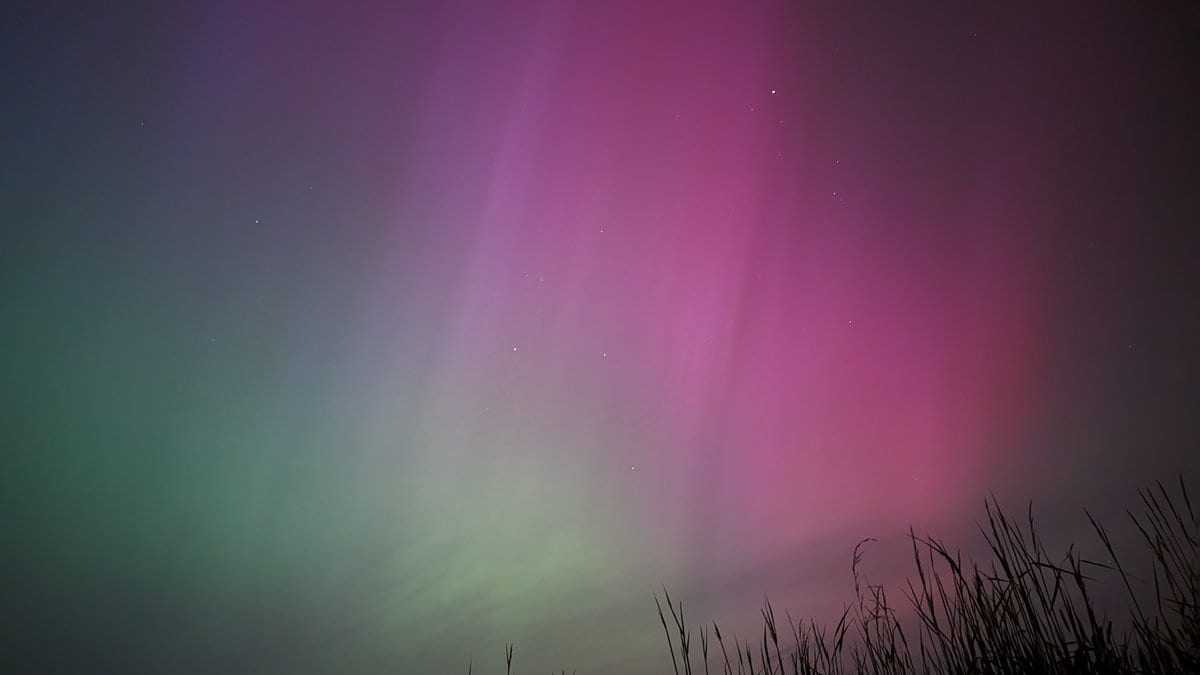
Photographs taken over Braunschweig and Göttingen, Germany, during the geomagnetic superstorm of May 10 and 11, 2024, show bright rays running continuously from the high red aurora into the green aurora beneath it. Bruce T. Tsurutani, formerly of NASA's Jet Propulsion Laboratory, and colleagues conclude that one mechanism produced both sets of rays: high-energy electron precipitation, meaning electrons raining down along Earth's magnetic field lines.
Why the sky glows red during a storm is an old question. The authors call the cause of red auroras a long-standing mystery of space physics, and they write that direct measurements are so difficult that the field has had to rely on theoretical arguments. The paper was published Nov. 3, 2026, in Annales Geophysicae, open access.
The rays are brightness enhancements, and both photographs were taken as the storm intensified for the second time. Both were consumer cameras set to a few seconds' exposure: the Braunschweig image was taken by Philipp Schulz of the Fraunhofer Institute for Surface Engineering on a Google Pixel 7 phone at 22:16 UT; the Göttingen image was taken by Sami K. Solanki of the Max Planck Institute for Solar System Research about half an hour later. The authors say the continuous path means energy was deposited directly from about 800 km down into the lower atmosphere by electrons falling along the field lines. Green auroral rays are known to come from precipitating electrons.
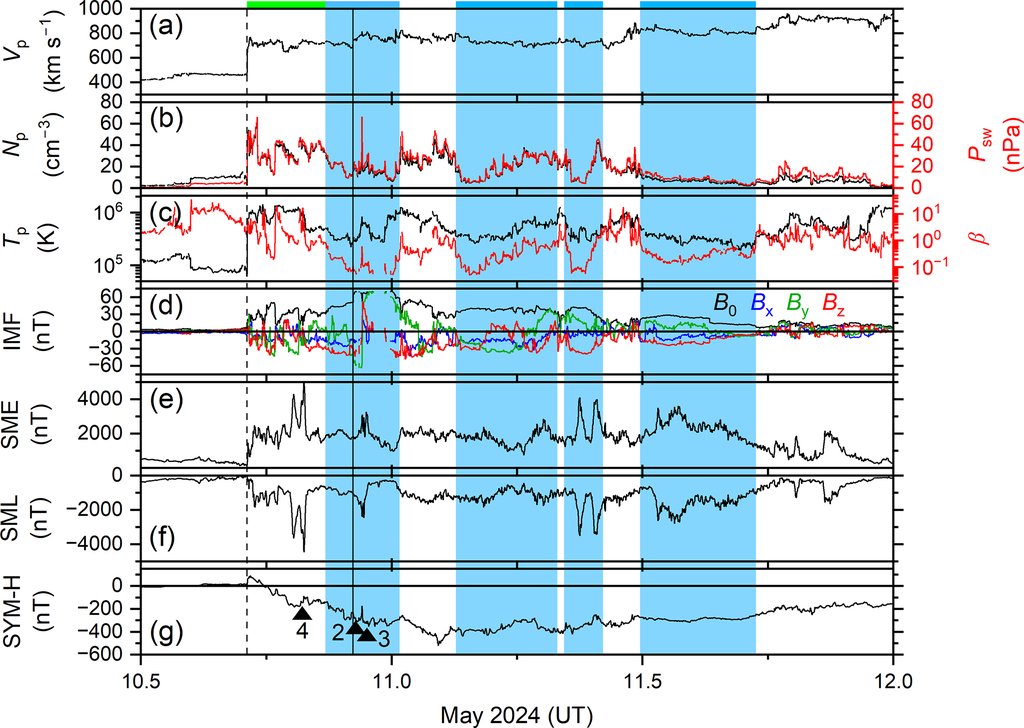
The authors say the continuous rays argue against long-proposed explanations in which the red light comes from heat conducted down the magnetic field lines, or from heavy oxygen ions rather than electrons. They also write that this is the first paper showing red and green auroras connected by continuous streaks.
No instrument measured what caused the red light that night, and the paper describes itself as a citizen science report. The authors ask for more close-up photographs of red auroras with exposures under 10 seconds. They add that a future red aurora with no streaks and no green aurora beneath it would point to a different mechanism.
Sources
- Annales GeophysicaePeer-reviewed