No Study Has Measured Plastic Intake and Excretion in the Same People
A review published Nov. 3, 2026, in the journal Microplastics and Nanoplastics argues that no human study has measured microplastic intake and excretion in the same people, so the models that convert an intake estimate into a dose inside the body cannot be fitted to the data.
Risk assessment for microplastics rests on that translation from a swallowed amount to a tissue dose, and the review calls it an assumption the field has left implicit. Timothy Yu Yee Ong, Lai Ti Gew and colleagues at the Jeffrey Cheah Sunway Medical School at Sunway University in Malaysia scoped 22 eligible studies. Those studies measured plastics in people, in lab-grown tissue, in animals and in cells, and none of them follows intake and elimination in the same individuals.
The authors call the resulting models non-identifiable: several different combinations of intake, retention and clearance fit the same measurements equally well, so the data cannot say which one is right. Plastic found in a tissue sample also mixes particles that arrived by swallowing, by breathing and through the skin, with nothing to assign them to a route. The review offers no independent estimate of how much plastic a person carries, and does not read the gap as evidence either way about harm.
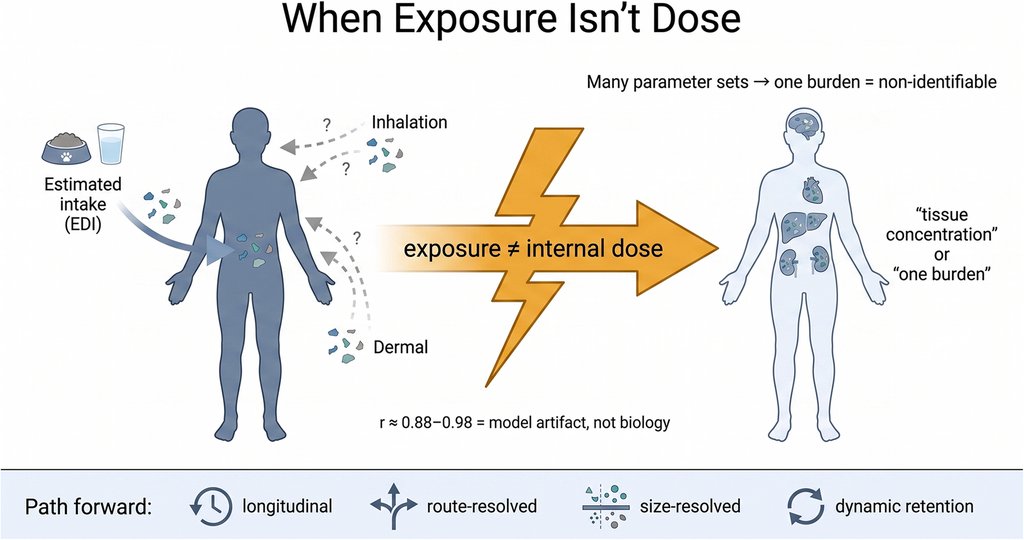
Many published models assume that a fixed share of what is swallowed is excreted. The group tested that assumption by running repeated randomized simulations on a synthetic data set built from published values. The researchers report that intake and excretion came out almost perfectly matched, at a correlation of 0.949 in their demonstration and between 0.88 and 0.98 across the conditions tested. They add that the tightness follows from how the model is written rather than from any coupling inside the body. The quantitative work covers particles 1 micrometer and larger, with smaller nanoplastics treated qualitatively.
The review sets out what a usable model would have to measure: the same people followed over time, with intake, elimination and retention recorded route by route. Those conditions are translated into design and reporting rules for future studies.
Sources
- Microplastics and NanoplasticsPeer-reviewed