Sea Level Rise Could Cost the World's Coasts 130 to 339 Billion Dollars a Year by 2100
Rising seas could cost the world's coasts between 130.06 billion and 339.41 billion international dollars a year by 2100 in lost ecosystem services, the benefits people draw from coastal land and water. A global valuation published Nov. 3, 2026, in PNAS Nexus gives that range across five scenarios of emissions and development. The unit is the international dollar at 2020 prices, adjusted for what money buys in each country, and the numbers are modeled valuations rather than losses anyone has recorded.
Hongyu Hu, Qinglong Shao and colleagues at Sun Yat-sen University's Shenzhen campus and the National University of Singapore say the valuation marks out where this natural wealth is eroding fastest, and they offer it as a quantitative basis for setting adaptation priorities.
The study pairs the sea level projections of the IPCC's sixth assessment report with valuation modeling from 2030 to 2100 across the five shared socioeconomic pathways. The authors report losses adjusted for local incomes, and the low end of the range belongs to one pathway and the high end to another.
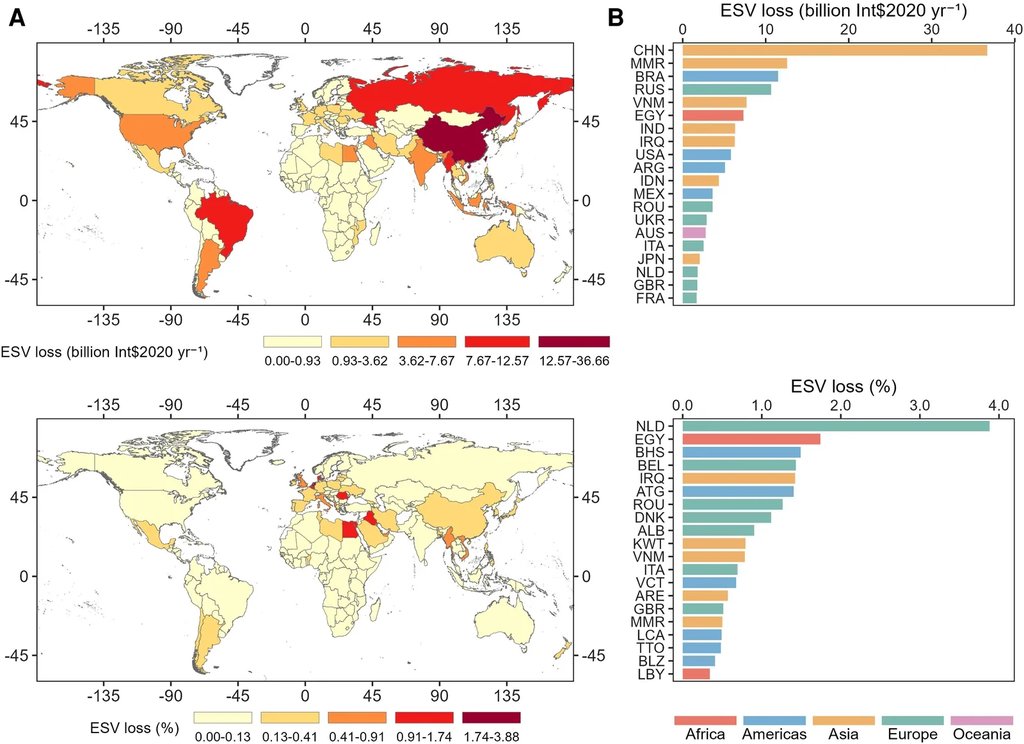
Built-up land and cropland together account for about 59% to 60% of the absolute losses in 2100 under every pathway, and that wetlands lose the largest share of their own value: 1.21% at one end of the scenario range and 2.20% at the other.
The paper reports a mismatch between who has emitted carbon and who stands to lose. The largest absolute losses fall in big countries, among them China and the United States, while small island and delta states with low historical per-capita emissions face the steepest relative declines. The authors condense that gap into an index of their own, which widens as emissions rise across the scenarios.
PNAS Nexus published the paper open access under a Creative Commons CC BY 4.0 license.
Sources
- PNAS NexusPeer-reviewed