Skip to content
See the World Through Science

NASA Photographs the 60-Foot Crater a Falcon 9 Stage Left on the Moon
Space

Republish this story

Our work is licensed under Creative Commons BY-NC 4.0. You may republish this piece for free — with credit to ALLATRA Media and a link to the original, unedited beyond length trims, and not for commercial use.

Read the full license

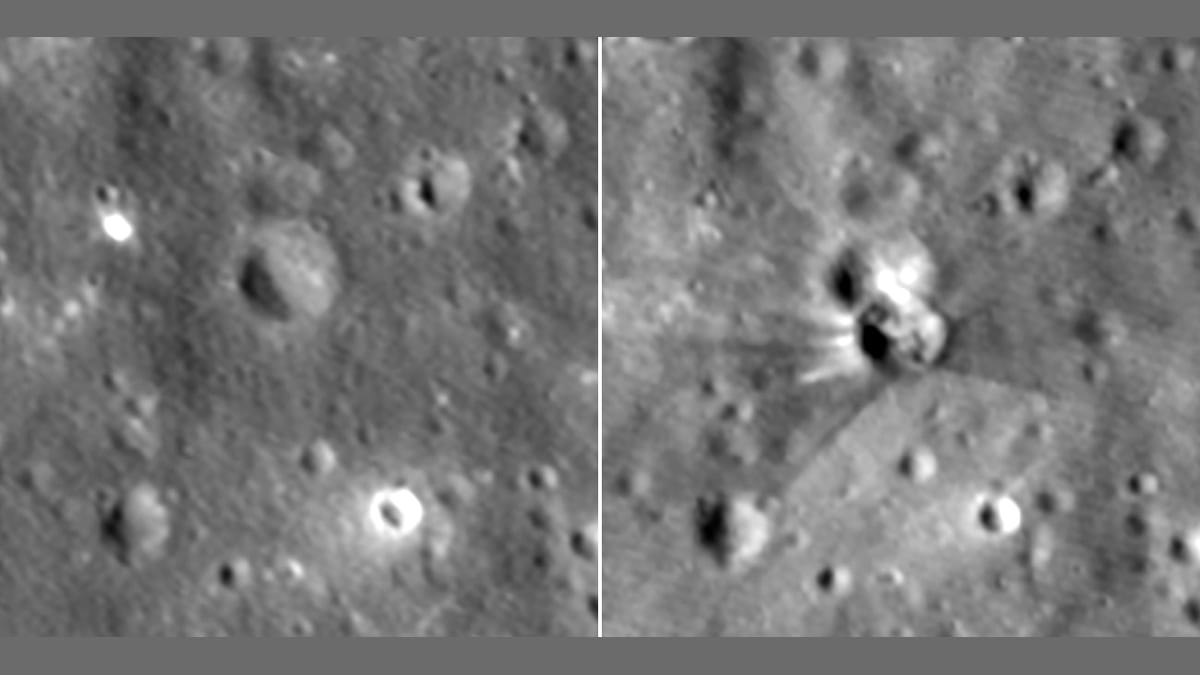
Two side-by-side Lunar Reconnaissance Orbiter Narrow-Angle Camera views of the same patch of grey lunar surface: on the left the ground before the impact, on the right the same ground with a small new crater at its centre and dark streaky rays fanning outward around a bright wedge of ejecta.
The image the news is about: NASA's Lunar Reconnaissance Orbiter Narrow-Angle Camera on the same ground before the impact (left) and after it (right), with the new 60-foot Falcon 9 crater at centre and its dark and bright ejecta rays. Frames M1370003265R and M1541091337R.LROC NAC frames M1370003265R and M1541091337R, NASA/GSFC/Arizona State University · LROC-Terms-of-Use

NASA's Lunar Reconnaissance Orbiter has photographed the crater left when a spent Falcon 9 upper stage struck the Moon on Aug. 5. The crater measures about 60 feet across.

The orbiter imaged the site on Aug. 11 and 12. Based on the shadows inside it, the crater is less than 10 feet deep, centered at 19.4759 degrees north, 266.7138 degrees east, at an elevation of 511 meters. The orbiter's Narrow-Angle Camera can pick out features as small as 3 feet.

NASA identified the impactor as the Falcon 9 upper stage left over from the January 2025 launch of the Blue Ghost 1 lunar lander.

Until the pictures came back, the impact point was known only from tracking predictions. NASA said the imaging validated its impact-prediction tools, which had placed the impact within about 0.6 miles of where the crater turned out to be.

Rays of thrown-out material surround the crater, some darker than the surrounding ground and some brighter. NASA reads the darker rays as dust and rock from roughly the top 1.5 feet, altered over long periods by solar wind, galactic cosmic rays and micrometeorite impacts, and the brighter streaks as fresher material dug from farther down.

Getting the shot took precise timing. NASA said that if the camera had fired 10 seconds early or 10 seconds late, the target would have drifted 10 miles off center.

Sources

Spot an error?

Spot an error?

Report an error

Spotted a mistake on this page? Tell us what's wrong and our editors will take a look.

What kind of problem?

Only if you'd like us to be able to follow up. We won't use it for anything else.

We correct mistakes openly. Select any text to flag it. Fixes are logged under our Corrections Policy.

Report an error

Reporting on

NASA Photographs the 60-Foot Crater a Falcon 9 Stage Left on the Moon

What kind of problem?

Only if you'd like us to be able to follow up. We won't use it for anything else.

We read every report. Corrections are logged publicly.