Webb Telescope Catches Early Galaxies Blowing Heavy Elements Into Space
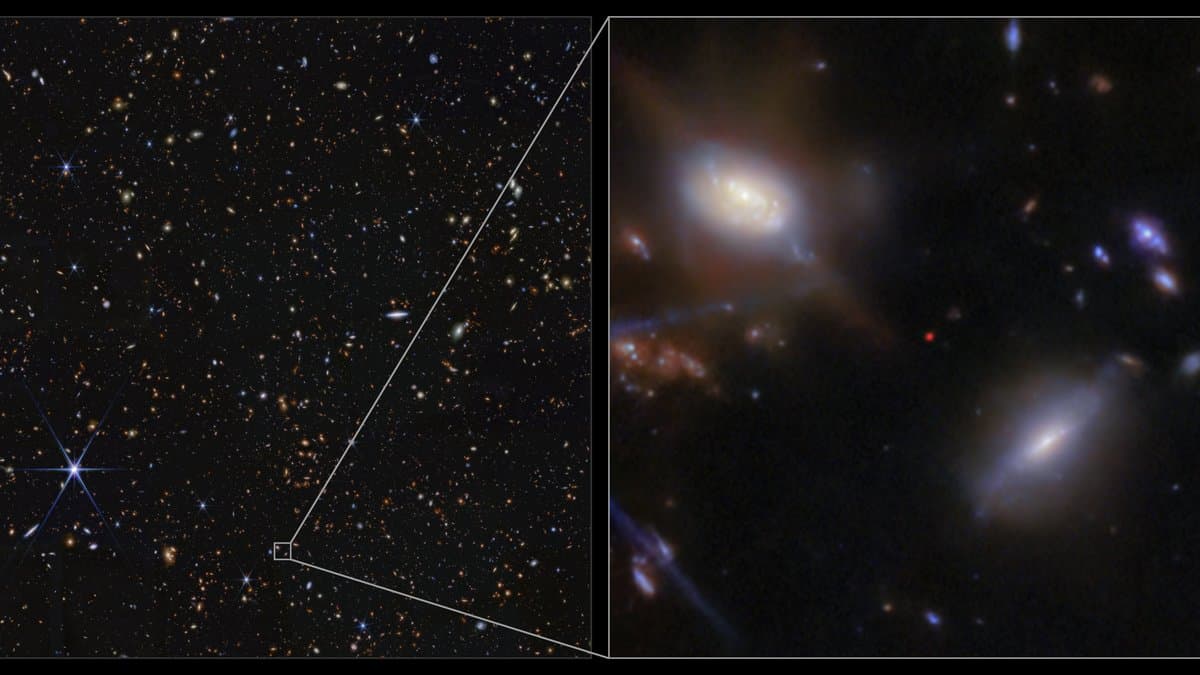
Oxygen, carbon and silicon were already streaming out of galaxies when the universe was only a few hundred million years old, according to a study published Sept. 24 in the journal Nature Astronomy. Yongda Zhu of the University of Arizona and colleagues used NASA's James Webb Space Telescope to detect the gas around three young galaxies.
In the paper, the authors report that models have long predicted galaxies should begin enriching their surroundings soon after their first stars ignite, but that direct measurements from that era are scarce. In astronomy, "heavy elements" means everything heavier than hydrogen and helium, and all of it is forged inside stars. Finding them outside a galaxy means stars there had lived, died and pushed their products into space.
The gas was found by watching how it absorbs light from the galaxy behind it. Zhu and colleagues report that the absorption is blueshifted by 50 to 250 kilometers per second relative to the galaxies themselves. A blueshift is the signature of gas moving toward the observer, so the team reads the offset as gas flowing out of the galaxies, or at least badly stirred up. The elements show up in both neutral and ionized forms.
The three galaxies sit at redshifts of 7.2 to 9.3. Redshift measures how much the expanding universe has stretched a galaxy's light on its way here. A higher number means an earlier galaxy. That puts all three before the midpoint of reionization, when ultraviolet light from the first stars stripped electrons off the hydrogen between galaxies and made the universe transparent.
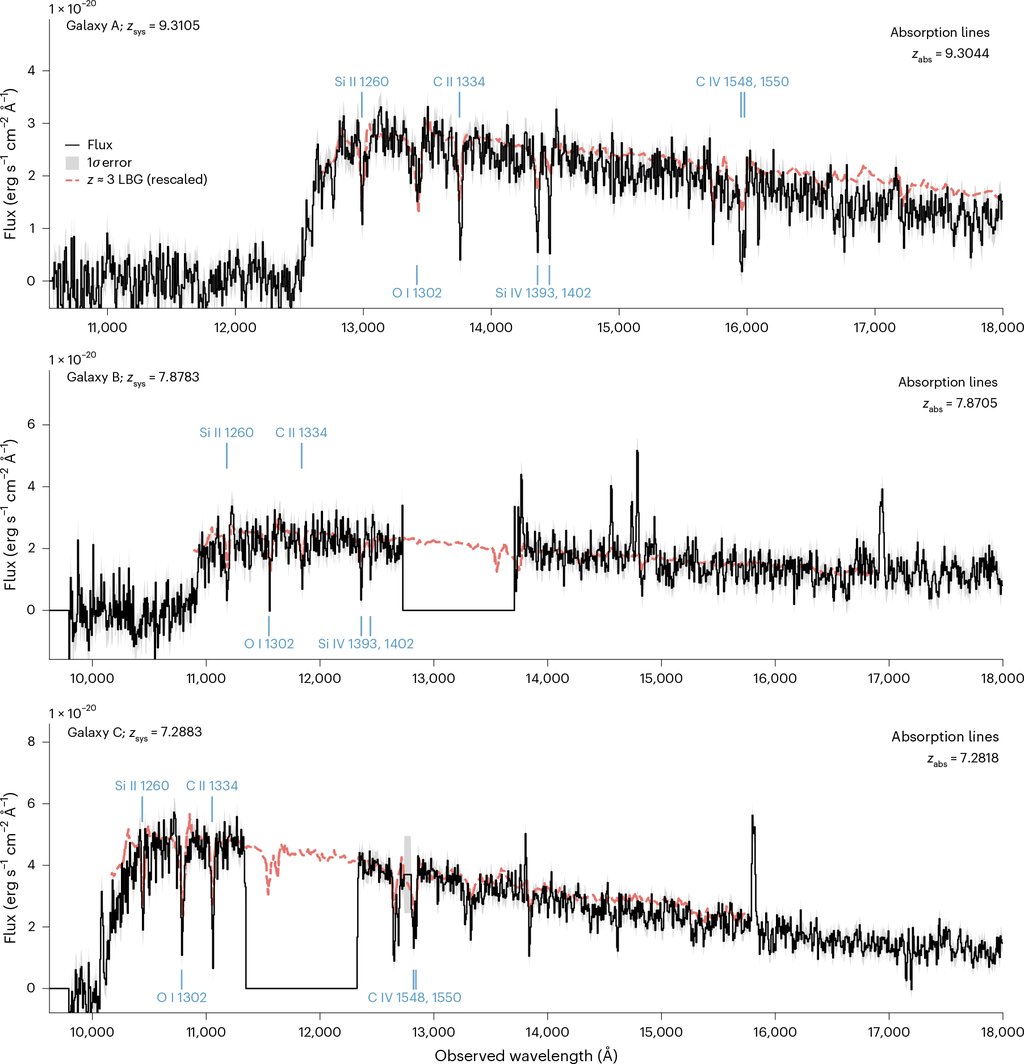
The University of Arizona said in its announcement that the galaxies are seen as they were about 500 million years after the Big Bang. Zhu searched publicly available JWST spectra of hundreds of galaxies by hand in a single night, and it took nearly 30 hours of exposure to pull out the faint lines.
"We observed that heavy elements escaped from galaxies very, very early in cosmic time," Zhu said in the announcement. "Not only were the galaxies producing these elements, but they were also dispersing them, possibly seeding other galaxies."
The university's release also raises the possibility that early enrichment explains why nobody has found a Population III star, the theoretical first stars, formed from pure hydrogen and helium. If galaxies were already spreading heavy elements that early, the release argues, pristine gas may not have survived long enough for anyone to catch it.
Sources
- Nature AstronomyPeer-reviewed
- news.arizona.edu