Skip to content
See the World Through ScienceA project of ALLATRA
Source: Peer-reviewedPhysical Review Letters2 sources

A Code-Breaking Method Found a Pulsar Hiding in 15 Years of NASA Data
Space

Republish this story

Our work is licensed under Creative Commons BY-NC 4.0. You may republish this piece for free — with credit to ALLATRA Media and a link to the original, unedited beyond length trims, and not for commercial use.

Read the full license

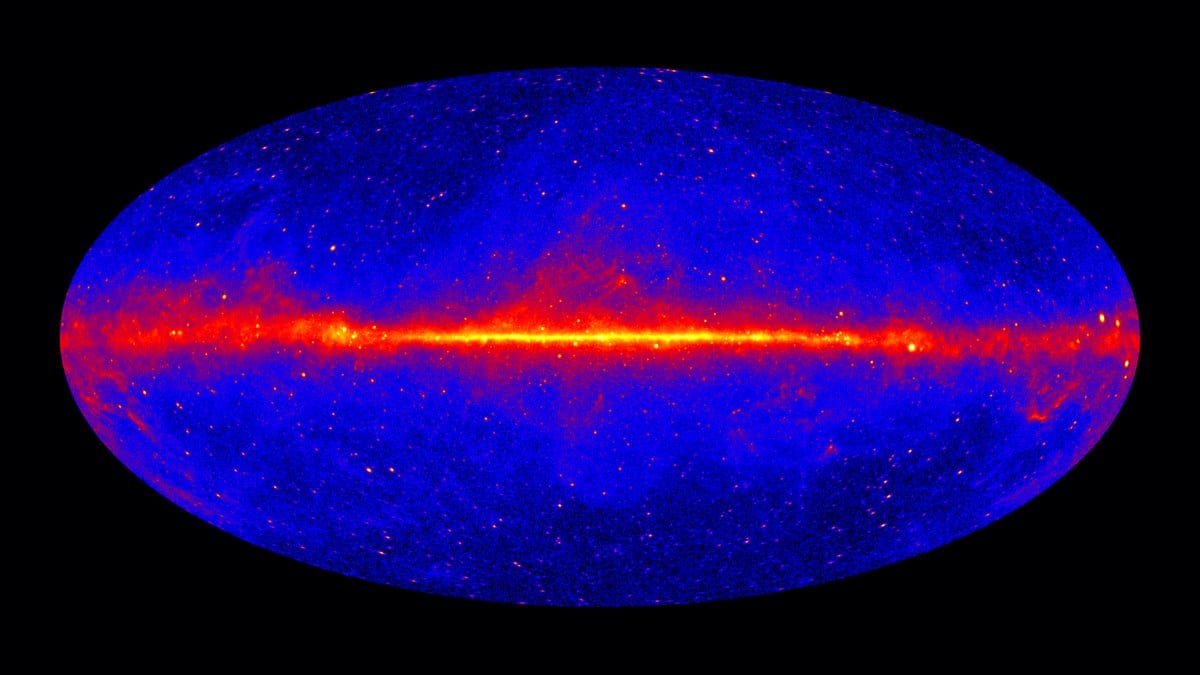
The whole sky seen in gamma rays, an oval map in which the plane of the Milky Way runs across the center as a bright red and yellow band on a deep blue background, with individual sources showing as small yellow points.
The method that found PSR J1622-7204 searched this archive: every photon the Large Area Telescope collected over 15 years. Small yellow points are individual sources, and the band across the middle is our own galaxy."Fermi's 15-year View of the Gamma-Ray Sky (SVS14976 - ait 180m gt1000 psf3 gal 0p1)" by NASA's Scientific Visualization Studio - NASA/DOE/Fermi LAT Collaboration, via Wikimedia Commons, Public domain

A team of astronomers has found a pulsar in NASA's public gamma-ray archive that the previous best search method had failed to find, using an approach borrowed from code-breaking mathematics. PSR J1622-7204, an isolated neutron star spinning 261 times a second, turned up in 15 years of data from NASA's Fermi Gamma-ray Space Telescope after about ten CPU hours.
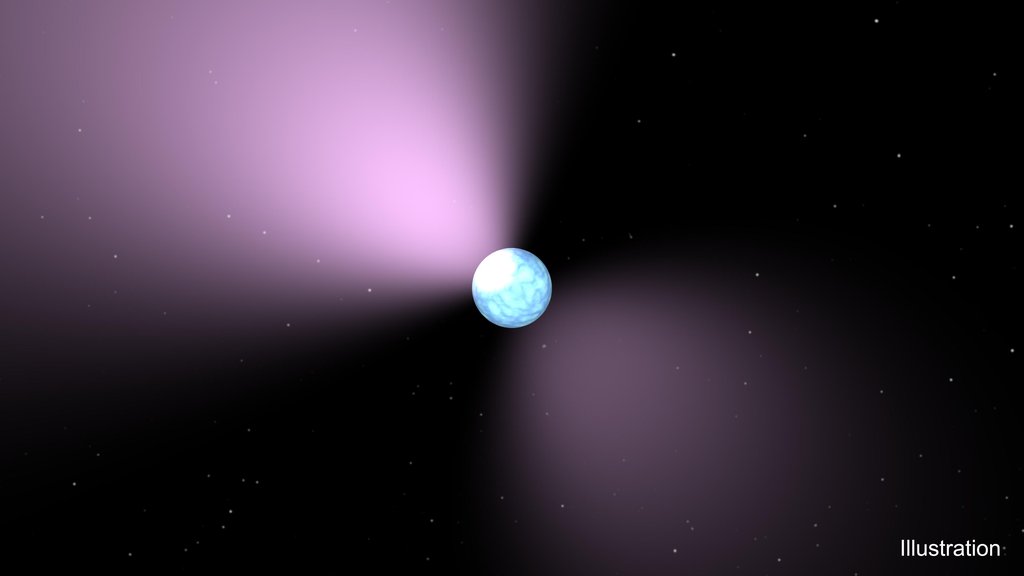
An illustration of a small blue-white neutron star with broad cones of pale purple light streaming away on opposite sides, set against a sparse star field.
A spinning neutron star sweeps beams of radiation across space, and a detector sees a pulse each time one crosses Earth (illustrative). The star reported here turns 261 times a second. "PIA21085 - Pulsar Artist's Concept" by NASA/JPL-Caltech, via Wikimedia Commons, Public domain

The authors, writing in Physical Review Letters, say the method may turn up many more gamma-ray pulsars, including ones orbiting a companion star, a case they describe as out of reach until now unless the orbit was already known.

Nothing new was observed — the data have been public for years, and what changed is the search. Finding a gamma-ray pulsar means guessing its spin rate, how fast that spin is slowing, and where it sits in the sky, all at once. "We have a four-dimensional grid, and we must search each direction with millions of trials in it," said lead author Daniel Pook-Kolb of the Max Planck Institute for Gravitational Physics.

Dotan Gazith and Barak Zackay, both at the Weizmann Institute of Science, recast that search as a geometry problem: finding the shortest vector in a high-dimensional lattice, a regularly spaced array of points. Those algorithms come from cryptographers trying to break encryption designed to resist quantum computers. "We have nothing to do with cryptography in our analysis here, but those algorithms can help us solve the problem of searching for pulsars in our data," Gazith said in NASA's release.

The paper reports that the earlier attempt ran for roughly 600 CPU years without finding it. NASA's release puts the gain at about a million times faster than before, and notes that conventional searches, run on computing time donated by volunteers, have typically needed the equivalent of hundreds of computer-years to find one pulsar.
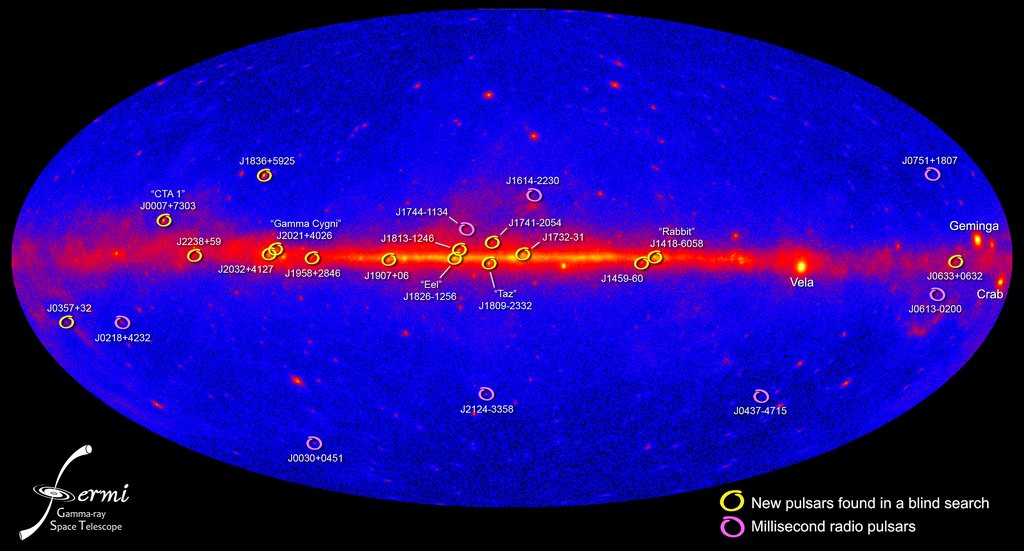
An oval gamma-ray map of the whole sky with about two dozen pulsars circled and labeled by catalog name, and a legend separating new pulsars found in a blind search from millisecond radio pulsars.
Each circle marks an earlier find in the same archive, labeled with its catalog name; the yellow ones came out of blind searches. The map dates from 2009, when the tally stood at about two dozen. "Fermi's Gamma-ray Pulsars" by NASA/DOE/Fermi LAT Collaboration, via Wikimedia Commons, Public domain

Colin Clark, a co-author at the Max Planck Institute, said tens or perhaps hundreds of pulsars are probably still hidden in the same data, and that the team will next run the algorithm on the volunteer computers of the Einstein@Home project.

Sources

Spot an error?

Spot an error?

Report an error

Spotted a mistake on this page? Tell us what's wrong and our editors will take a look.

What kind of problem?

Only if you'd like us to be able to follow up. We won't use it for anything else.

We correct mistakes openly. Select any text to flag it. Fixes are logged under our Corrections Policy.

Report an error

Reporting on

A Code-Breaking Method Found a Pulsar Hiding in 15 Years of NASA Data

What kind of problem?

Only if you'd like us to be able to follow up. We won't use it for anything else.

We read every report. Corrections are logged publicly.