JWST Reads Three Weather Patterns on a Starless Brown Dwarf
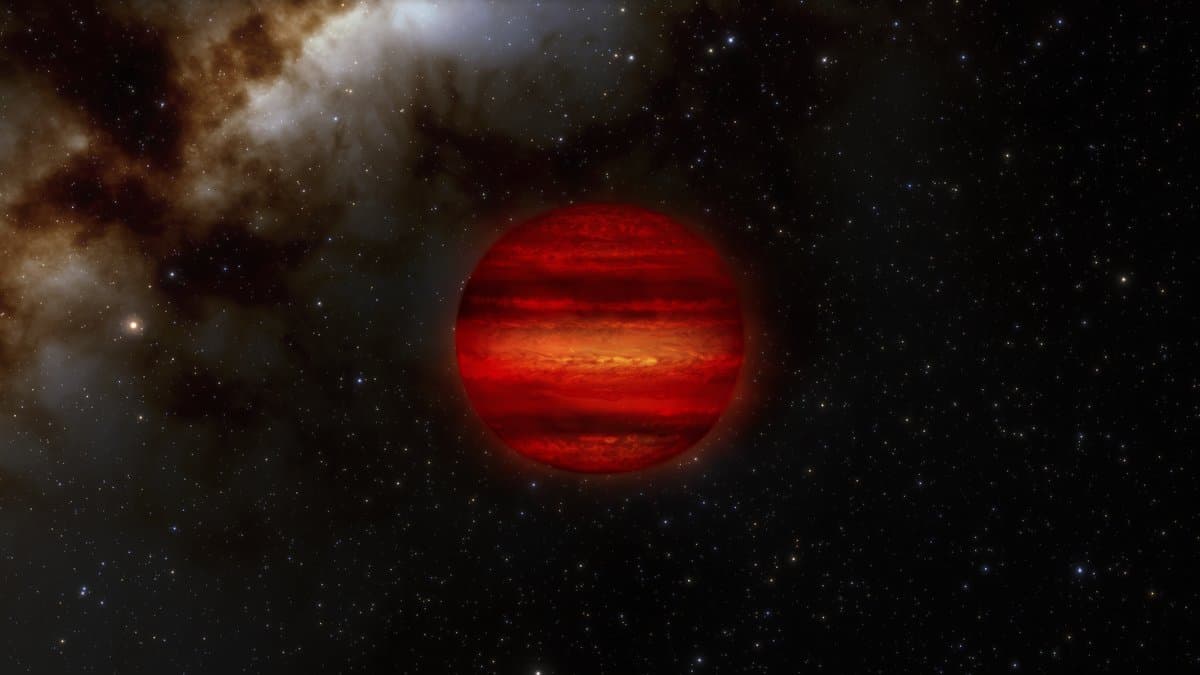
Astronomers at Trinity College Dublin used NASA's James Webb Space Telescope to track one full rotation of SIMP J013656.5+093347, a free-floating brown dwarf that orbits no star, and applied principal component analysis to break down how its atmosphere changes over time.
The work, published Sept. 16 in Astronomy & Astrophysics, offers researchers a model-independent tool for reading the atmospheres of substellar objects, including analogues of directly imaged exoplanets.
Merle A. Schrader, Johanna M. Vos and colleagues analyzed JWST/NIRSpec PRISM time-series spectra covering one rotation of the object, known as SIMP 0136 and classified as a young T2.5 brown dwarf near the planetary-mass boundary. The team applied principal component analysis, a statistical technique that extracts the smallest set of independent patterns that account for the variation in the data. Two components were sufficient to reduce the residuals to the noise floor: two dominant signals capture essentially all the detectable variation.
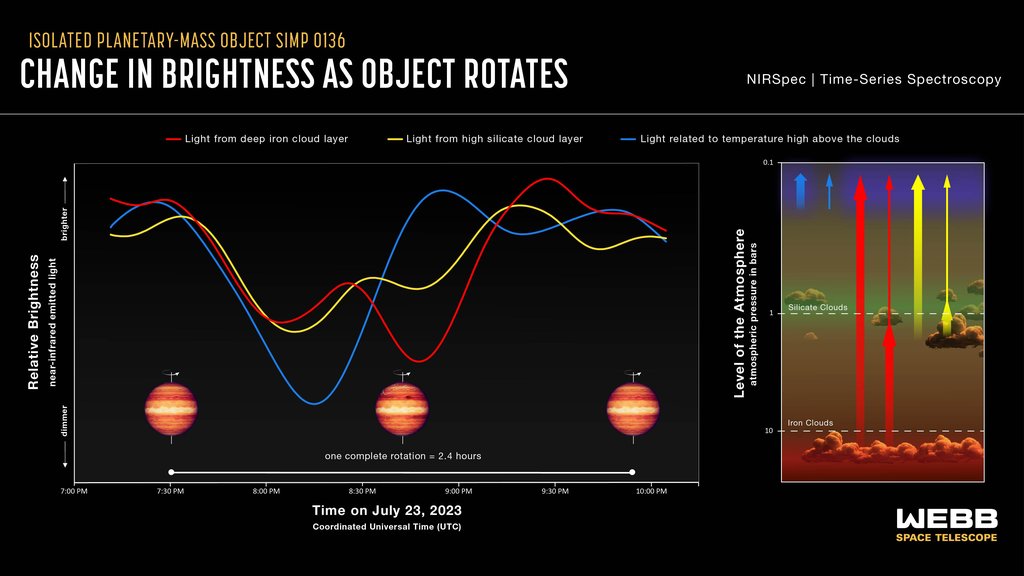
The first component tracks broadband brightness changes, which the paper links to temperature shifts. The second traces color-dependent variation tied to the vertical structure of clouds. The authors report that the existence of just two dominant components means the observed spectra can be described as mixtures of three distinct atmospheric states: the statistical endpoints implied by the two-component system. They mapped how much each state contributes as the object rotates, showing that the spectrum shifts because different surface regions rotate in and out of view.
As a check, the team projected the Sonora Diamondback atmospheric model grid into the same component space and found the mathematical patterns matched, indicating the same physical processes drive both the model and the observations.
SIMP 0136 has long served as a stand-in for directly imaged exoplanets because it is young, free-floating, and shows strong atmospheric variability. Schrader, Vos and colleagues write that PCA provides a computationally efficient, physically interpretable approach to analyzing JWST time-resolved spectra of similar objects.