A Giant Planet's Evening Edge Runs About 650 K Hotter Than Its Morning
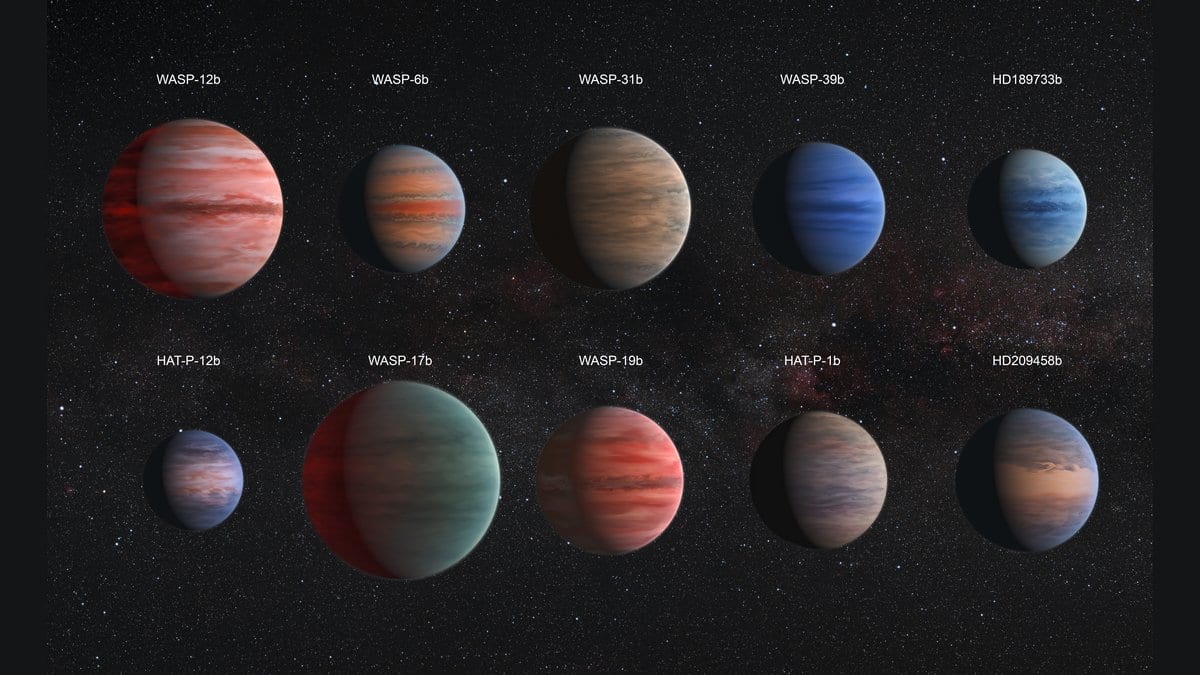
Astronomers have mapped the thin ring of atmosphere at the edge of a giant planet angle by angle, and measured the side turning into evening about 650 K hotter than the side turning into morning. Lili Alderson of Cornell University and the University of Bristol and colleagues published the result Oct. 14, 2026, in Nature Astronomy.
The planet, WASP-17 b, keeps one face permanently toward its star, and simulations of how such planets carry heat predict such a gap between the edge rotating into daylight and the edge rotating into night. Earlier observations averaged the whole rim into one spectrum, a single reading of the starlight filtering through it, which left the gap unmeasured. The authors report that their map hands those simulations a profile to be checked against.
Working from archival JWST transits, the team extracted a separate spectrum at individual angles around the rim, in steps as fine as 20 degrees and across wavelengths from 0.6 to 12 micrometers. The temperature retrieved for the morning edge is 858 K and for the evening edge 1,522 K. The morning value is much the looser of the two, spanning several hundred degrees: the colder morning air leaves shallower features to measure.
Water and carbon dioxide stay at roughly constant amounts around the rim, while the temperature does not. The transits were recorded in March 2023 with three JWST instruments and had already been analyzed as one averaged spectrum. What changed is the fitting. Transmission strings, developed by David Grant and Hannah R. Wakeford of the University of Bristol, fit a non-circular outline to the planet's silhouette, so the radius, and with it the spectrum, can change with angle.
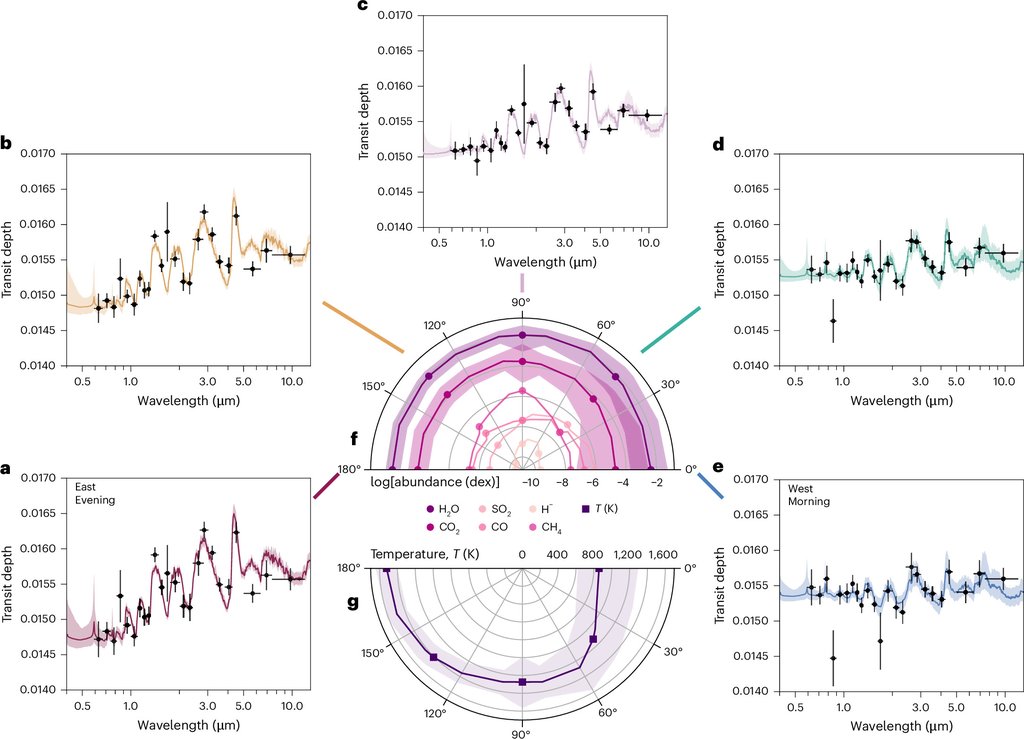
The paper notes that the contrast is larger than those reported for three cooler planets measured with earlier methods that split the rim in two, and that the temperatures agree with two other readings of the planet: its night side in emission and its day side mapped during eclipse.
The authors write that more mid-infrared observations of the planet are scheduled, which should sharpen the longest-wavelength end of the map.
Sources
- Nature AstronomyPeer-reviewed
- www.bristol.ac.uk