Coffee-Cup Plastic Intake Is 42 Times Below the Lab Dose That Burst Blood Cells
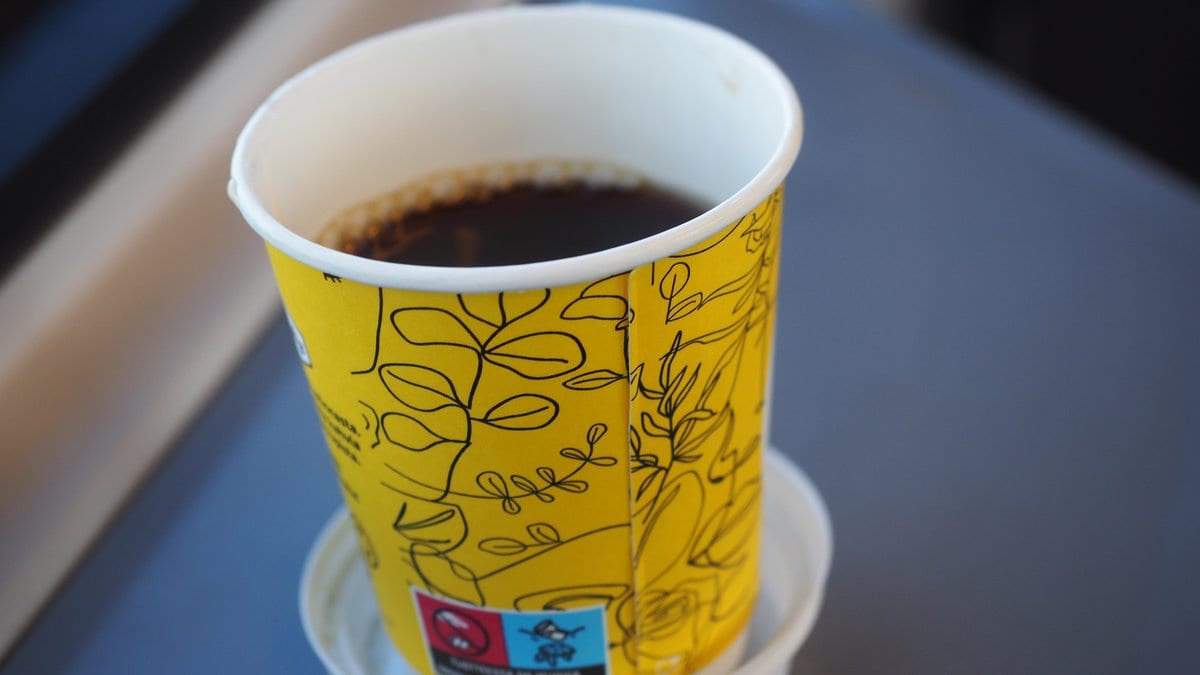
Researchers at the University of Nebraska-Lincoln made plastic particles from the liners of real disposable coffee cups, then set what a person swallows in a day against the doses that damaged cells in the laboratory. The estimated intake came out about 42 times below the lowest concentration tested on red blood cells, a level that already burst them.
Most laboratory work on plastic particles uses manufactured spheres, because particles from a real cup liner are hard to make in the amounts a toxicity test needs. The study, published Nov. 4, 2026, in Microplastics and Nanoplastics, pairs particles from the real material with a measured estimate of intake. The authors put world use of plastic-lined paper cups at 250 billion to 300 billion a year.
Olivier Irumva, Yusong Li and colleagues shaved particles off cup liner film with ultrashort laser pulses, producing irregular polyethylene fragments, more than 80% of them smaller than 500 nanometers and closely matching in shape and size what hot water releases from a cup.
In cultured human kidney cells, survival fell as dose and exposure time rose but stayed above 50% across the full range tested. In mouse red blood cells, bursting passed the standard ASTM test method's threshold at every concentration tested, and depended mostly on exposure time.
Release varied with contact time, temperature, agitation and whether the cup was rinsed before use. Under the highest-release case (vigorous shaking), the group estimates an intake of about 274 billion particles smaller than 1 micrometer per person per day, equivalent by mass to roughly 0.37 micrograms per milliliter of drink, below every concentration tested on cells.
The comparison cannot be translated directly into a safety margin or tissue-level risk, because a swallowed drink and a dose applied to cells in a dish are different exposure scenarios. They also say mass may not be the governing measure of dose for particles this small, and that long-term low-dose exposure and cumulative intake remain uncharacterized.
The work was funded by the US National Institute of Environmental Health Sciences and the University of Nebraska-Lincoln's Grand Challenge Program.
Sources
- Microplastics and NanoplasticsPeer-reviewed