JWST Survey Catches Planet-Forming Disks Changing How They Lose Gas
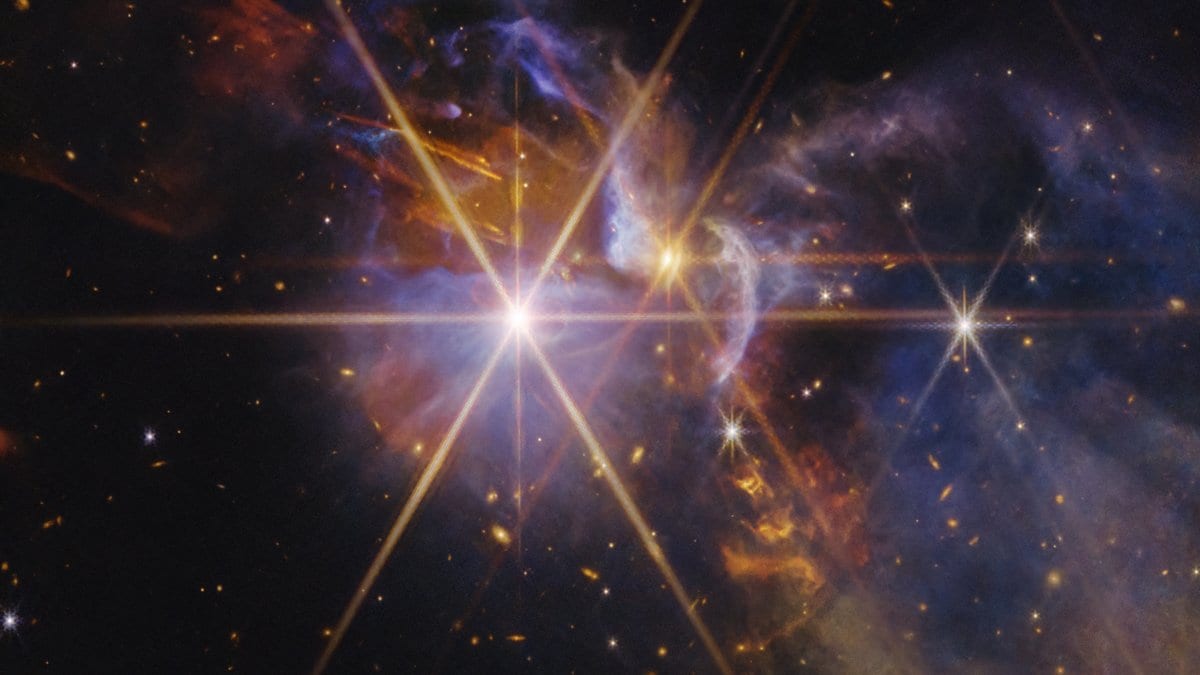
Astronomers have mapped the jets and winds streaming away from 72 planet-forming disks and report that the outflows shift from molecular to atomic as the star draws in less material. The survey, built from archived observations by the James Webb Space Telescope, was published Aug. 25 in The Astronomical Journal by a team led by Naman S. Bajaj and Ilaria Pascucci of the University of Arizona.
The team reanalyzed data from JWST's Mid-Infrared Instrument, which can separate light by both position and wavelength, for 72 disks tilted more than 40 degrees to our line of sight. Extended emission from molecular hydrogen, from ionized neon, or from both was detected around 66 of them.
Applying a method they developed to sort the shapes, the authors identify cone-shaped molecular hydrogen winds around 46 disks and fast neon jets, running perpendicular to the disk, around 40. Every disk with a neon jet also showed a wind, traced by molecular hydrogen in 85% of those cases and otherwise by atomic oxygen.
How often jets and molecular winds turn up rises with the rate at which the star is pulling in material, and shows no dependence on the tilt of the disk or the mass of the star, according to the paper. Slower, barely resolved neon winds appear preferentially around the stars accreting least. Among disks with molecular hydrogen winds the hotter components drop off faster than the cooler one as accretion falls.
Compared against high-resolution spectroscopy of atomic oxygen at 6300 angstroms, extended molecular hydrogen winds show up mainly around stars taking in more than about 10 to the minus 8.5 solar masses a year, while below that only atomic winds are seen.
The authors' conclusion is that atomic jets and mixed atomic and molecular winds, consistent with being launched by magnetic fields threading the disk, dominate the early, actively accreting phase, and that at lower accretion rates the jets weaken and the winds become mostly atomic.
Sources
- The Astronomical JournalPeer-reviewed