Europe's Juice Probe Borrows a Push From Earth on Its Way to Jupiter
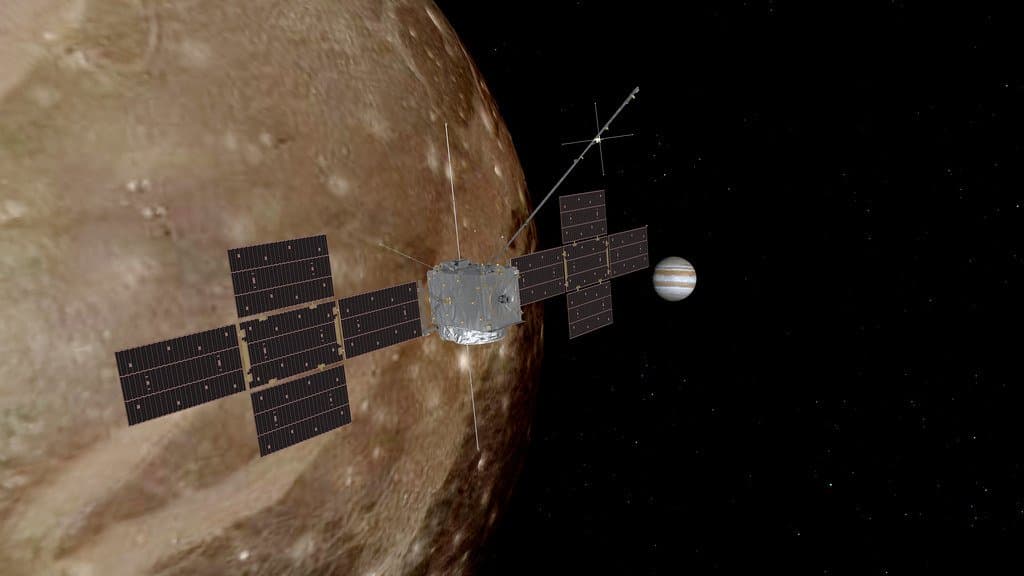
The European Space Agency's Jupiter Icy Moons Explorer, Juice, skimmed the outer edge of Earth's atmosphere on Sept. 28, 2026, passing 8,640 kilometers above the Indian Ocean at 11:45 UTC and using the planet's gravity to bend its course toward Jupiter.
ESA reports the pass turned Juice 20 degrees off its previous heading and added 3.5 kilometers per second to its speed. That is what a gravity assist does: the spacecraft falls past a planet and leaves on a new course, taking a share of the planet's motion around the Sun instead of burning fuel for it. The fuel saved is what Juice will have left to maneuver with when it arrives at Jupiter in 2031.
ESA said its operators needed only one of the six course corrections set aside for the approach to line the spacecraft up. "Thanks to our very careful planning, we used only a small amount of the propellant reserved for this flyby," said Angela Dietz, Juice's spacecraft operations manager. "This gives us more to use at Jupiter to carry out observations of the planet's icy moons."
The agency also used the encounter to test Juice's science instruments on a target it already knows well. Claire Vallat, the mission's project scientist, said the cruise to Jupiter "provides only a few opportunities to calibrate and validate the instruments under well-understood environmental conditions."
During the flyby, Juice spent several days crossing Earth's magnetotail, the part of the planet's magnetic field that trails away from the Sun, measuring magnetic fields and charged particles far from Earth. ESA said the European-Chinese Smile mission was watching the northern lights and taking similar measurements close to the planet at the same time, and that images and spectra from some of Juice's instruments will be published in the coming weeks.
One more Earth flyby, in January 2029, will put Juice on its final track to Jupiter.