Quasar Light Reveals Where a Black Hole's Jets Reach Into Its Galaxy's Gas
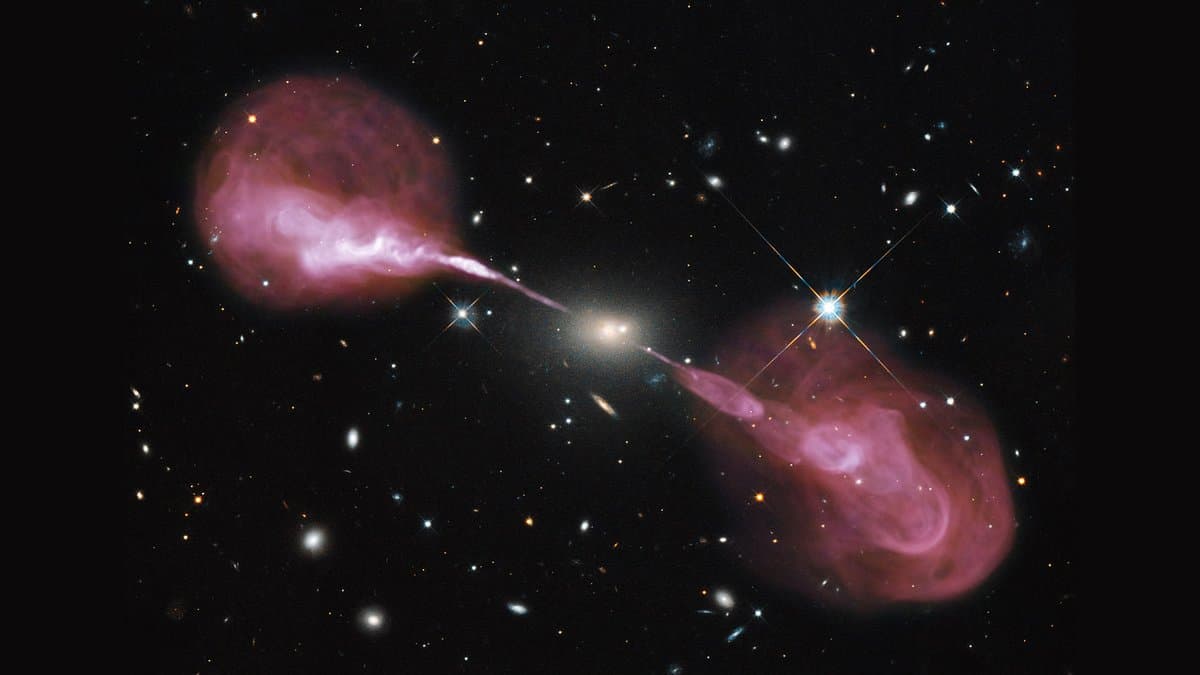
Hydrogen gas around radio galaxies glows only inside the narrow cone their black hole jets point along, and nowhere else in the same halos. Namrata Roy of Arizona State University and the Raman Research Institute, along with colleagues, report the measurement in The Astrophysical Journal Letters, published online Sept. 24.
The paper asks how the activity of a galaxy's central black hole changes the circumgalactic medium, the thin gas surrounding a galaxy, and it tests whether that effect depends on direction. What the stacking finds is direct evidence that a jet disturbs the gas reservoir around its own galaxy.
Gas this faint cannot be imaged one galaxy at a time, so the team stacked spectra of background quasars recorded by the Dark Energy Spectroscopic Instrument (DESI). Those are distant bright sources whose light crosses a nearer radio galaxy's halo on its way here, and for each sight line the authors kept track of the angle to the radio jet's axis. Within 20 degrees of that axis the stacked H-alpha signal (light given off by hydrogen) rises above 5σ, roughly 100 times brighter than ordinary halos. Averaged over all 324 sight-line angles, the same data show no detection at all, below 2σ.
The aligned signal is also uneven with distance: strongest just beyond the region that holds half the host galaxy's light, and rising again near the radio lobes. Magnesium absorption along the same sight lines shows no difference between jet-aligned and off-axis directions.
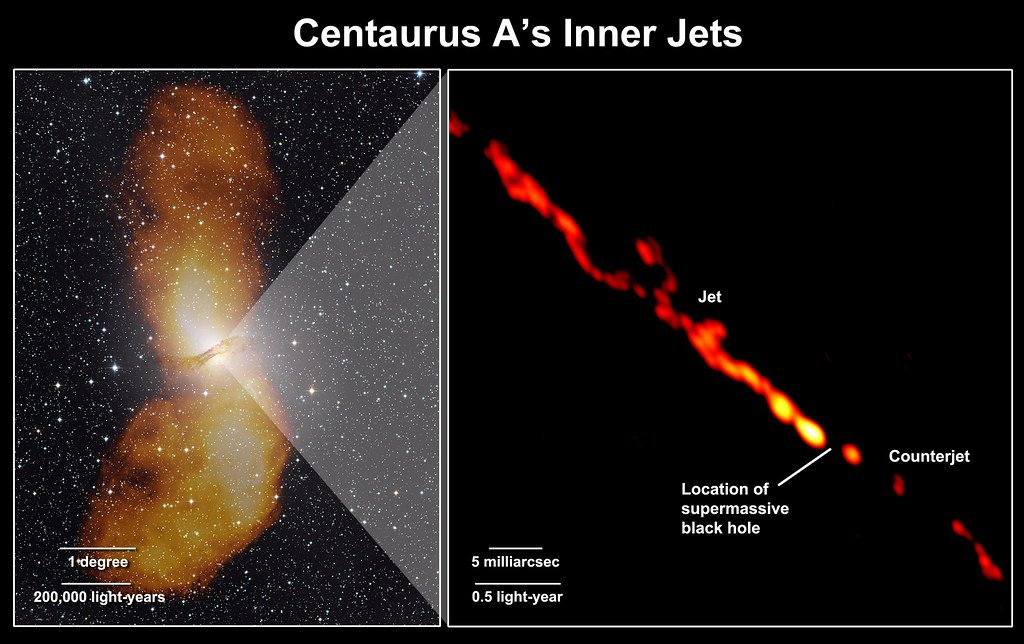
Roy and colleagues read that split as two things being seen at once: magnesium tracing the clumpy gas reservoir already in place, and the hydrogen glow coming from small pockets whose density, pressure or ionization the jet has raised as it drives through. Their conclusion goes no further than that: clear evidence of a local interaction between jet and surrounding gas in radio-jetted galaxies.
The letter is open access under a Creative Commons BY 4.0 license, and lists Arizona State University as the funder of the work.
Sources
- The Astrophysical Journal LettersPeer-reviewed