Uranus and Neptune May Not Have the Magnetic Fields Voyager 2 Measured
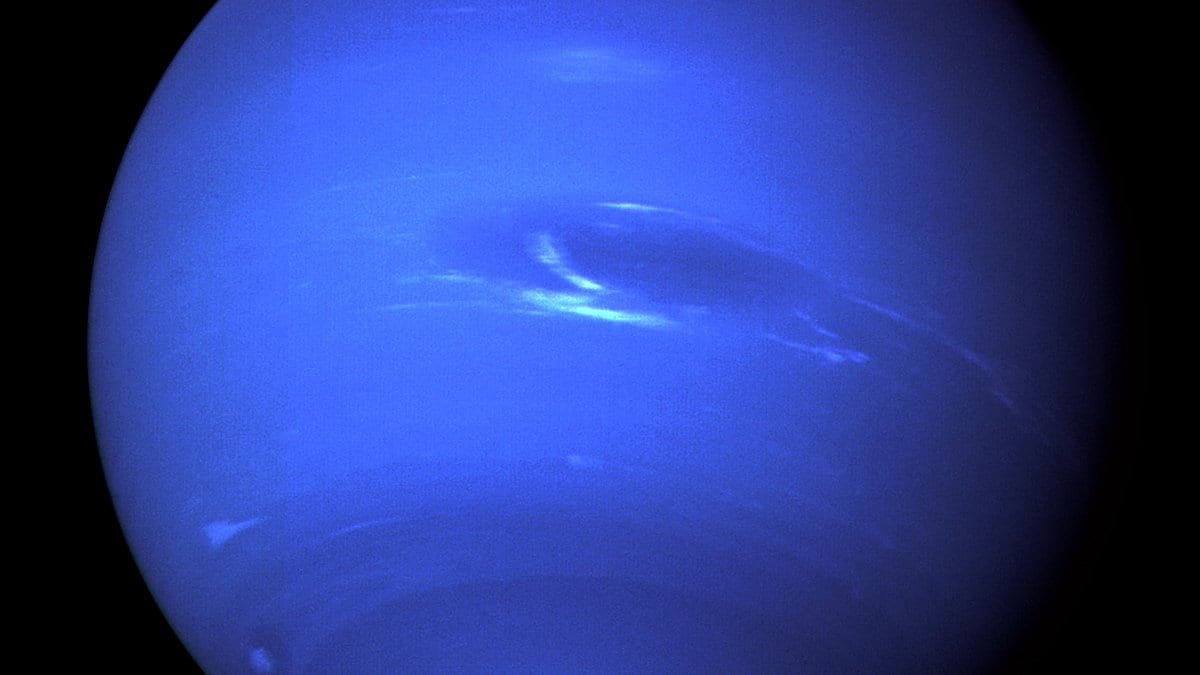
Simulations of the electrically conducting fluid deep inside Uranus and Neptune reproduce the lopsided magnetic fields Voyager 2 measured there, if the fluid's conductivity climbs with depth. A team led by Chi Yan and Krista M. Soderlund of the University of Texas Institute for Geophysics reports the result in Communications Physics. The authors write that earlier ice giant dynamo models left that variation out.
The paper, published Nov. 3, 2026, ties the result to two problems: a field that has shifted since the 1980s would change how astronomers read the planets' auroras, and would feed into planning for future missions there.
Most planetary fields look like a bar magnet near the spin axis. The University of Texas at Austin release puts Earth's magnetic tilt at nearly upright, Uranus' at 59 degrees from its rotation axis and Neptune's at 47.
The team ran its simulations with conductivity constant across the dynamo region, then with it rising toward the center. The constant runs produced ordinary single-pole fields that never reversed. Once conductivity rose with depth, the fields broke into several poles, lost their symmetry about the spin axis and flipped at irregular intervals, in every interior shape tested. The authors caution that the pattern is not unique to the ice giants and does not by itself establish that this is what the planets do.
The simulated fields also move: in one run that came closest to Uranus' observed field, the magnetic tilt shifted 84 degrees over 40 years. "Earth's magnetic tilt drifts by only a degree or so over 50 years," Yan said in the release. "In some stretches the tilt swings by tens of degrees within decades. In others it shifts only slightly over the same span." Neither planet has been measured up close more than once, so the authors write that any real change is poorly constrained.
Per the release, the group is working through James Webb Space Telescope images of the planets' auroras, whose shape could show whether the tilt has moved, and says pinning down the interiors would take new missions.
Sources
- Communications PhysicsPeer-reviewed