A Shifting Gamma-Ray Signal Is Confirmed in the Brightest Burst on Record
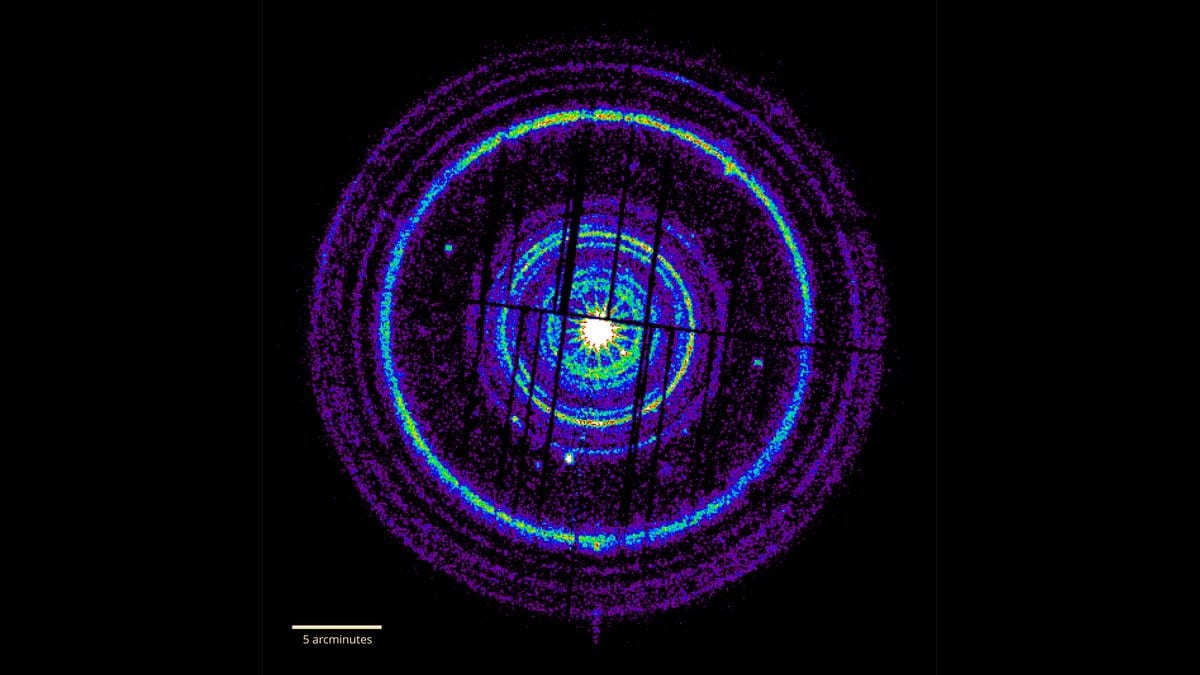
A narrow spike of gamma rays whose energy slides downward as the burst unfolds has been confirmed in GRB 221009A, the explosion of Oct. 9, 2022, that the paper calls the brightest of all time. Zhi-Qiang Ding of the Chinese Academy of Sciences and colleagues report that the spike, an emission line, falls from about 40 MeV, a few tens of millions of electronvolts, and that its brightness rises before dropping away.
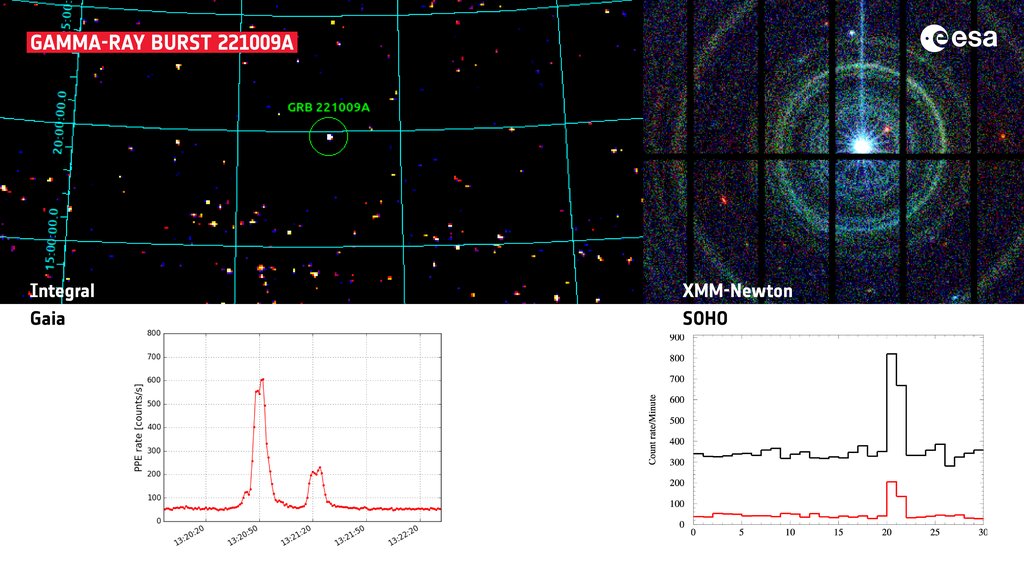
The authors say measurements in this energy band, taken while a burst is still going off, remain hard for today's gamma-ray observatories, and that is the gap the work fills. The paper, published online Nov. 12, 2026, in The Astrophysical Journal Letters, reconstructs how the burst's spread of energies changed from moment to moment, continuously from 2 to 255 MeV.
The measurements come from HEPP-H, an instrument on board the CSES-01 satellite, cross-calibrated against data from the GECAM-C detector. Both data sets were unsaturated, meaning neither instrument was overwhelmed by the burst, and the reconstruction rests on that.
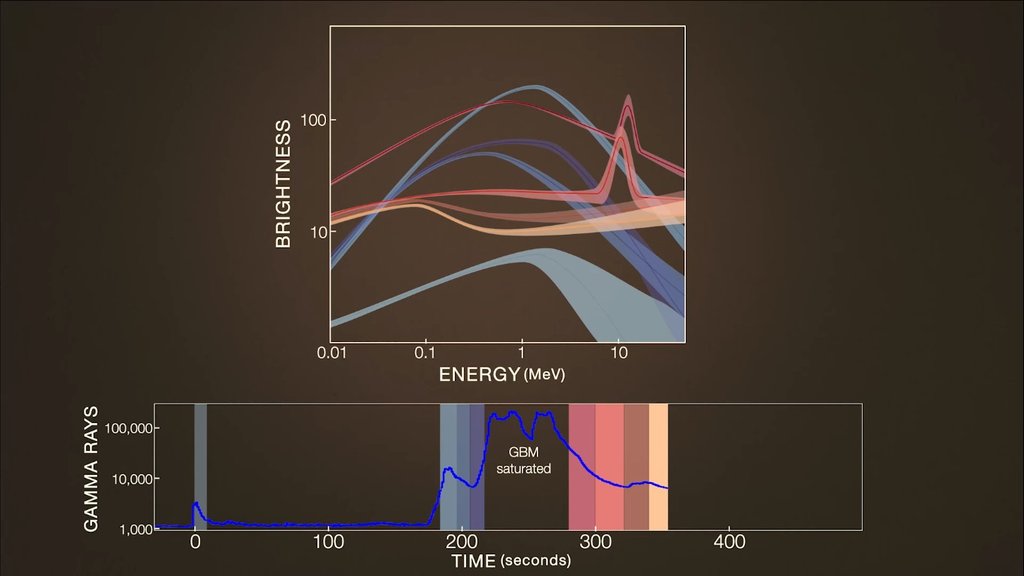
The paper's own word for the line is a confirmation, not a first detection. Its energy drops roughly in inverse proportion to the time elapsed, and the rise and fall of its brightness implies weak emission from the center of the jet, in the authors' reading.
Those features together, the authors say, hint at a jet that carries most of its energy in magnetic fields and is empty along its axis.
In the first peak of the burst's light curve, the record of how its brightness changed over time, the team also found an unusual bump near 2 MeV.
Sources
- The Astrophysical Journal LettersPeer-reviewed