Skip to content
See the World Through ScienceA project of ALLATRA
Source: PreprintarXiv1 source

A Radio Signal From a Nearby Red Dwarf, and Three Possible Sources
Space

Republish this story

Our work is licensed under Creative Commons BY-NC 4.0. You may republish this piece for free — with credit to ALLATRA Media and a link to the original, unedited beyond length trims, and not for commercial use.

Read the full license

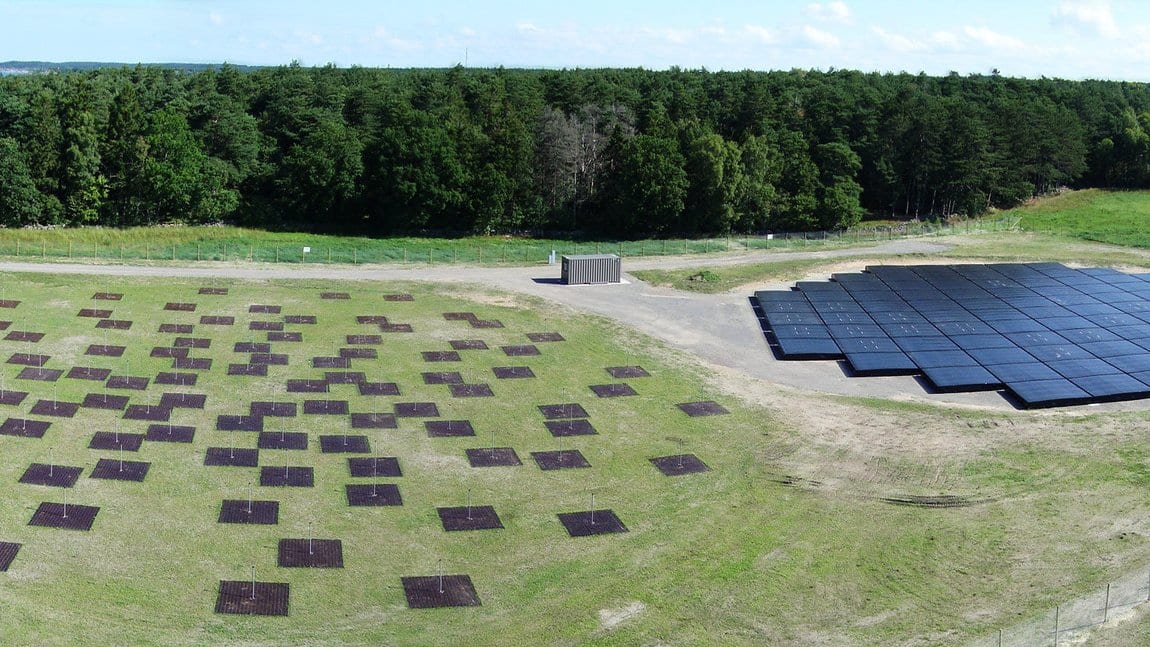
Aerial view of a LOFAR radio telescope station: dozens of low-band dipole antennas on dark mats across a grass field at left, and a block of flat black high-band antenna tiles at right.
Low-band antennas, at left, are the type that recorded the 45 megahertz signal; the tiled high-band field lies at right. Photographed July 11, 2011 (illustrative)."Onsala's LOFAR station" by onsalarymdobservatorium, via Flickr, CC BY-NC-SA 2.0

A radio survey that was not aimed at any particular star has picked up a strongly polarized signal at 45 megahertz from GJ 725A, a planet-hosting red dwarf about 11.5 light-years away. The authors report that the data cannot say whether the emission came from a planet, from the star, or from an interaction between the two.
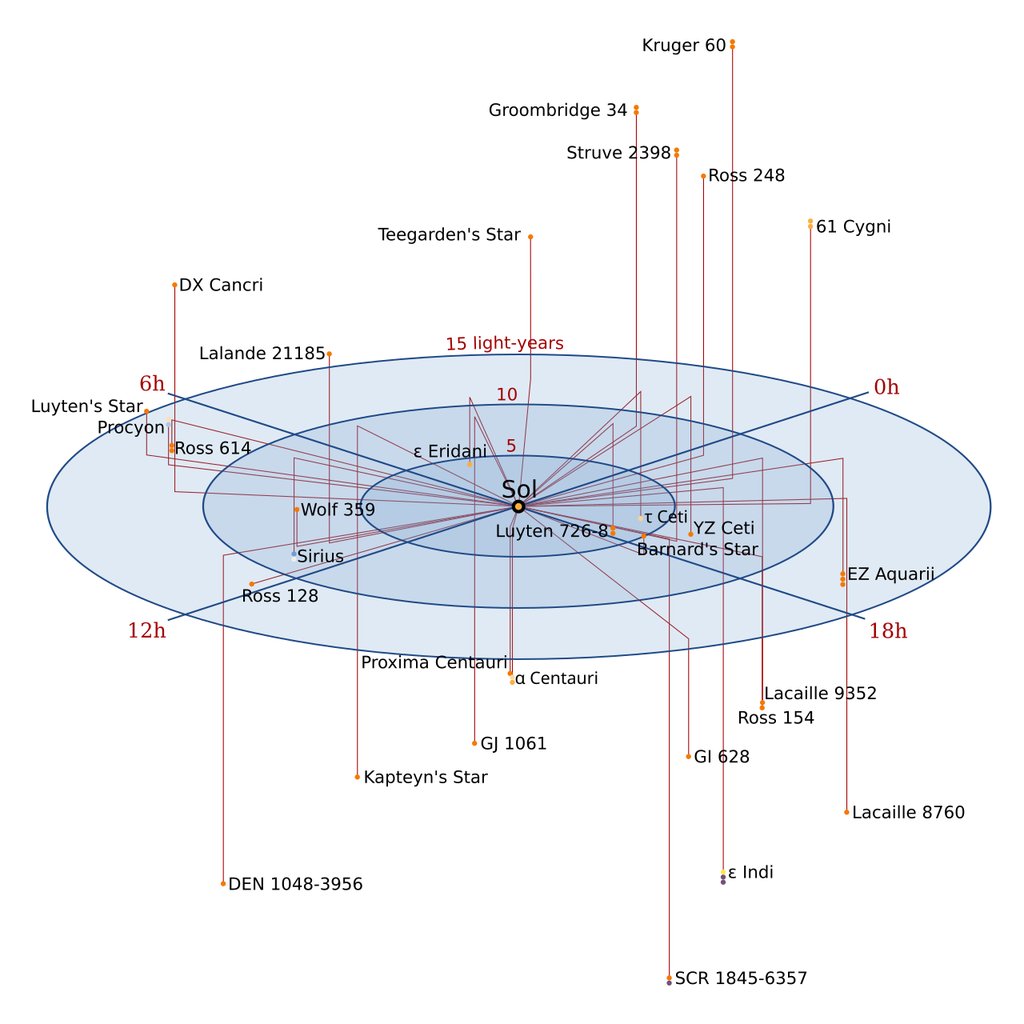
Labeled three-dimensional map of the Sun's nearest stars, with the Sun at the center of tilted blue rings marking 5, 10 and 15 light-years, and named stars on stems around it.
The Sun sits at the center of this chart of its closest neighbors. The red dwarf in this report lies about 11.5 light-years out (illustrative). "Nearby Stars (14ly Radius)" by Inductiveload, via Wikimedia Commons, Public domain

Radio waves at these low frequencies carry information about stellar and planetary magnetic fields that is hard to get at other wavelengths, the authors write in a paper accepted for publication in Astronomy & Astrophysics. No emission of this kind had been clearly detected in this band before.

The signal turned up in V-LoLSS, a search for circularly polarized sources with LOFAR's low-band antennas. It appeared in one archival observation, on Dec. 11, 2020, and in none of the others. Its peak brightness was 135 millijanskys per beam, and 74% of it was circularly polarized, meaning the waves twisted one way. Nothing was detected above 50 megahertz, a sharp cutoff.

From the brightness and polarization, the team favors the electron cyclotron maser, the process behind Jupiter's radio aurorae. The cutoff puts the field in the emitting region at about 18 gauss, close to Jupiter's surface field.
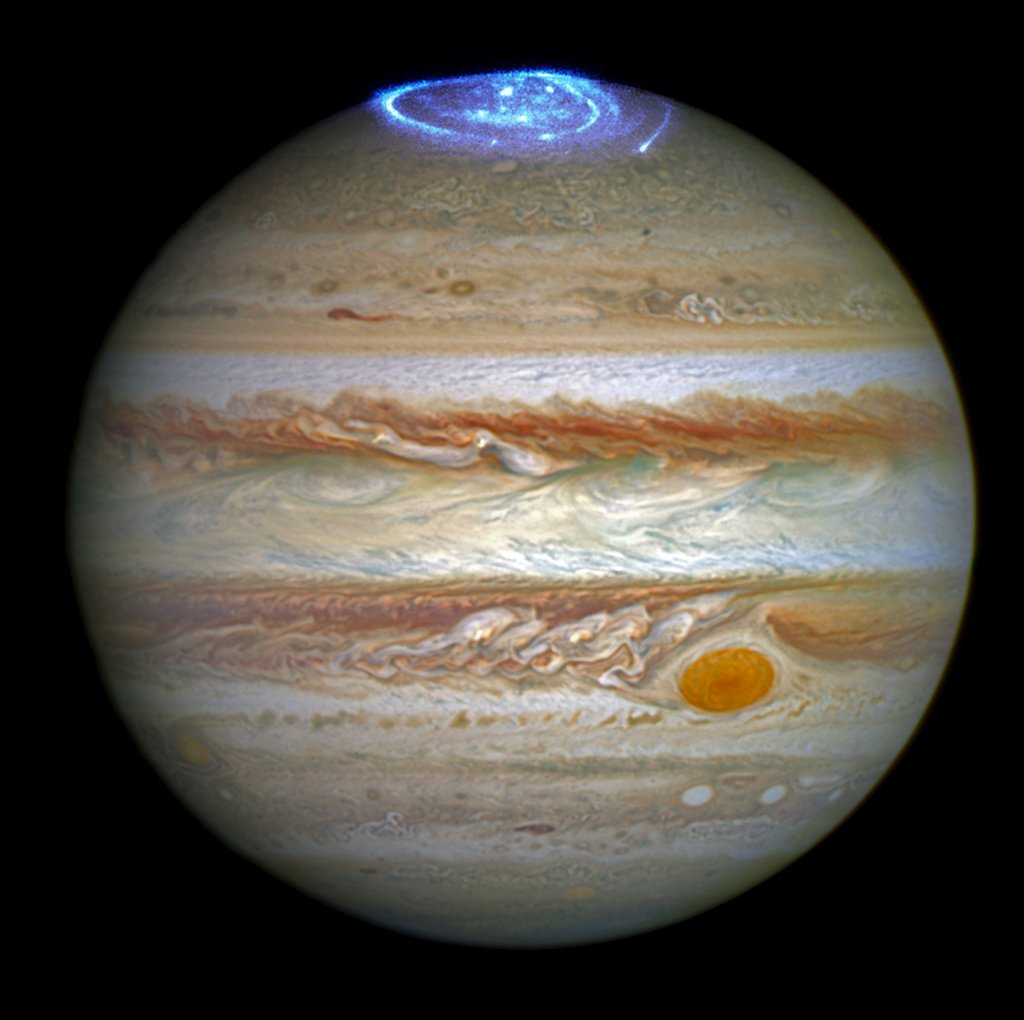
Hubble image of Jupiter with a glowing blue ultraviolet auroral oval above the north pole, over the planet's banded cloud tops.
The ultraviolet ring over the north pole is driven by the same maser process the authors favor for this signal, and the field strength they infer is close to Jupiter's own. Imaged June 30, 2016 (illustrative). "Hubble Captures Vivid Auroras in Jupiter's Atmosphere" by NASA, ESA, and J. Nichols (University of Leicester), via Wikimedia Commons, Public domain

The paper sets out three origins and settles on none. An aurora on a planet would need an undiscovered giant world on a wide orbit: the one known planet, a super-Earth on an 11.2-day orbit, is far too light to generate a field that strong. The others are an interaction between the star and that known planet, or a rare stellar flare.

GJ 725A rotates slowly and flares rarely compared with the active stars LOFAR usually finds. The authors say that makes a stellar origin less likely without excluding it, and they describe it as the lowest-frequency confirmed detection of a stellar system.

The team plans repeat monitoring with LOFAR: a signal returning every 11.2 days would indicate the known planet, while one repeating over hours would point to a giant planet's aurora.

Sources

Spot an error?

Spot an error?

Report an error

Spotted a mistake on this page? Tell us what's wrong and our editors will take a look.

What kind of problem?

Only if you'd like us to be able to follow up. We won't use it for anything else.

We correct mistakes openly. Select any text to flag it. Fixes are logged under our Corrections Policy.

Report an error

Reporting on

A Radio Signal From a Nearby Red Dwarf, and Three Possible Sources

What kind of problem?

Only if you'd like us to be able to follow up. We won't use it for anything else.

We read every report. Corrections are logged publicly.