A Blind Spot in the Galaxy's Next Great Planet Census

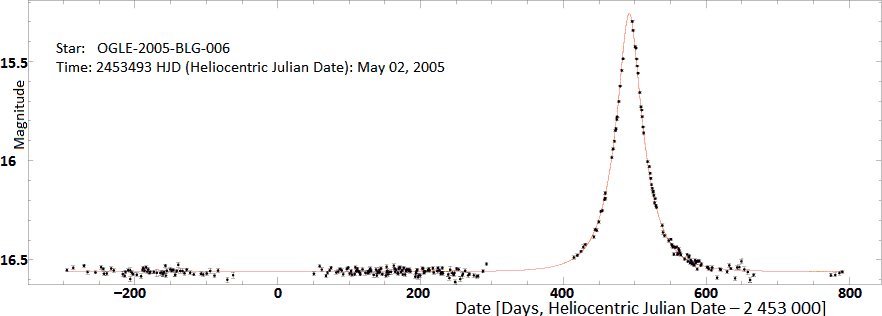
Gravity is the least fussy way to find a planet. It does not need the planet to pass in front of its star, or the star to be nearby and bright. When one star drifts almost exactly in front of another, its gravity bends and concentrates the light of the background star, brightening it for a few weeks. A planet orbiting the foreground star adds a small extra kink to that brightening. More than 200 planets have turned up this way, and NASA's Nancy Grace Roman Space Telescope will use the method to take a census of worlds spread across the Milky Way.
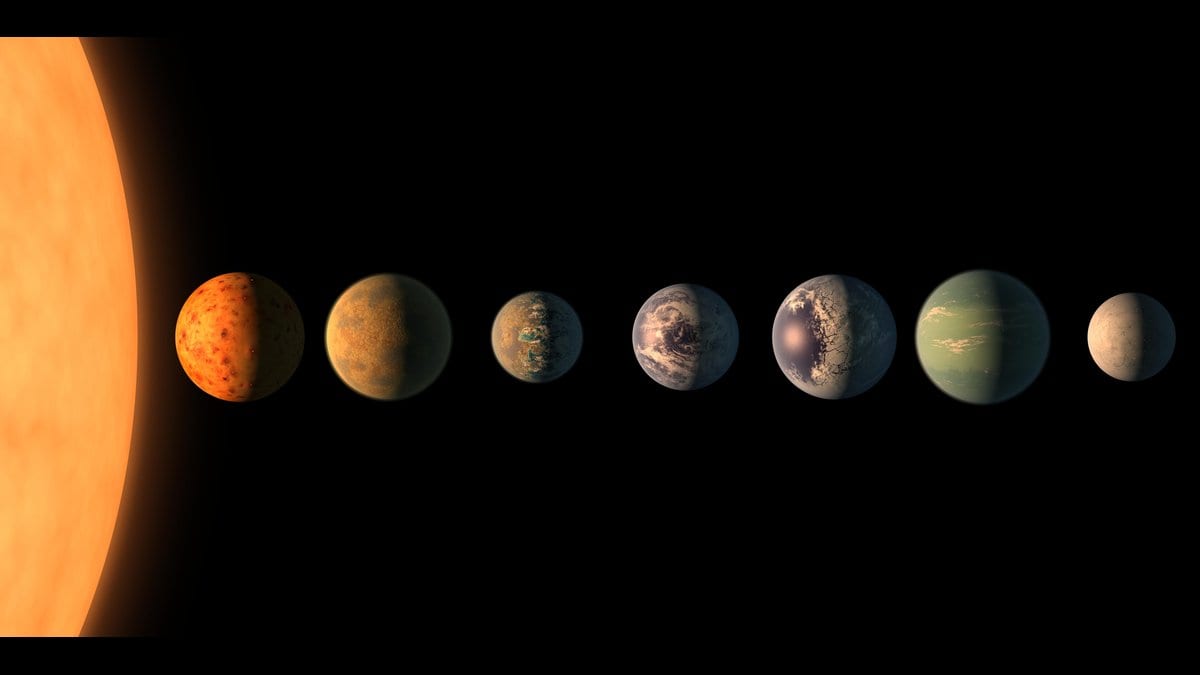
Which makes it worth asking what the census will not count. Stephen R. Kane, a planetary scientist at the University of California, Riverside, worked that question through for the most tightly packed system anyone has heard of. In a calculation posted Nov. 3, 2026, he put the seven planets of TRAPPIST-1 in front of a bulge star, with the lens halfway between Earth and the galactic center, and solved for what Roman would record. All seven together produce a signal about seven orders of magnitude below the score of 160 that astronomers use as the bar for calling a planet detected. Even at a precision ten times finer than Roman's own, the shortfall is five orders of magnitude.
The result is not two things. It is not an observation: the real TRAPPIST-1 sits roughly 40 light-years away and is lensing nothing. The paper asks what would happen if a system like it were the lens. Nor is it a proof of impossibility. Kane evaluates a single lensing geometry, and he calls his own result a non-detection for one event rather than a limit on how common such systems are. His summary figure describes the gap it draws as a gap in sensitivity rather than a hard exclusion, since detections stay possible there at reduced efficiency. Over the full mission he still expects Roman to see 0.1 to 0.4 such systems with a planet in the sensitive zone. The work is a preprint; his arXiv submission says it has been accepted by the Publications of the Astronomical Society of the Pacific, and no journal version has appeared yet.
The planets are too close in, not too small
Microlensing is sensitive in a ring, and the lens star's mass sets its size. TRAPPIST-1's host is an ultracool dwarf, barely able to fuse hydrogen, and at a tenth of the Sun's mass its ring would sit a little beyond the Earth-Sun distance. The lensing zone, the band around that ring where the method actually works, starts outside it. All seven planets fall 12 to 63 times closer to the star than the zone's inner edge. Mass is not the obstacle: the microlensing survey is designed to register objects as light as Mars, well below any TRAPPIST-1 planet. The same geometry defeats heavier stars too. A 2021 study by Sajadian put Roman's detection efficiency for Earth-mass planets in the comfortable zone of more massive hosts at about 0.01%, because those orbits also lie well inside the ring.
And a planet that close to its star barely registers as a separate body at all. The pair acts almost exactly like a single lens of their combined mass, placed at their shared center of gravity. Fitting a single-lens curve to the light, which is what anyone analyzing a real event does, absorbs that displacement and most of the planet's effect with it. The background star appears as two images on opposite sides of the lens, and the planet's leading distortion shifts both the same way, so its effect on the total brightness largely cancels out. What survives falls off as the cube of the planet's separation, faster than the planet moves inward. As the paper puts it, "compactness itself suppresses the observable signal." The strongest of the seven, planet g, shifts the light by less than a thousandth of Roman's single-exposure precision.
What would make them visible would also pull them apart
Kane asks how much heavier the planets would have to be. Scaling every mass by the same factor is the case most favorable to detection, since it lifts all seven signals at once. At Roman's precision the factor is about 1,900, which would turn each Earth-sized world into a gas giant of up to roughly eight Jupiter masses. The architecture gives out long before that. At a factor of about seven, the tightest pair of orbits reaches the classical limit beyond which two neighboring planets are no longer guaranteed to stay clear of each other. Kane is careful about what that means: crossing the limit removes the guarantee of stability rather than proving the system would come apart, and a chain of planets locked into a shared orbital rhythm may hold together somewhat further. Settling the point would need orbital simulations he did not run.
Widening the orbits instead leaves the dynamics alone, and it fails for the opposite reason: the signal climbs into reach only once the planets have spread so far apart that the system is no longer compact. Either route to detection destroys the thing being detected.
An empty result will not mean these systems are rare
That is the part of the paper that outlives TRAPPIST-1. Transit surveys suggest compact multi-planet systems orbit somewhere between a fifth and nearly half of mid-sized M dwarfs, and if the rate carries over to the coolest stars, these may be among the commonest planetary arrangements in the galaxy. Microlensing would register none of them. An absence in Roman's microlensing catalog will therefore say nothing about how often they occur, which matters to anyone tempted to read survey yields as galactic demographics. Nor is the blind spot TRAPPIST-1's alone. For an ultracool-dwarf lens it covers anything orbiting in under about five months, and for a host of any mass, anything orbiting in under a few days. The microlensing census is systematically incomplete at short periods, exactly where the transit census is complete.
Roman will run both halves. Its bulge fields are watched often enough and long enough to double as a transit survey of the same stars. Tamburo, Muirhead and Dressing predicted in 2023 that the survey would yield about 1,350 small transiting planets around cool dwarfs in those fields. Kane flags two limits on reading that as the fix: it counts individual planets, not resolved seven-planet systems, and the transiting hosts bright enough to work sit mostly in the nearer foreground disk, far in front of his hypothetical lens. His own summary: "The two channels observe the same fields but largely sample different distances."
One caveat about the survey he models. The Roman parameters come from a 2019 design study, and the mission has since been pinned down: its bulge survey now covers 1.7 square degrees across six fields, imaged every 12.1 minutes, with four slower seasons in the middle years. None of the differences closes the gap, and they do not all push one way. The smaller area trims the event counts the paper derives, which firms up the non-detection. The faster cadence lifts the signal slightly, against a shortfall of seven orders of magnitude. The slower seasons, five days between looks, are no use for a disturbance lasting about an hour. The first real measure of how common crowded terrestrial systems are across the galaxy will have to come from Roman's transit data rather than from its lenses.