Enceladus Sorts Its Own Ocean Chemistry on the Way Into Space

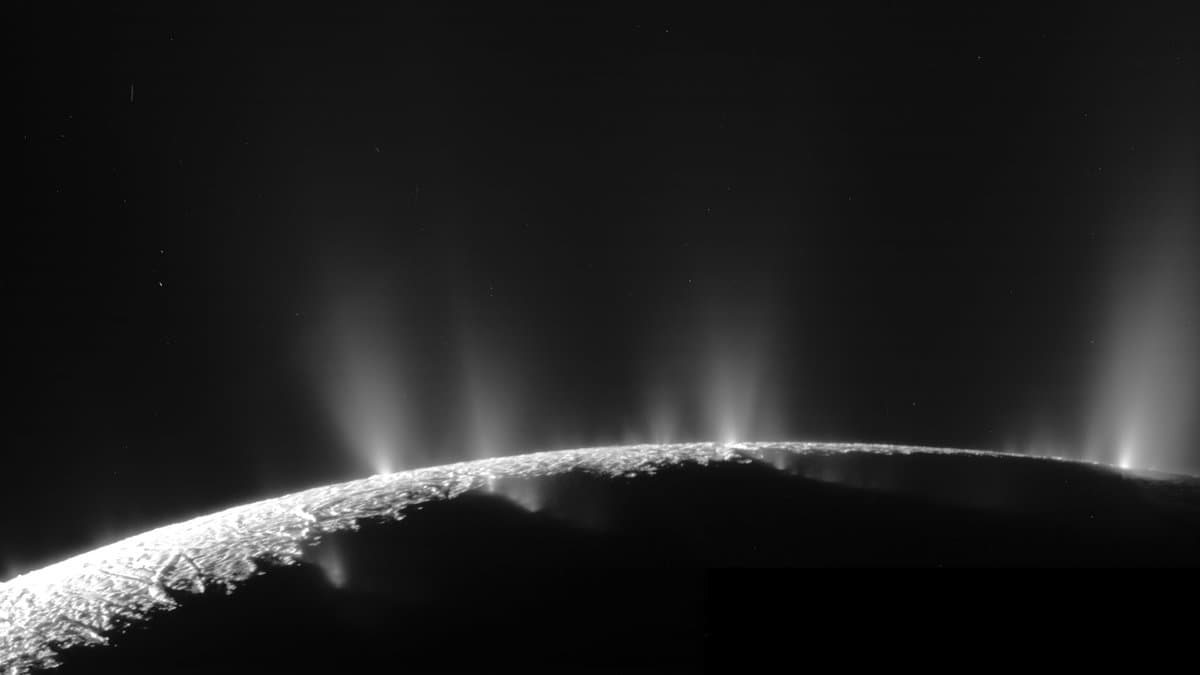
A chemist who wants to know what is dissolved in a jar of seawater has to take the sample apart first: separate the salts, concentrate each one, then put it in front of an instrument on its own. On Saturn's moon Enceladus, something close to that happens without anyone having to do it. Ocean water is sprayed through cracks at the moon's south pole, freezes as it travels through the ice shell and vents, and arrives in space already sorted into grains of different composition. That is the argument of a study led by Frank Postberg, a planetary scientist at Freie Universität Berlin, published Sept. 25, 2026 in the peer-reviewed journal Science Advances.
Working from about 1,000 chemical fingerprints, or mass spectra, of individual salt-rich ice grains recorded by Cassini's Cosmic Dust Analyzer, the team reports that those grains are far from uniform. They fall into at least five basic types by composition, dominated variously by sodium chloride, sodium carbonate or bicarbonate, sodium phosphate, sodium hydroxide, potassium chloride or potassium hydroxide. Enceladus hands over not an average of its ocean but a set of parts.
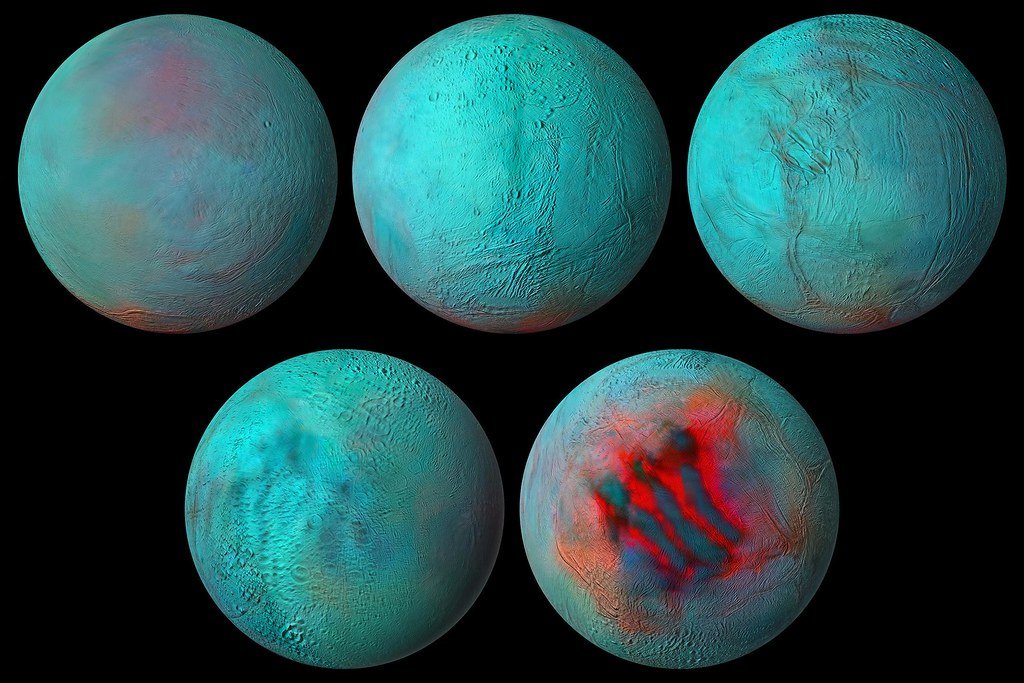
How a droplet of ocean water ends up carrying one salt instead of a mixture is the part Cassini could not watch. For that the team ran laboratory experiments and thermodynamic calculations, and the answer they arrive at is the rate at which the droplets freeze. Salts separate inside a freezing droplet, in the pattern the Cassini spectra show, only when the droplet is larger than 10 micrometers across and freezes more slowly than 20 kelvins a minute. The authors suggest that spray leaving the ocean begins at an average size of hundreds of micrometers, carried in a slow flow of gas, which allows it to freeze slowly enough for the salts to sort themselves as the ice closes in. The droplets are then accelerated to more than 100 meters per second inside narrow ice vents, where repeated collisions with the walls break them into much smaller fragments that mostly contain a single type of salt.
Two details in that account come from Freie Universität Berlin's own announcement of the two studies rather than from either paper: that the droplets form when gas bubbles burst at the ocean's surface, and that the fragments end up only about one to two micrometers across.
"Enceladus thus takes over part of the sample preparation that we would go to considerable effort over in a chemistry laboratory on Earth," Postberg says in the release, in remarks translated from German. "The components of the ocean are separated from one another and at the same time strongly enriched in individual ice particles."
A sorted plume is easier to read than an averaged one
The release spells out why that matters for the search for biosignatures, the measurable signs that something is alive. If microbial material were drifting in one of those ocean droplets, the same slow freezing that separates the salts could concentrate it as well, and the shattering could leave it in a few grains rather than thinly spread through all of them.
"For the search for life, this is good news," Postberg says, in remarks translated from the German release. "Future spacecraft would have to examine many individual ice particles when flying through Enceladus' ice fountains. But if they hit one containing microbial material, biosignatures in it could be particularly well recognized with measurement technology that is already available."
A vent microbe kept making methane at pH 11
Whether anything could live in water like that is the question behind the companion study, led by Vanessa Helmbrecht of Ludwig-Maximilians-Universität in Munich with William D. Orsi as its senior author and published the same day. Enceladus is thought to hold a soda ocean: strongly alkaline, rich in carbonate, nearly without oxygen, with hydrogen produced where water reacts with the rock below. Such water carries a great deal of carbon in total, almost all of it as carbonate. What it barely carries is free carbon dioxide, and free carbon dioxide is what a methane-producing microbe needs as a carbon source.
Helmbrecht and colleagues recreated that chemistry in the laboratory and put a single-celled microbe called Methanothermococcus okinawensis into it, one that Ken Takai and colleagues isolated in 2002 from a hot vent chimney at the Iheya Ridge in the Okinawa Trough. The species was previously reported to grow between pH 4.5 and 8.5, with an optimum around 6.7. In the simulated Enceladus water it continued growing at pH 11, a jump of roughly two and a half pH units beyond its previously reported upper limit, and it ran its whole carbon and energy metabolism on hydrogen released by the simulated reactions between water and rock. Gene-expression measurements showed how they handled the carbon shortage: they increased activity in the reductive acetyl-CoA pathway, an ancient carbon-fixing route, and scavenged carbon dioxide even at extremely low concentrations. It is one laboratory result on one organism, not a settled property of the species.
The release adds a detail that sharpens it: in a growth medium that is normally ideal for these cells, the same high pH left them unable to survive, because dissolved carbon dioxide was lacking. It was the Enceladus recipe, including hydrogen produced by the rock-water reaction, that let them keep multiplying.
"We really did not expect this," says Nozair Khawaja of Freie Universität Berlin, a co-author of the second paper, in remarks also translated from the German release. "It was an experiment in which we considered such a success unlikely."
What the next mission would have to do
ESA is studying a mission that would go and look. L4 is the agency's fourth large-class mission and the first large-class mission of its Voyage 2050 programme. ESA describes it as a mission to land on Enceladus, sample the plumes and make measurements from the surface, seeking out the ingredients that could fuel life. Nothing in either new paper says those ingredients have been found.
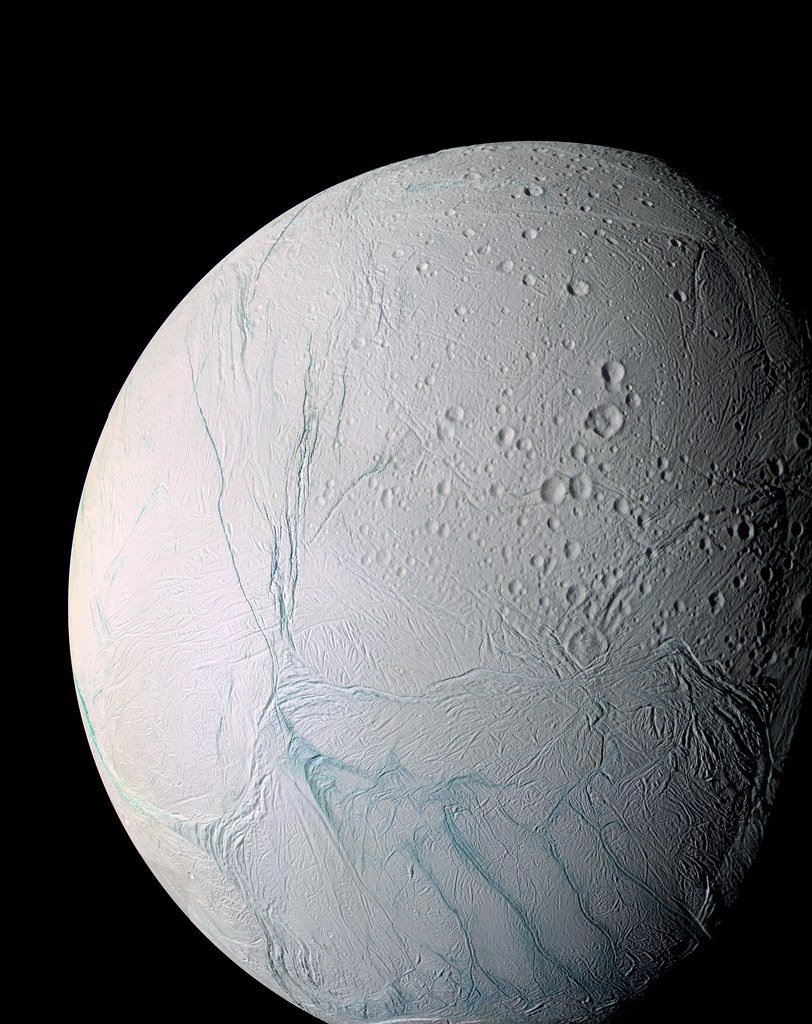
"On Enceladus the particular geochemical conditions could make one of the oldest known metabolic pathways of terrestrial life possible even at high pH values. That by no means says there actually is life there," Postberg says in the release, in remarks translated from German. "But if there is, our first study shows that future spacecraft could now have a good chance of finding its traces in some of the ejected ice particles."
Sources
- Science AdvancesPeer-reviewed
- Science Advances
- idw-online.de