Radar Reaches No More Than 32 Meters Into Europa's Ice
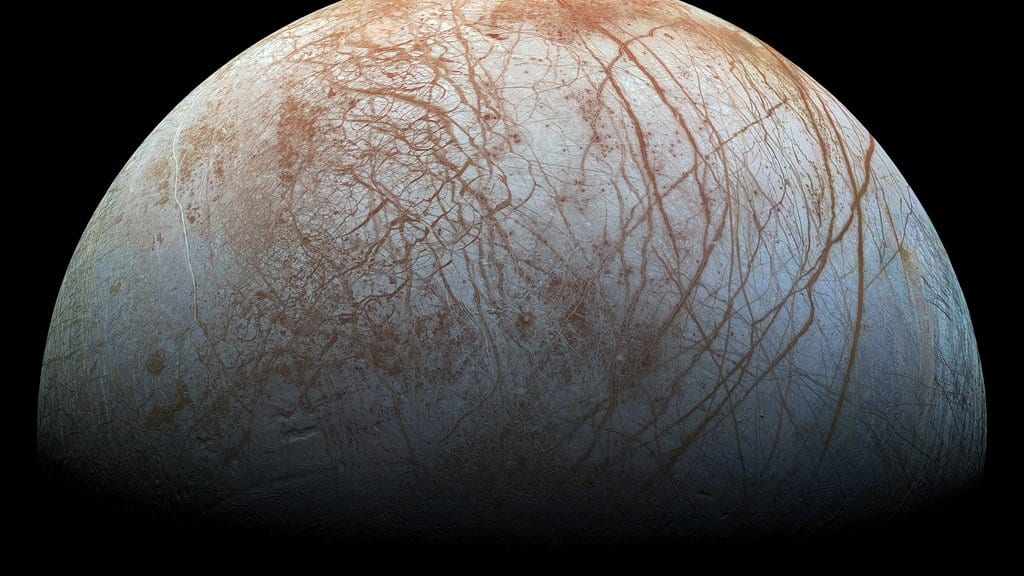
Radar waves at a wavelength of 3.5 centimeters penetrate no more than about 32 meters into Europa's surface, according to a bound reported by Tunhui Xie, Jean-Luc Margot and six co-authors from 13 years of observations of Jupiter's moon. The figure is a ceiling on the penetration depth, not a measurement of how deep the signal actually reaches.
The observations were made with NASA's Goldstone Solar System Radar and the Green Bank Telescope between 2011 and 2024, the team writes in a preprint posted Aug. 18 on arXiv and accepted for publication in The Planetary Science Journal. Goldstone both transmitted and received on its own for part of the campaign; for the rest it transmitted while Green Bank listened, a two-station arrangement the authors say is what makes the depth bound possible. They describe the result as the most longitudinally comprehensive set of radar measurements of Europa to date.
From the Goldstone-only data the team reports radar albedos of 0.92, plus or minus 0.11, in one circular polarization and 1.35, plus or minus 0.13, in the other, with a ratio between the two of 1.44, plus or minus 0.12. The values recorded at Green Bank are similar, according to the paper.
The two-station geometry let the team place a lower bound of 36 arcseconds on the width of a brightness spike Europa shows when the illumination and viewing directions nearly coincide. A wider spike corresponds to a shallower reach, so that lower bound converts to the upper bound of 32 meters, or roughly 1,000 wavelengths, on how far the waves get into the ice.
The authors write that the polarization ratios "suggest" a difference between the moon's leading and trailing hemispheres, and that their results "support the existence" of the coherent backscatter opposition effect, which they call the most widely accepted explanation for the unusual way the icy Galilean moons return radar signals.
The radar properties of those moons had not been measured since observations in 1987 to 1991, the paper states.
Sources
- arXivPreprint