A New Model Ranks Nearby Planets by How Much Carbon Life Could Have Fixed
Researchers at Northern Arizona University and the University of Bristol have proposed a way to estimate how far life could have evolved on a distant planet without observing any life there. Their measure is the total amount of carbon that photosynthesis could have turned into living matter on that planet over its lifetime. It is a model; nothing has been detected or measured at any planet outside the solar system.
The paper appeared Sept. 22 in the International Journal of Astrobiology. In it, Christopher Doughty and Michael Gowanlock of Northern Arizona University and their colleagues acknowledge that the hypothesis underneath the method is untestable. Earth is the only planet known to carry life, so the idea that biological evolution tracks the carbon a biosphere has fixed can be neither proved nor disproved. The authors say they are exploring what it would imply rather than establishing it, and that such an estimate would help decide where telescopes should look.
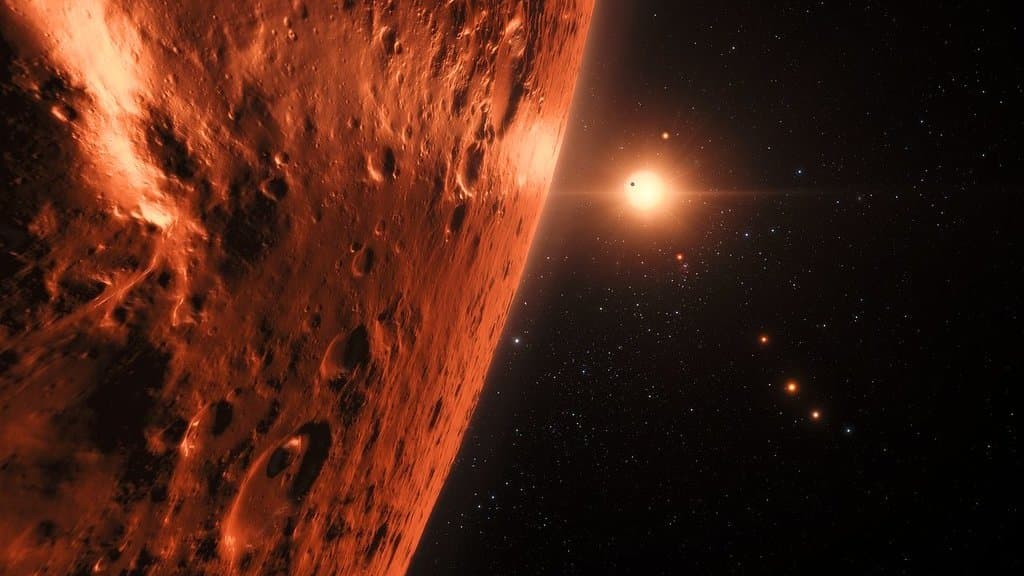
On the authors' accounting, Earth has fixed about 9.4 × 10²⁵ grams of carbon over its history. Modeled as an ocean world, TRAPPIST-1e, a planet roughly 40 light-years away that orbits a red dwarf at a distance where water could stay liquid, would need 18 billion years to reach the same total. Its mean estimated age is 7.6 billion years, which places it at a possible microbial rather than multicellular stage. The climate figures came from simulations an earlier model-comparison project had published, not from observations.
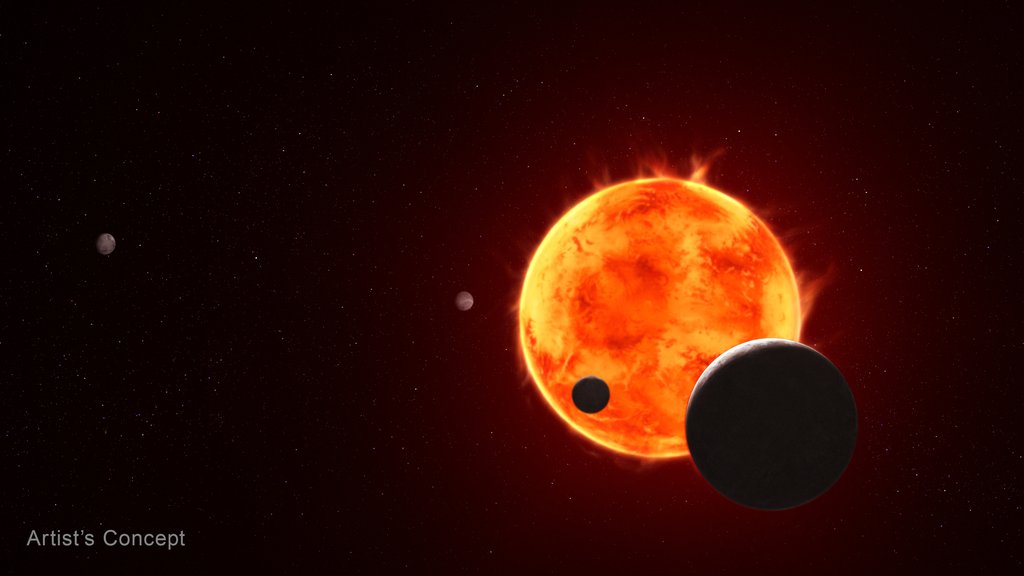
Applied to 29 nearby planets judged to have conditions that might suit life, the method puts two above Earth's running total and six at a possible multicellular stage. GJ 1061c and K2-3d come out highest under several of the scenarios, because they are larger, hotter, brighter and older than the rest. The paper names predicted rainfall as the largest uncertainty in the analysis. The authors recommend aiming observing time at those two planets.
The paper is open access, and the data and code behind its figures are posted on the Dryad repository.