Skip to content
See the World Through ScienceA project of ALLATRA
Source: Peer-reviewedScientific Reports1 source

Comets Almost Never Delivered Usable Cyanide to the Early Earth, Simulations Find
Space

Republish this story

Our work is licensed under Creative Commons BY-NC 4.0. You may republish this piece for free — with credit to ALLATRA Media and a link to the original, unedited beyond length trims, and not for commercial use.

Read the full license

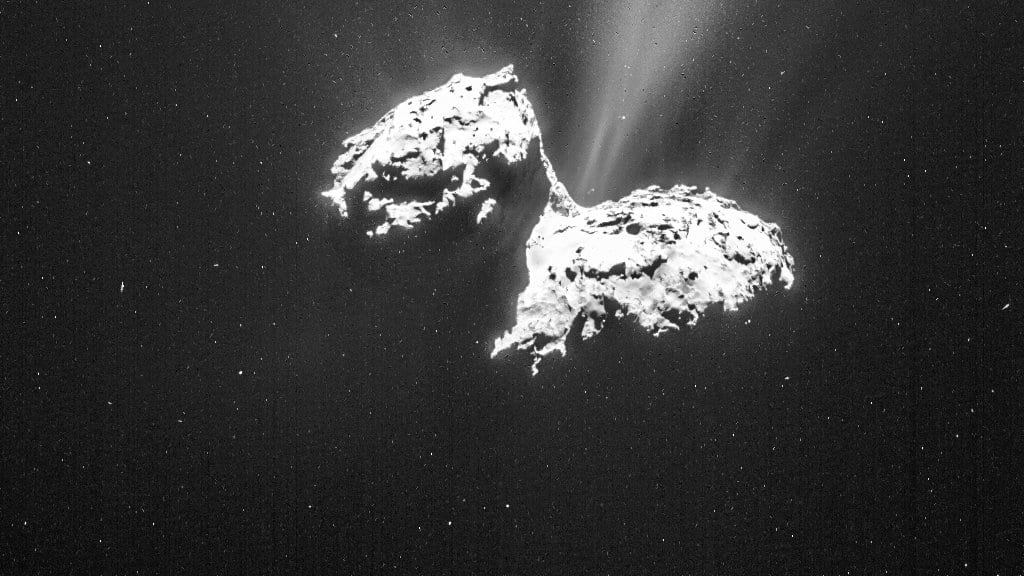
The two lobed icy nucleus of comet 67P/Churyumov-Gerasimenko, lit from the left, with faint dust jets rising from the neck between its lobes against a black sky.
Dust jets rise from the neck of comet 67P/Churyumov-Gerasimenko, imaged by the Rosetta orbiter on Feb. 6, 2015. Hydrogen cyanide is locked in cometary ice like this, and the Cambridge simulations find that little of it survives a high speed impact."Comet on 6 February 2015 – NavCam ESA15250366" by European Space Agency, via Wikimedia Commons, CC BY-SA 3.0 igo

In 100,000 simulated histories of Earth's early comet bombardment, the median number of impacts that delivered hydrogen cyanide to dry land in a concentration that prebiotic chemistry could use was zero. Richard J. Anslow of the University of Cambridge's Institute of Astronomy and colleagues report that result, published Oct. 28, 2026.

Their paper in Scientific Reports tests an idea more than a century old: that comets stocked the early Earth with the reactive molecules that the chemistry leading to life would have needed. The authors use hydrogen cyanide as the test case, reporting that it is the only one of those molecules observed in comets at a useful concentration, and the most resistant to being destroyed by the heat of a high-speed impact.

The team set the bar at 10 mM, the lowest concentration that recent experiments have used to build sugars, fats and the building blocks of DNA and RNA, then sent comets through a model of atmospheric entry and a published model of how cyanide is destroyed on impact. Only slow, highly glancing strikes got their cyanide to the ground intact, and that window is narrow enough that most runs produced no qualifying impact at all. In the 46% of runs that produced at least one, it fell overwhelmingly in the planet's first few hundred million years. The authors say they cannot rule out one fortunate slow, glancing comet having delivered nearly all of its cyanide.
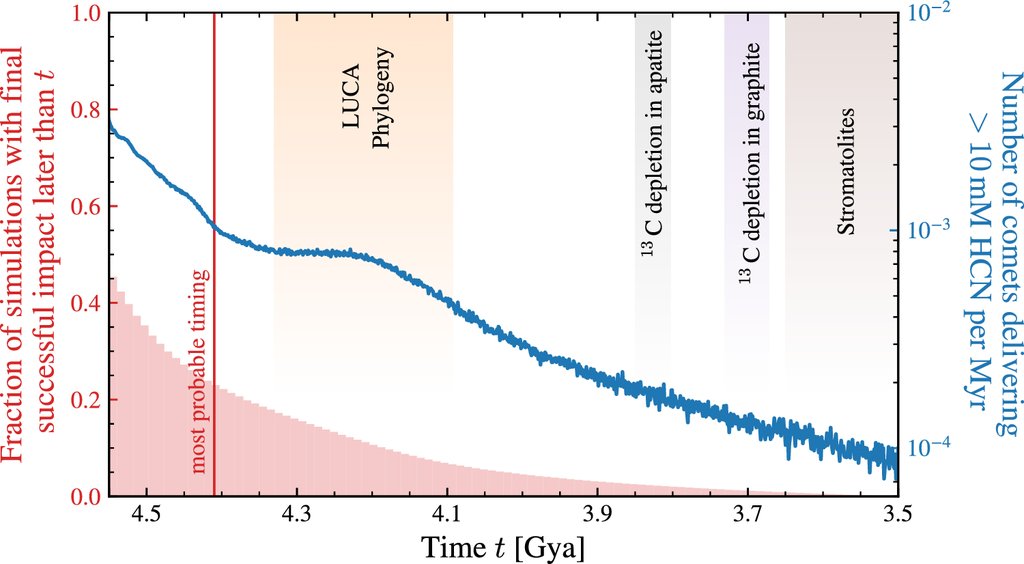
A chart with a red histogram peaking near 4.5 billion years ago and a falling blue curve, crossed by shaded vertical bands labeled LUCA phylogeny, carbon 13 depletion in apatite, carbon 13 depletion in graphite, and stromatolites.
In the minority of runs that do produce a successful impact, the last one most probably falls near 4.4 billion years ago, ahead of the geological and genetic markers of early life shaded at right. Figure 3 from Richard J. Anslow, Catriona H. McDonald, Amy Bonsor, Paul B. Rimmer, Auriol S. P. Rae (2026), "Cometary impacts an unlikely pathway towards the origins of life on Earth", Scientific Reports — CC BY 4.0, resized

In the same simulations, Mars does far better: the authors count 744 successful impacts there, against 87 for Earth and 24 for Venus. Those three counts set aside how much dry land each planet had. For Earth, the authors report, the scarcity of exposed land on the earliest surface takes the median from 87 to zero.
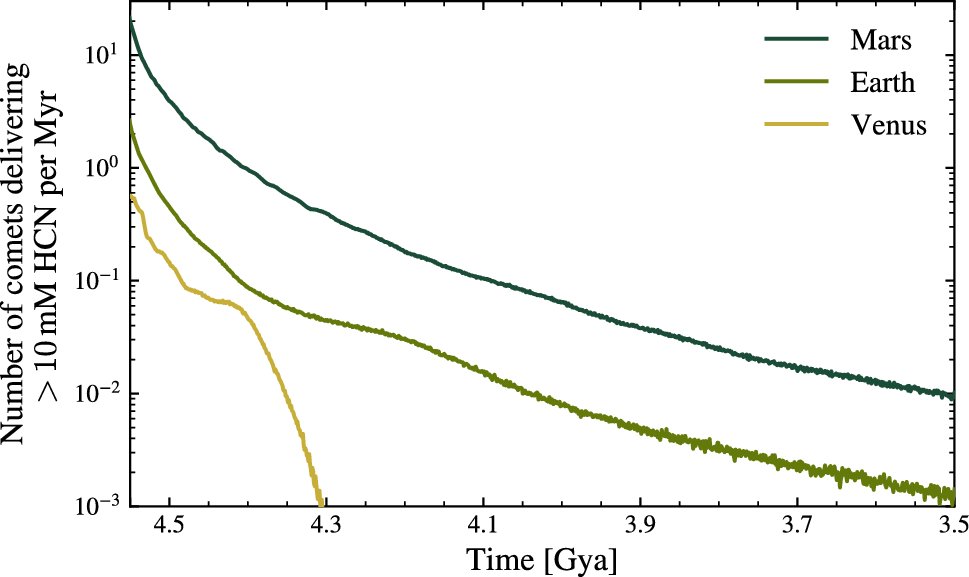
A line chart of the number of comets per million years delivering more than 10 millimolar hydrogen cyanide, with the Mars curve highest, the Earth curve about ten times lower, and the Venus curve falling off sharply before 4.3 billion years ago.
The model gives Mars roughly ten times Earth's rate of cyanide bearing comet impacts across the whole interval, and gives Venus effectively none after about 4.3 billion years ago. Figure 4 from Richard J. Anslow, Catriona H. McDonald, Amy Bonsor, Paul B. Rimmer, Auriol S. P. Rae (2026), "Cometary impacts an unlikely pathway towards the origins of life on Earth", Scientific Reports — CC BY 4.0, resized

The authors attribute Mars's advantage to its lower escape velocity and thin atmosphere, which together let almost every comet large enough to survive entry reach the ground. By their account, Venus's dense atmosphere destroys most of the comets that arrive, including some several kilometers across.

Sources

Spot an error?

Spot an error?

Report an error

Spotted a mistake on this page? Tell us what's wrong and our editors will take a look.

What kind of problem?

Only if you'd like us to be able to follow up. We won't use it for anything else.

We correct mistakes openly. Select any text to flag it. Fixes are logged under our Corrections Policy.

Report an error

Reporting on

Comets Almost Never Delivered Usable Cyanide to the Early Earth, Simulations Find

What kind of problem?

Only if you'd like us to be able to follow up. We won't use it for anything else.

We read every report. Corrections are logged publicly.