Atoms in Orbit Fell Together for 280 Days to Test Einstein's Gravity Rule
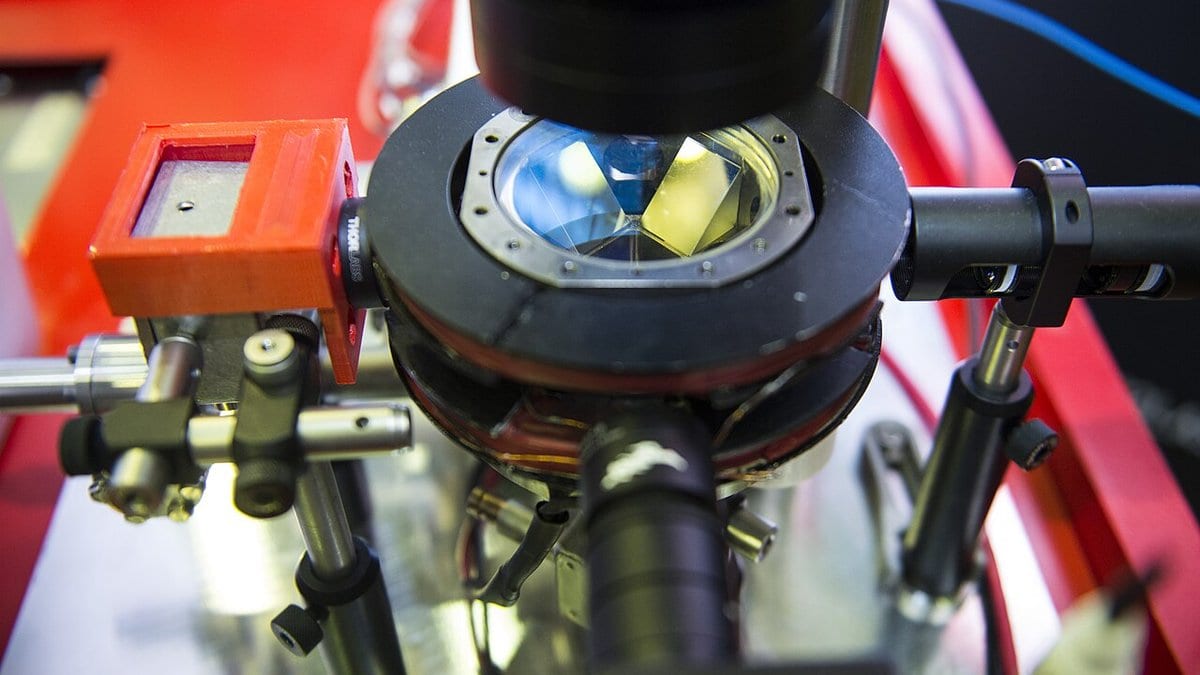
A rubidium atom interferometer aboard the China Space Station has completed an in-orbit quantum test of the weak equivalence principle, the rule that objects fall at the same rate regardless of what they are made of. The authors report the test in a paper published on August 28 in the journal Science Advances (DOI 10.1126/sciadv.aeh4502).
The instrument compares two isotopes at once, rubidium-85 and rubidium-87. From 280 days of test data, the authors report a test uncertainty of 2.8 × 10⁻⁸ and, after error estimation, a test result of (−2.7 ± 4.7) × 10⁻⁷. The stated uncertainty is larger than the central value, so the measurement records no departure from the principle.
The authors write that the result "improves prior atom-interferometric WEP tests in microgravity by three orders of magnitude."
Much of the work went into suppressing noise the experiment generates itself. The paper names three methods used for that: platform motion suppression, fluorescence detection switching and two-photon detuning switching, which the authors write were developed to "eliminate phase noise and improve measurement accuracy."
Dan-Fang Zhang of the Wuhan Institute of Physics and Mathematics, part of the Chinese Academy of Sciences, is the first author. The authors describe the work as paving "the way for space-borne quantum inertial sensors and their application to future fundamental physics in space."
Funders listed in the published record include the National Natural Science Foundation of China, the Chinese Academy of Sciences, the Space Application System of China Manned Space Program and the Quantum Science and Technology National Science and Technology Major Project.
Sources
- Science AdvancesPeer-reviewed