Boosting the Healthy Copy of an Autism Gene Eased Its Effects in Lab-Grown Brain Tissue
A team at the University of California, Los Angeles, has used CRISPR to turn up two autism risk genes in lab-grown human neurons and cortical organoids, pea-sized clumps of brain tissue grown from stem cells. The group reports that the genes became more active only in cells carrying a mutation, and that several of the differences the mutation causes moved back toward normal. Nothing in the work was tested in an animal or in a person.
The authors write that about 15% of the genetic susceptibility to autism comes from new mutations that knock out one of a gene's two copies, leaving the other to work at roughly half strength. Their approach leaves the broken copy alone and raises output from the healthy one, using the cell's own controls. The paper was published Nov. 13, 2026, in Nature Neuroscience.
The group mapped stretches of regulatory DNA called enhancers around the two genes, CHD8 and SCN2A, and picked ones predicted to be active during fetal brain development. Aiming the same activator at a gene's promoter instead raised expression in healthy cells too: the overshoot they wanted to avoid.
In the mutant lines, CHD8 ran at about half the normal level, and mutant organoids grew larger, with too many of the dividing cells that go on to make neurons. The authors report that treated organoids came back toward normal size, with fewer of those cells and more neurons, and that overall gene activity shifted toward the unmutated pattern. Only about a quarter of the cells in a treated organoid carried the activating protein.
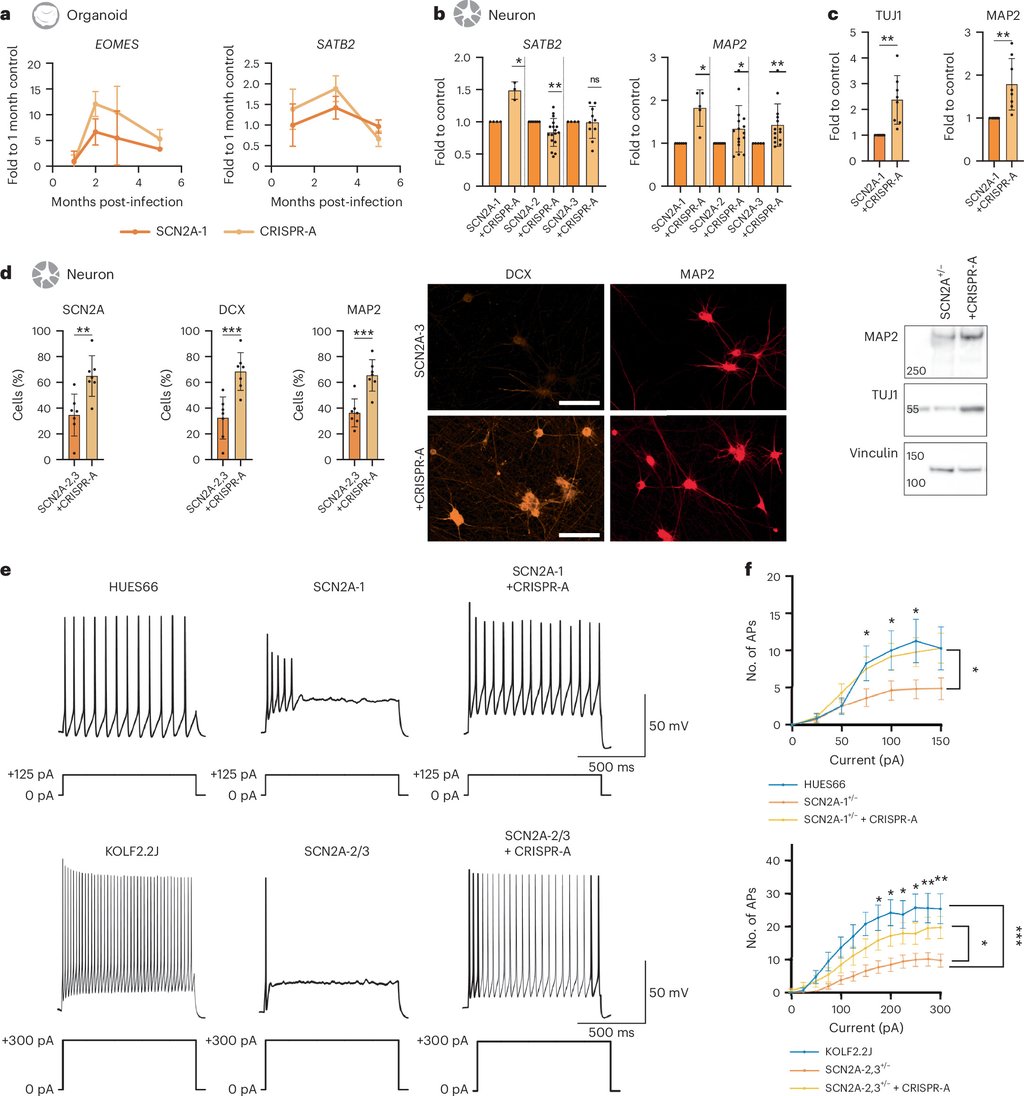
SCN2A encodes a sodium channel neurons use to fire. Treated neurons fired at close to normal rates, including neurons grown from two patients' own cells. One treatment lasted months in culture, and timing mattered: the increase faded later on, and organoids first treated at 300 days old showed none.
The authors call the work a proof of principle and offer the method as a workflow for other autism risk genes. They report no rise in the activity of neighboring genes, one of the off-target checks they ran.
Sources
- Nature NeurosciencePeer-reviewed

Medical Disclaimer: This content is provided for general informational and educational purposes only. It is not medical advice and should not be used as a substitute for professional medical advice, diagnosis, or treatment. Always consult a qualified healthcare professional regarding any medical condition, concern, symptom, or treatment decision.