What Explosive Volcanism Looks Like Under 6 Kilometers of Water
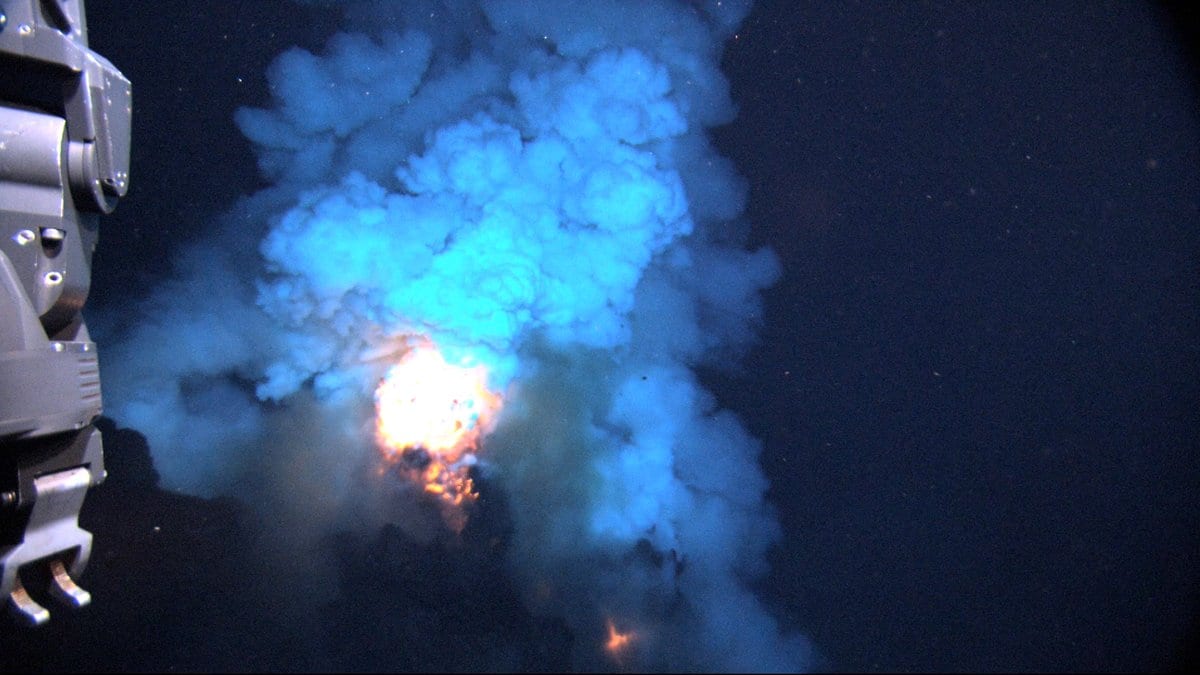
Three dives by a remotely operated vehicle on the slope above the Challenger Deep brought up volcanic rock that had been blasted into fragments and then welded back together by its own heat, more than 6,000 meters below the surface. Robert J. Stern of the University of Texas at Dallas and colleagues describe the samples as the deepest known products of a submarine explosive eruption.
The team collected them with the vehicle Jason/Medea on a cruise in late 2024 and reported the find Nov. 23, 2026, in Frontiers in Earth Science. The paper presents the rocks as evidence of a style of deep-sea explosive eruption that no earlier sampling had reached.
Pressure is why the authors expect that style to differ — water dissolved in rising magma cannot flash to steam at such depths. Instead, the paper argues, it leaves the melt as a supercritical fluid, neither liquid nor gas, taking up roughly 3% of the volume the same mass of steam would. The authors hypothesize that an eruption driven that way breaks the magma apart more gently, mixes less with seawater, and keeps enough heat for the fragments to fuse where they settle.
The rock is what points that way. Stern and colleagues report that the samples are hard and welded, and that outcrops on the seafloor form thin, lobed sheets cracked into regular rectangles, which they read as pyroclastic flows (deposits of eruption debris) that cooled and contracted in place. Welded deposits of this kind are known from ancient submarine rocks, the paper says, but young ones had not been reported from the modern seafloor. The deepest explosive submarine volcanism reported before this cruise came from deeper than 5 kilometers, in the same stretch of seafloor.
The vents that fed the flows have not been found, according to the paper, which places them somewhere upslope of the sampled sites. Jason/Medea cannot work below 6,500 meters and the floor of the Challenger Deep lies at 10,935 meters, so the authors call for dredging and crewed deep submersibles to reach what the vehicle cannot.
Sources
- doi.orgPeer-reviewed