A Chemical Clock in Fossil Shells Now Dates Polar Seabed Layers
Darrell Kaufman of Northern Arizona University and colleagues have calibrated a chemical clock for dating polar deep-sea sediment and released a free age calculator that applies it. The clock is amino acid racemization — the slow change proteins undergo inside a shell after the animal dies. The calibration appeared Nov. 21, 2026, in Scientific Reports.
The paper names the problem it addresses: polar deep-sea cores are hard to date, because sediment builds up at uneven rates and the usual method of matching layers to global ice-age cycles in oxygen isotopes often does not work there. That, in the authors' account, makes racemization an important alternative.
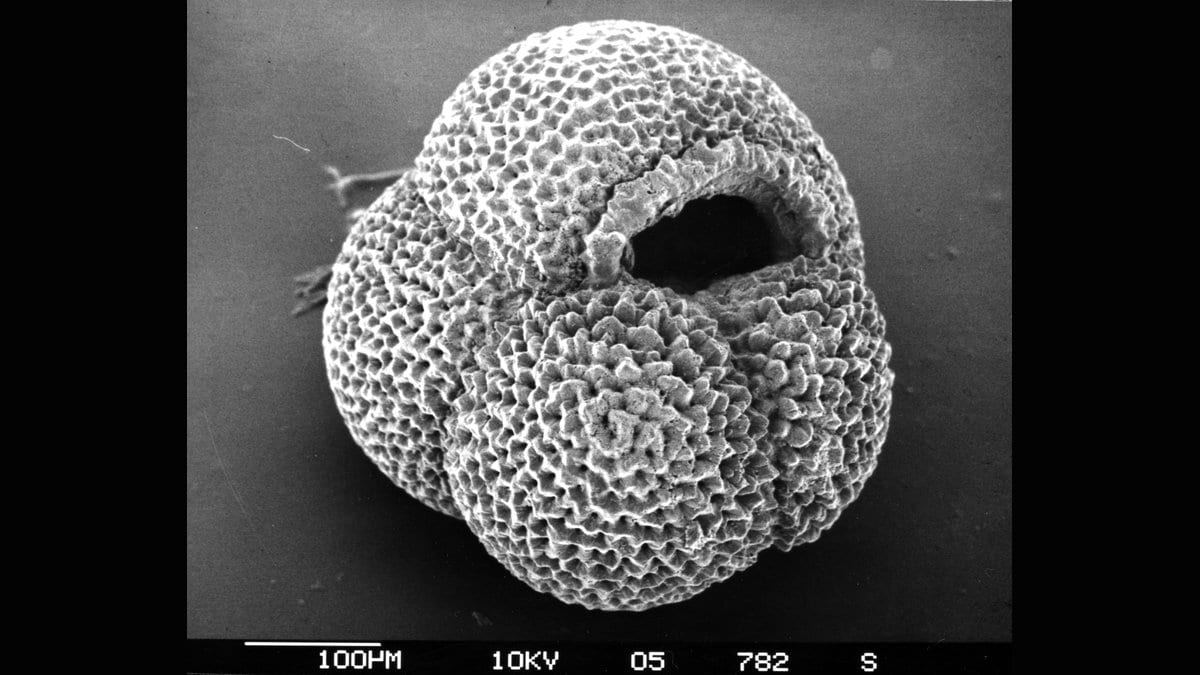
The team measured racemization in Neogloboquadrina pachyderma, the shell-building plankton that dominates high-latitude waters, and tied its rate to 140 samples already dated by other means, from sites in the Arctic, the Nordic Seas, the North Atlantic and the Southern Ocean, spanning the past 1.4 million years. Rates vary less between those ocean basins, the authors report, than between individual sites. Ages come from aspartic acid, the more precise of the two amino acids they measured; glutamic acid gives an independent check.
The calculator returns uncertainty ranges that take in calibration and measurement error. The authors put the realistic uncertainty on an age at roughly ±32% at the 66% level, which they say is not enough to assign a sample to a single stage of the ice-age cycle but still useful for many polar cores. A single age picks correctly between two candidate ages 90% of the time when those ages differ by a factor of 2.3, and an independently dated layer in the same core narrows the uncertainty to about ±28%.
The authors recommend applying the method as a series of measurements down a core, since comparisons between samples are more precise than absolute ages. The calculator ships with the open-access paper as a spreadsheet and an interactive web page. The acknowledgements state that the authors used Anthropic's AI assistant, Claude, to help with data analysis, including formulating the age equations and building the calculators. The US National Science Foundation funded the work.
Sources
- Scientific ReportsPeer-reviewed