Skip to content
See the World Through ScienceA project of ALLATRA
Source: Peer-reviewedScience1 source

The Seafloor Does Not Collapse All at Once, Underwater Monitoring Shows
Science

Republish this story

Our work is licensed under Creative Commons BY-NC 4.0. You may republish this piece for free — with credit to ALLATRA Media and a link to the original, unedited beyond length trims, and not for commercial use.

Read the full license

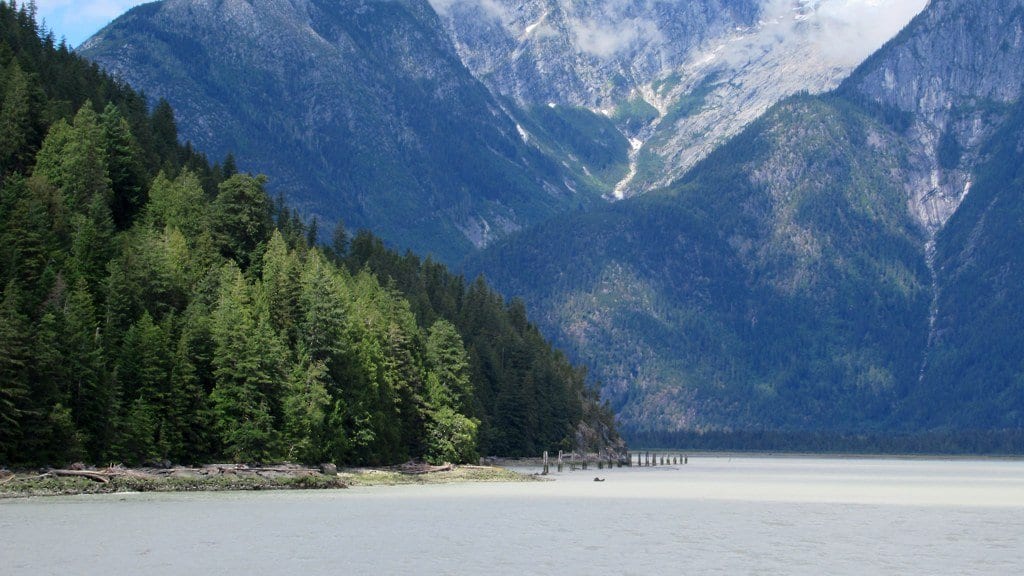
Gray, sediment-laden water at the mouth of the Homathko River in British Columbia, with a forested shore and steep mountains behind.
Glacial silt clouds the water where the river meets the head of Bute Inlet, British Columbia, at the delta whose underwater slope the study watched. Photographed Aug. 6, 2020."Homathko River Estuary (50337603711)" by David Stanley from Nanaimo, Canada, via Wikimedia Commons, CC BY 2.0

Researchers have directly monitored underwater landslides as they happened at the Homathko Delta in British Columbia, and the seafloor there did not give way all at once. It failed slowly, creeping back up the slope. Rebecca G. Englert of Durham University and colleagues report in a paper published Nov. 12, 2026, in Science that landslides taking place entirely underwater had never been directly monitored in nature before.

The authors say the finding matters for anything built on the seabed. Submarine landslides threaten seabed structures, and whether a failure drags on or happens in an instant bears on the stress those structures must be designed to withstand.

The paper describes what it recorded as breaching, a slow failure that migrates up the slope. Breaching in sandy parts of the seafloor was among the existing hypotheses for how submarine landslides fail, and those hypotheses had remained unvalidated for natural settings.
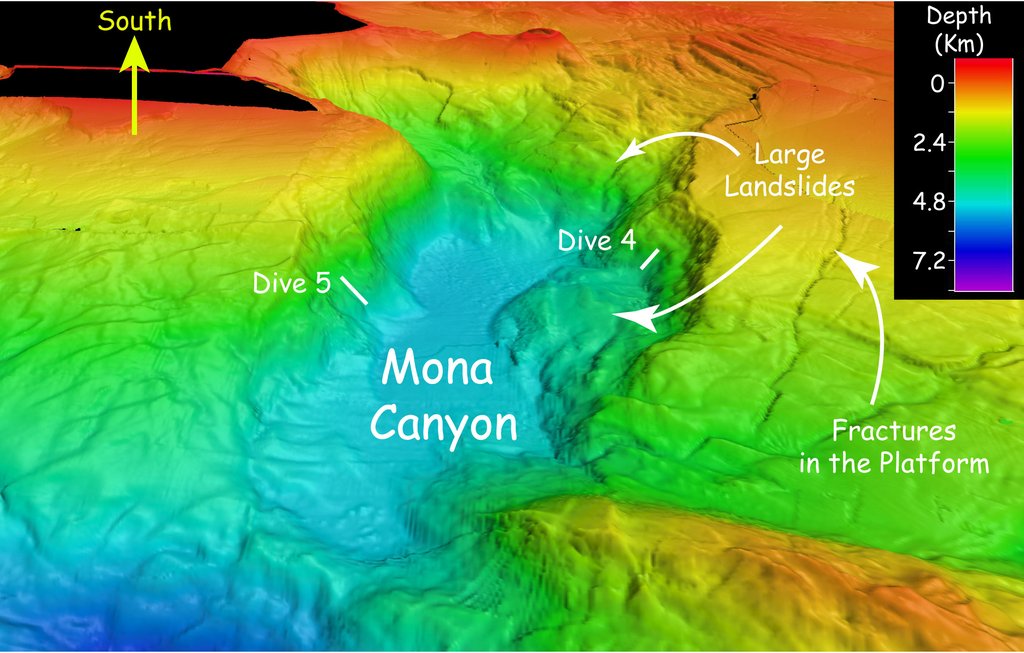
Color-shaded sonar map of a deep submarine canyon, with arrows labeling landslide scars and fractures on the canyon walls.
Sonar mapping of the Mona Canyon off Puerto Rico, where landslide scars and fractures are marked on the canyon walls (illustrative). "Mona Canyon" by NOAA, via Wikimedia Commons, Public domain

Prolonged landslides also start sustained flows of sediment, known as turbidity currents, which carry sediment, carbon and pollutants farther offshore. Submarine landslides move what the authors call globally important amounts of that material into the deep sea.

The paper lists 20 authors at universities, geological surveys and research institutes in Britain, Canada, the Netherlands, the United States and Turkey. The supporting data for the study are deposited openly on Zenodo.

Sources

Spot an error?

Spot an error?

Report an error

Spotted a mistake on this page? Tell us what's wrong and our editors will take a look.

What kind of problem?

Only if you'd like us to be able to follow up. We won't use it for anything else.

We correct mistakes openly. Select any text to flag it. Fixes are logged under our Corrections Policy.

Report an error

Reporting on

The Seafloor Does Not Collapse All at Once, Underwater Monitoring Shows

What kind of problem?

Only if you'd like us to be able to follow up. We won't use it for anything else.

We read every report. Corrections are logged publicly.