A Protein Leaves the Cell Surface to Help Fat Droplets Grow
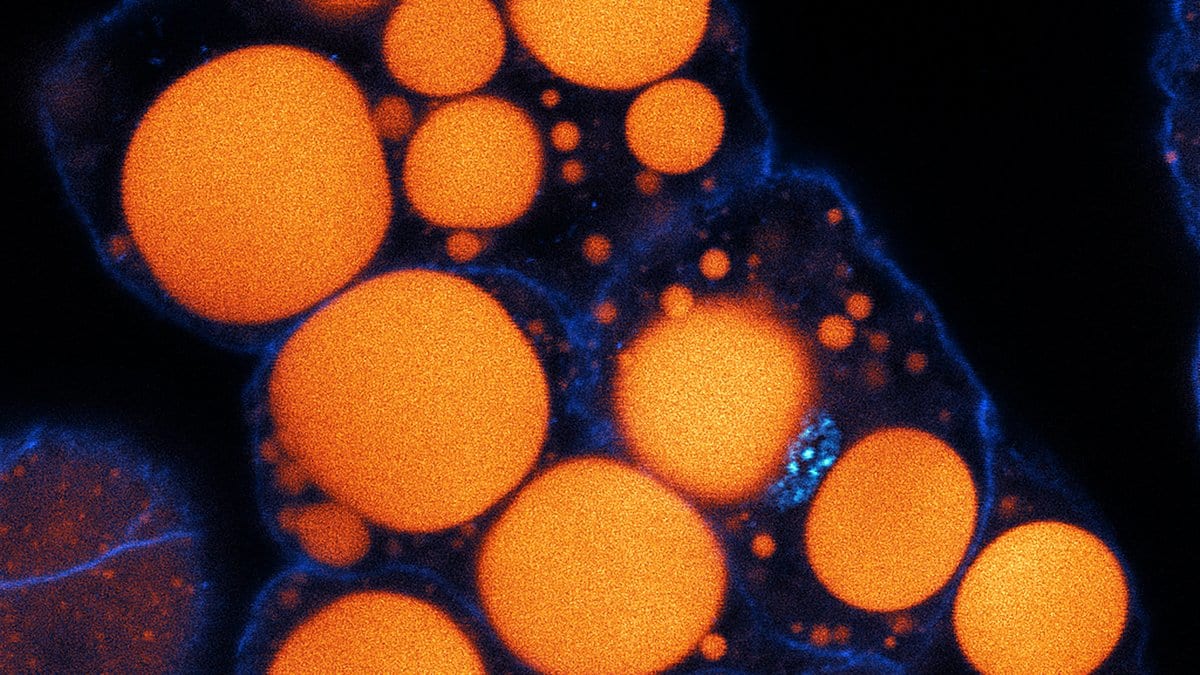
Researchers at the University of Potsdam report that dietary lipids pull caveolin-1 off the surface of a cell and onto its fat-storage droplets within three hours. Caveolin-1 is one of the proteins that make up caveolae, small pits in a cell's outer membrane that are involved in taking up and storing fat. The paper was published Nov. 19, 2026, in Proceedings of the National Academy of Sciences.
The authors report that droplets carrying caveolin-1 grew significantly larger and describe the protein as critical for droplet growth. Deleting the middle section of caveolin-1 abolished both the move onto the droplets and the growth. That deletion, Cav1-F160X, has been found in patients with lipodystrophy, a disorder of fat storage. They present the finding as an early mechanistic account of how caveolin-1 mutations disturb fat storage inside cells. The experiments were done in cultured cells — not in animals or people.
Caveolae measure 50 to 100 nanometers across. Oleic acid and cholesterol each made them rounder and drove caveolin-1 into the cell. Electron microscopy and protein tagging placed caveolin-1 at the droplets with no intact caveolae present, so the protein arrives there alone. Caveolin-1 reaches the droplets through the cell's early sorting compartments, within one hour of oleic acid treatment.
The paper notes that earlier work had already found caveolae proteins at fat droplets without establishing what they do there. Several mutations in caveolin-1 and in a related protein, cavin-1, are associated with lipodystrophy in people.
The work was funded by the Deutsche Forschungsgemeinschaft, the Chan Zuckerberg Initiative and the Else-Kroener-Fresenius-Stiftung, and the paper is published under a Creative Commons BY-NC-ND license.
Sources
- doi.orgPeer-reviewed