Microbial Slime Is a Major Route Into the Soil's Long-Lived Carbon
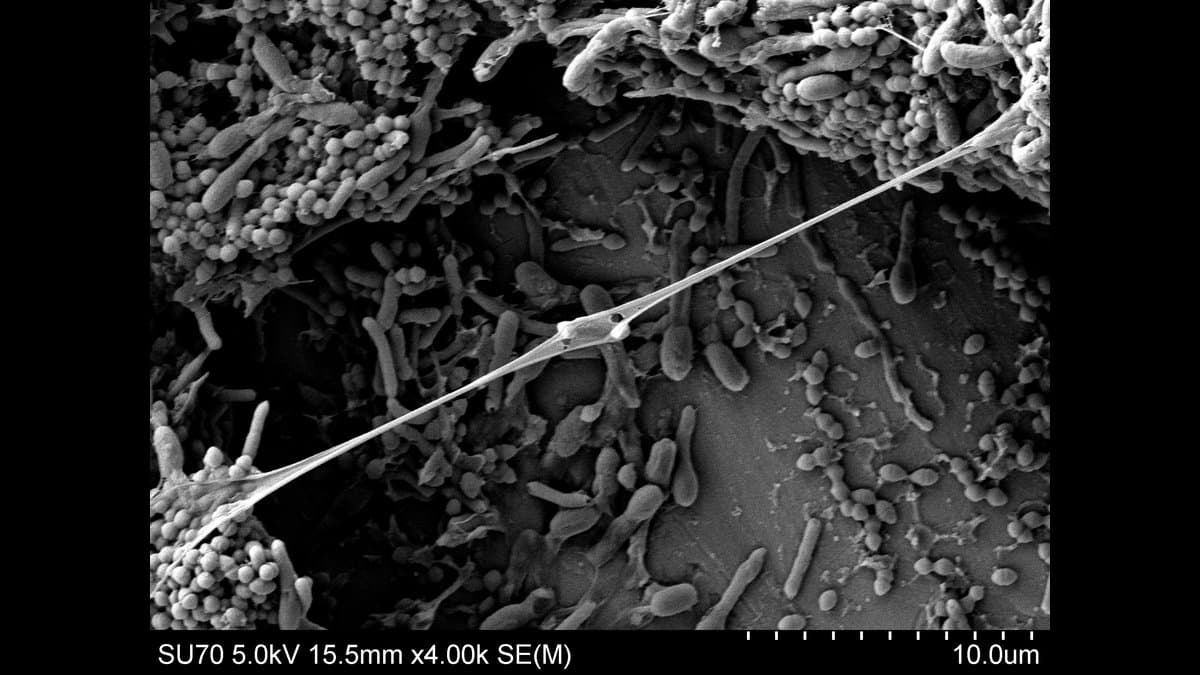
The sticky substances soil microbes release while they are alive are a major route into the soil's longest-lasting carbon store, researchers at Huazhong Agricultural University in Wuhan report. Their measurements place that route alongside the one soil science has counted for years: the remains of dead microbial cells.
The paper, published Sept. 28, 2026 in Nature Geoscience, calls the extracellular route an important and previously underappreciated mechanism feeding the carbon that ends up bound to soil minerals, and says its measurements give a mechanistic view of how soil microbes shape the fate of carbon under global change.
Peipei Qian, Yichao Wu, Peng Cai and colleagues developed a tracing method that adds water labeled with oxygen-18, a heavy form of oxygen, to soil. They then followed the label into the material microbes build while they grow. That material is extracellular polymeric substances, or EPS, which the paper describes as mucus-like mixtures of sugars, proteins and other biopolymers released by microbes. The method was applied across a national survey of cropland soils in China.
The authors report EPS production rates comparable to those of microbial cellular residues. Across the survey soils, EPS showed statistical associations, rather than measured transfers, with mineral-associated organic carbon: the carbon that clings to clay and other mineral surfaces and is slowest to break down. In separate microcosm experiments using carbon-13 as a label, carbon derived from EPS entered that mineral-associated pool at rates comparable to or exceeding those of cellular residues.
Dead-cell remains are already established as a substantial microbial contribution to soil carbon storage, while the extracellular side had stayed poorly quantified. Co-authors include researchers at the University of Leeds, the Royal Horticultural Society and several Chinese Academy of Sciences institutes. The work was funded by the National Natural Science Foundation of China and by Chinese provincial programs, and the study's data and analysis code are posted publicly on figshare.
Sources
- Nature GeosciencePeer-reviewed
