Antarctic Shelf Leaves No Mark on the Carbon Sinking Into the Deep Sea
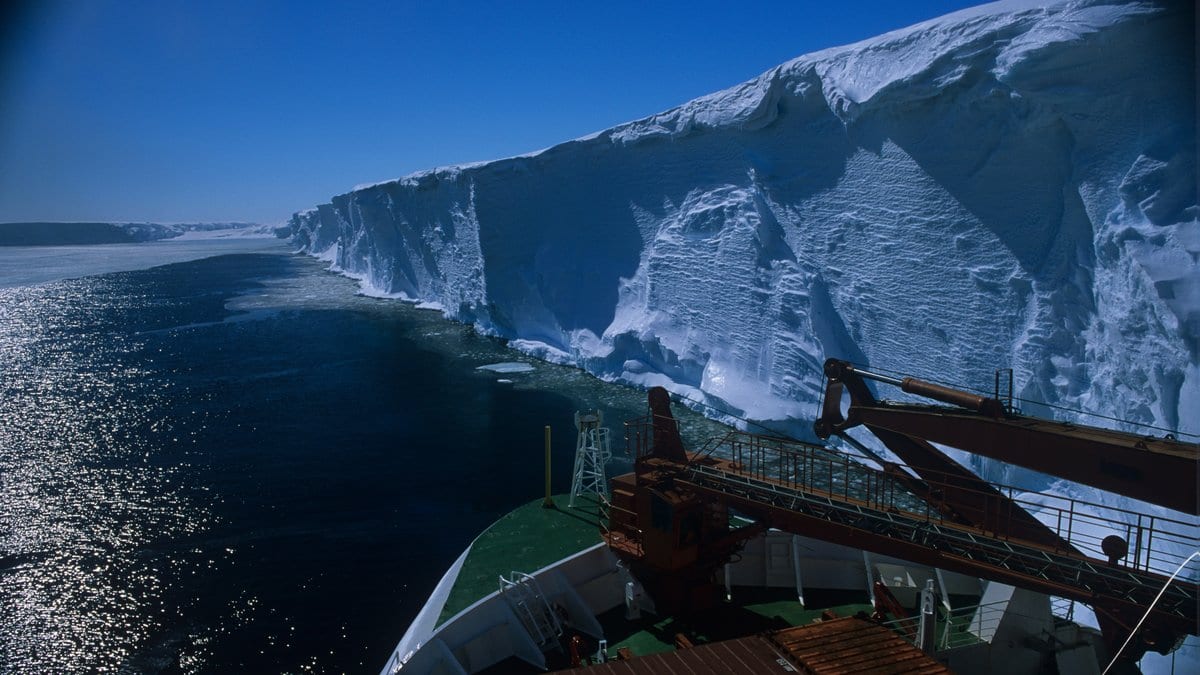
Organic carbon dissolved in the water that sinks off the Antarctic shelf arrives in the deep Weddell Sea with no detectable chemical mark of the shelf it crossed, researchers reported Nov. 10, 2026, in Nature Communications. The same measurements put the carbon moving from the Weddell Sea into Antarctic Bottom Water, the cold dense layer that fills the deep ocean, at 0.155 ± 0.03 petagrams a year. A petagram is a billion metric tons.
The paper says that understanding how organic matter forms and leaves the Antarctic shelf is essential to knowing how carbon enters that deep reservoir, where it stays out of contact with the atmosphere for centuries. The Weddell Sea supplies up to 50% of that water, whose volume has been falling as the Southern Ocean warms. Because nothing the team measured depended on shelf biology, the authors expect that makeup to stay the same even as bottom-water formation weakens.
The sampling came from two voyages of the icebreaker Polarstern, in 2016 and 2021. First author Gonzalo V. Gomez-Saez of the Alfred Wegener Institute, Thorsten Dittmar of the University of Oldenburg and colleagues collected 178 water samples at the sites where dense water forms, then followed it through the water masses that feed the deep ocean. Three methods pointed the same way: mass spectrometry, magnetic resonance of the molecules' structures, and radiocarbon dating. Concentrations did not differ between the water masses, and neither did the molecular or structural properties. The carbon they dated was thousands of years old everywhere, including under the productive surface.
Their explanation is time. Water sits on the Weddell Sea shelf for 6 to 12 years on average. The authors say that is long enough for freshly made organic matter to break down to inorganic carbon before any is exported.
The finding is about composition rather than quantity. The team writes that substantial gross carbon export still occurs during deep-water formation, and expects that flux to fall as warming and sea-ice loss slow the production of dense shelf water. The paper is open access and its data are in Zenodo.
Sources
- Nature CommunicationsPeer-reviewed