Climate Policy Gets Much More Expensive if Farms and Forests Sit It Out

The European Union wrote a target for cutting the methane and nitrous oxide that come off its farms, then withdrew it after farmers protested. More than a quarter of the world's greenhouse gas emissions now carry a price of some kind, and almost all of that price falls on energy and industry rather than on land. Climate policy keeps dropping the part of the problem that grows food.
Both of those facts open a paper published Nov. 11, 2026, in Nature Sustainability, in which Leon Merfort, Elmar Kriegler and colleagues at the Potsdam Institute for Climate Impact Research ask what that omission costs everyone else. They ran a dozen packages of land policy, from every option switched on to every option switched off, against nine levels of climate ambition, using a model of the world's energy economy coupled to a model of its land. The emissions coming out of each run then went through a simple climate model to see how warm the world got.
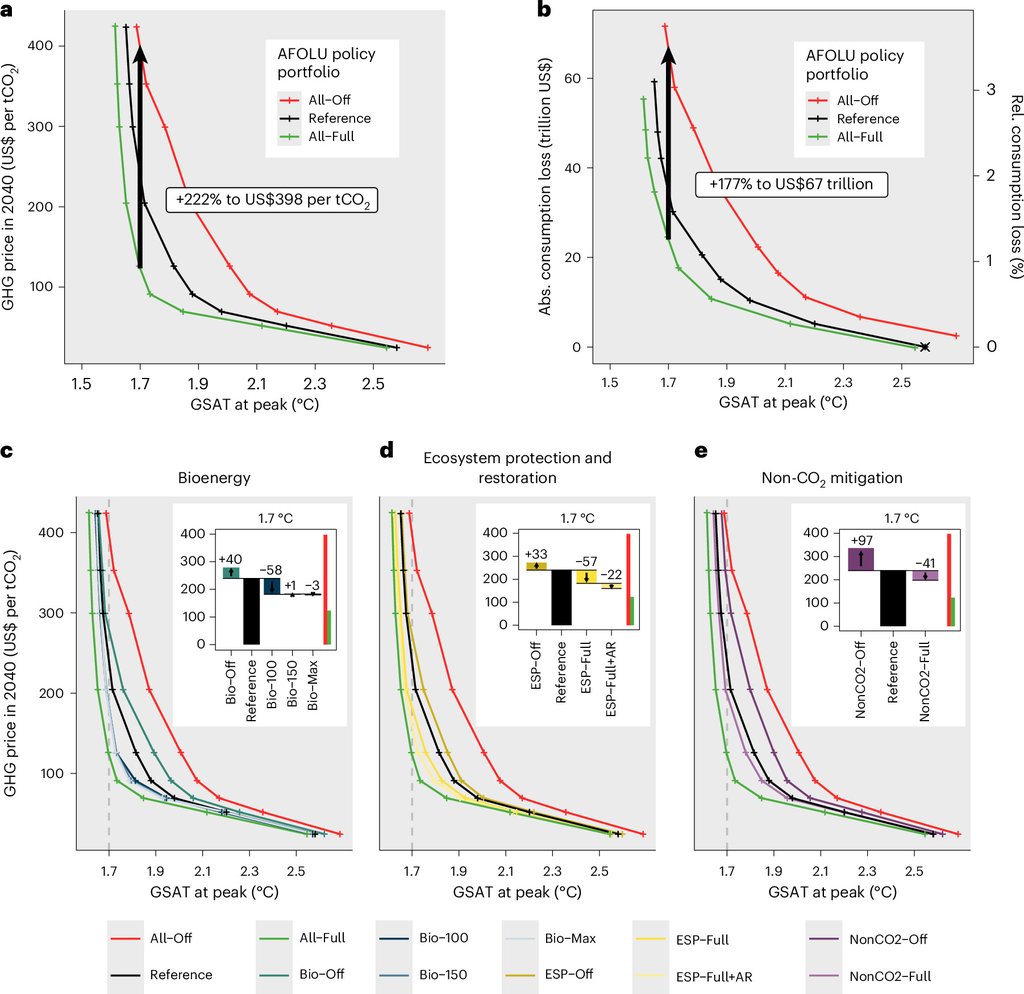
The answer is a gap that widens as the target tightens. Holding peak warming, the highest point the temperature reaches, below 1.7 °C costs 1.3% of global consumption when every land option is working, and 3.5% when the land sector contributes nothing. Both figures are measured against a world that carries on with the policies it has already passed, added up over the rest of the century and discounted; the larger comes to 24 trillion dollars. With nothing from the land, 1.5 °C is not reachable at all this century, at any carbon price the team modeled.
Consumption loss is a narrow measure, and the authors are plain about what it leaves out: it is what the policy costs, not what the warming would have done. "Ultimately, this study shows only the costs of climate change mitigation," they write.
What each piece of land policy is worth
Because each option can be switched on by itself, the model can price them one at a time, all at that same 1.7 °C target. With none of them available, the carbon price the model needs in 2040 climbs to almost 400 dollars a metric ton of CO₂, more than three times the price the same target needs when the land sector is working. Collecting farm and forestry residues for fuel brings it down. So does growing woody energy crops, so does protecting forests with a carbon price, and so does extending that protection to the grassland, scrub and peat that are not forest.
The largest single saving, though, comes from the emissions the European Union backed away from regulating. A price on agricultural methane and nitrous oxide, capped at 75 dollars a metric ton of CO₂ equivalent, does more for the carbon price than any other option the team tested, because every metric ton it keeps out of the air is a metric ton the energy system is no longer required to remove.
What the land does not do, the energy system has to, and that shows up in prices. Final energy prices, averaged across electricity, fuels and heat in homes, industry and transport, rise 46% by 2040 on the way to the same target when the land sector contributes fully, and 103% when it contributes nothing. These are the marginal prices of an idealized market rather than the figure at the bottom of a household bill, a distinction the authors draw themselves.
The cheapest path still needs a great deal of land
Cheapest is not the same as small. The portfolio with everything switched on still has 66 million hectares growing bioenergy crops by 2050, an area a little smaller than Texas, and that is the lowest land demand of any package the team ran for a 1.7 °C peak. Leaning on bioenergy alone, with no ecosystem protection and no price on farm emissions, takes 267 million hectares. Every package that grows energy crops and holds the target crosses a precautionary ceiling of 50 million hectares for bioenergy crop area, a limit this paper takes from earlier work rather than sets itself.
The pattern underneath cuts against the usual worry about land-based climate policy, which is that its pieces compete with one another for ground. In the model they help one another: the harder a portfolio pushes on protecting ecosystems and on farm emissions, the fewer energy crops it needs to reach the same temperature. The ceiling the authors propose for all woody biomass together, residues and purpose-grown crops, is 100 exajoules a year, inside the range other researchers estimate the world could supply sustainably, and going above it, they find, buys almost nothing at the peak.
The finding the authors flag themselves
One result cuts against most of the modeling literature, and the team says so before anyone else can. In these runs, bioenergy barely touches food prices. What moves food prices is the price on agricultural methane and nitrous oxide, charged on emissions a farmer cannot abate and passed down the chain to the consumer. The paper's own opening pages cite a line of studies connecting land-based climate policy to higher food prices and to more people at risk of hunger. "Our finding that bioenergy hardly affects food prices is unintuitive and seems to contradict other findings," Merfort and colleagues write.
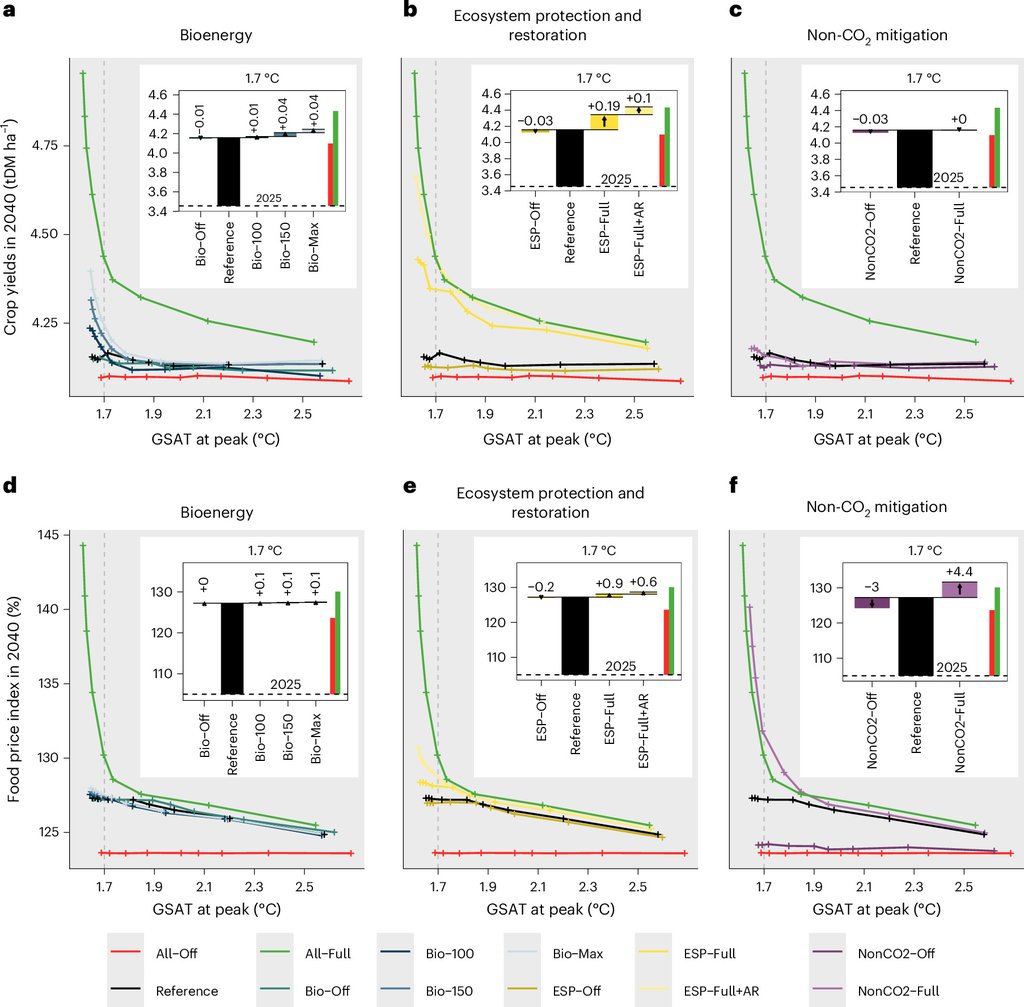
They give two reasons to hold it loosely. The first is that, as far as they know, no earlier study separated bioenergy's effect on food prices from the effect of pricing farm methane and nitrous oxide, so the two may have been charged to the same account. The second is a property of their own land model, in which crop yields rise when land gets scarce because the model responds by investing in agricultural research. "This may be a rather optimistic assumption, given that real-world actors might under-invest into R&D owing to positive externalities," they write. Run with that response turned down, bioenergy does push food prices up, slightly, and by more late in the century.
Both models are open source, and every run behind the paper is deposited at Zenodo, so another group can take the scenarios apart. The authors ask for exactly that: cost differences this large, they write, call for comparing several models on land policy, and the bioenergy result in particular "might be challenged by other models applying, for example, alternative mechanisms regarding future crop yield increases." The study also stops at the peak, and land-based removal matters as much for bringing temperatures back down after it. What no model settles is the question the paper leaves on the table. "In the end, the burden sharing between the food and energy sectors is a political issue," the authors write.
Sources
- Nature SustainabilityPeer-reviewed