Satellites See the Water Changing Color Near the Great Pacific Garbage Patch
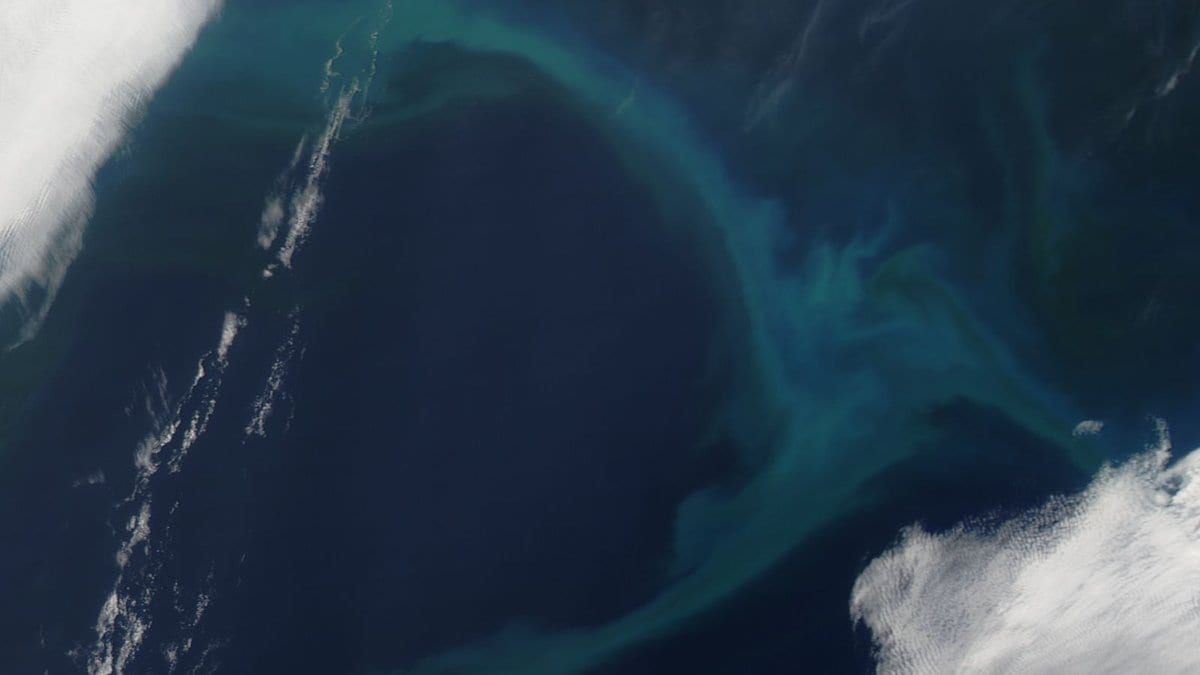
Shea Cheatham, Daniel Koestner and Børge Hamre of the University of Bergen in Norway report that the ocean's color near the Great Pacific Garbage Patch has shifted, and that the shift they measured is hard to produce without plastic suspended in the water. Their analysis of three 20-year satellite records finds the water in and near the patch brightening in blue and green at the same time, which leaves it looking more cyan than the ocean around it. The satellites measured color, not plastic.
The paper, published Nov. 5, 2026, in Communications Earth & Environment, offers that color signature as a possible way to watch the plastics nobody can currently count: particles under 300 micrometers, a third of a millimeter, which the authors describe as nearly impossible to remove once suspended and too small for the infrared methods that spot floating litter from orbit.
The records are NASA's MODIS-Aqua, the Copernicus GlobColour product and the European Space Agency's Ocean Colour Climate Change Initiative. They disagree in places, and the authors call the ESA record the most conservative of the three. All three show a statistically significant rise in both blue and green light in and near the modeled boundaries of the patch.
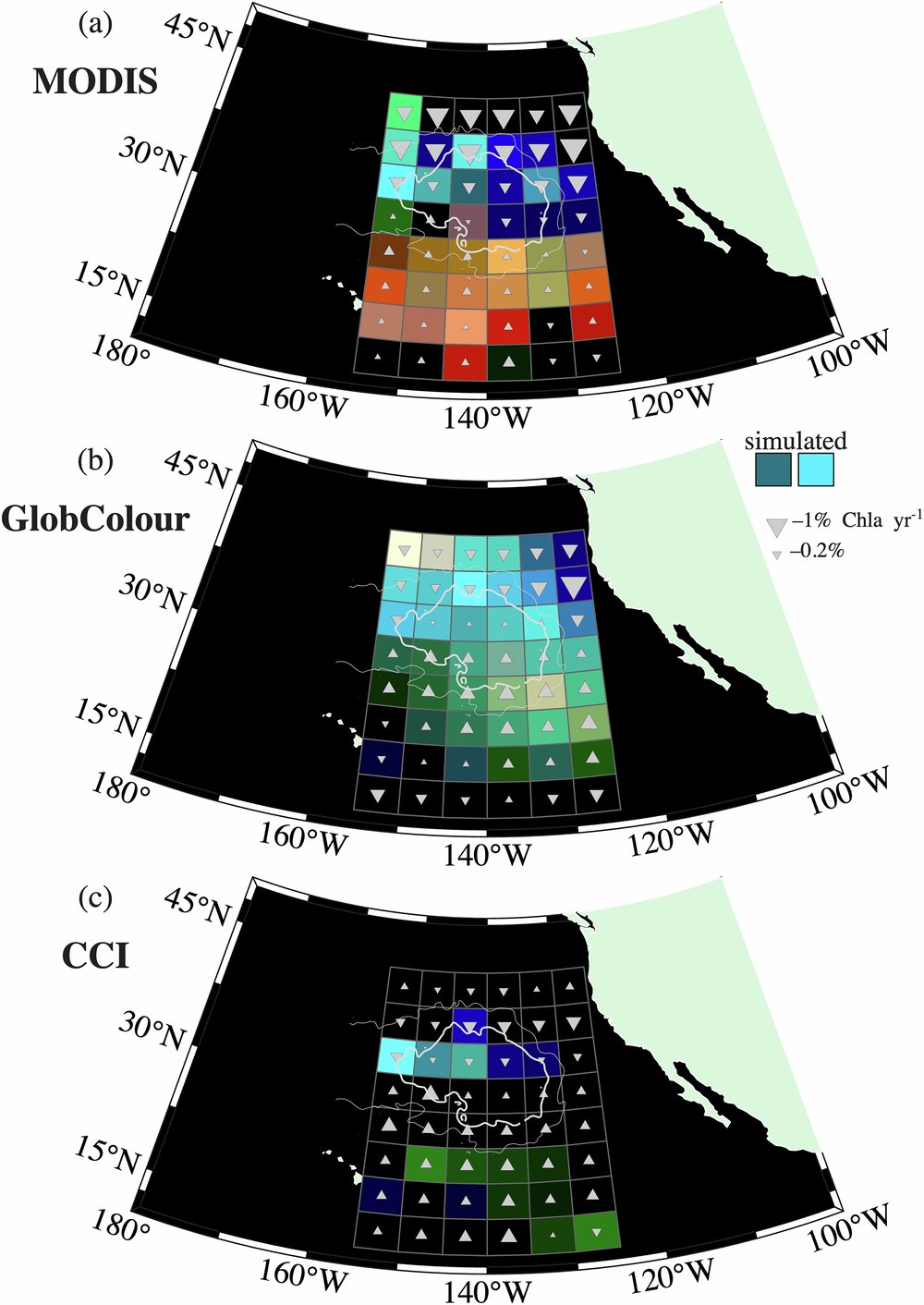
To test whether ordinary changes in ocean life could produce the same signature, the team modeled how light moves through seawater and generated over 50,000 simulated brightening patterns. The simulations varied what naturally tints open ocean water: dissolved organic matter, suspended particles and the kinds of plankton present. In the set with no microplastics, 3% of the brightening patterns came out cyan, and each of those required a wholesale change in the plankton community, from larger species to smaller ones. With microplastics included as a variable, 13% came out cyan, a more than four-fold increase.
The authors write that the brightening they see "does not, in itself, indicate that microplastics are the root cause of the perceived brightening," and their conclusion keeps that register. They report the cyan pattern as unlikely to arise from natural shifts in ocean color, and offer it as a possible tool for gauging microplastic buildup. They do not rule out a disturbed ecosystem as an alternative explanation.
The simulation inputs, configuration files and outputs are posted publicly, and all three satellite records are open. The core solver they run on, AccuRT, is proprietary.
Sources
- Communications Earth & EnvironmentPeer-reviewed