Ocean Eddies off the Canary Islands Held up to Three Times More Microplastic
Two ocean eddies south of the Canary Islands held up to three times more microplastic in their upper 200 meters than the surrounding region, according to shipboard sampling published Sept. 3 in Scientific Reports.
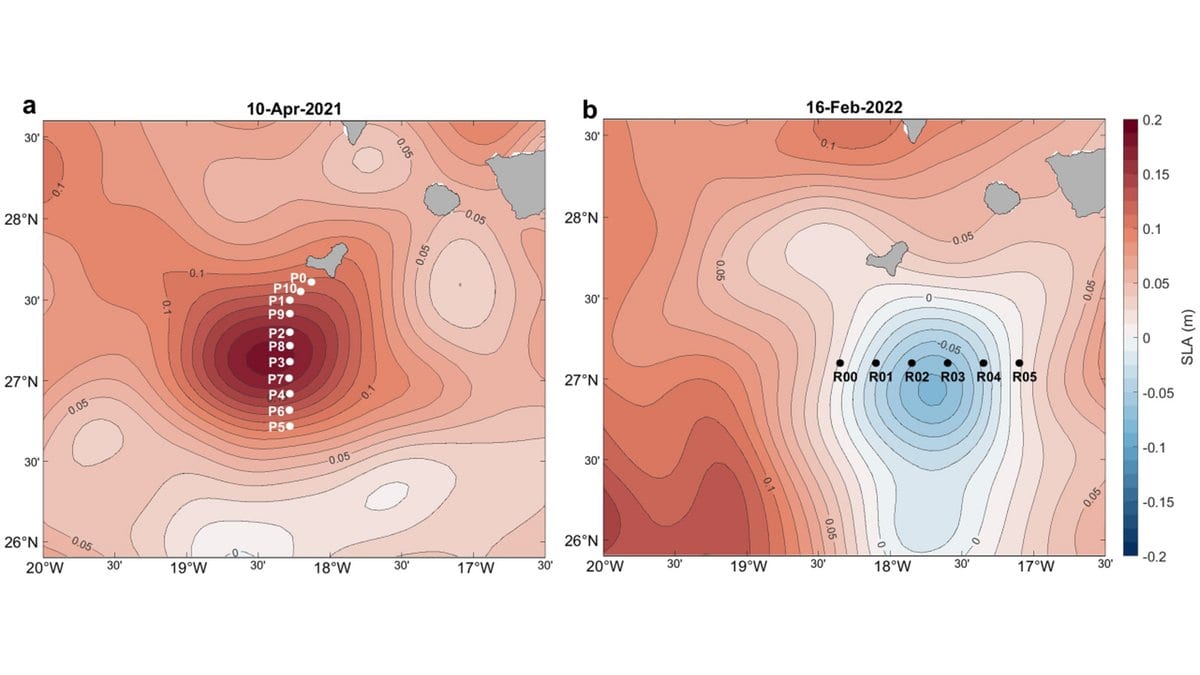
The team collected seawater at four depths per station, from 50 to 1,200 meters, inside two rotating eddies of opposite spin: an anticyclone surveyed April 10 and 11, 2021, and a cyclone surveyed Feb. 16, 2022. Both cruises ran aboard the R/V Ángeles Alvariño for the VULCANA-III project, led by the Spanish Institute of Oceanography (IEO-CSIC), the paper states. They produced 44 samples from the anticyclone and 27 from the cyclone.
The threefold figure is the maximum the authors report rather than a typical value, and it applies to the upper 200 meters of a column sampled down to 1,200 meters. The comparison is against a regional background taken from earlier surveys: 20.3 particles per liter for fragments smaller than 500 micrometers and 2.2 per liter for fibers. Available ship time did not allow a station far enough from both eddies to measure that background directly, the authors write, noting that this adds uncertainty to the enrichment estimates.
What the eddies held differed by type. Fragments smaller than 200 micrometers, about a fifth of a millimeter, dominated the counts overall. Fibers were significantly more abundant in the cyclone and larger fragments in the anticyclone, a split the authors read as evidence that a particle's own size and density decide where it ends up.
The authors set the work against a gap in the plastic budget: land inputs to the ocean have been estimated at 5 million to 12 million tons a year, while less than 0.3 million tons has been observed floating at the surface, they write, citing published figures.
Both features were tracked with satellite sea-level data to check that their boundaries stayed intact around the sampling. The anticyclone held together as a coherent structure for 40 days and the cyclone for 20, the paper reports.
Sources
- Scientific ReportsPeer-reviewed